Welcome to ScapeCrunch

We are ScapeCrunch, the place where planted aquarium hobbyists come to build relationships and support each other. When you're tired of doom scrolling, you've found your home here.

Yugang Reactor Help

Joined
Apr 23, 2026
Messages
95
Reaction score
299
Location
GTA
Hey guys, needing some expert insight on my 90P build regarding the Yugang reactor . I’d like a sanity check on sizing.

System
  • Display: 90 × 45 cm outside, 10 mm glass, so ~88 × 43 cm inside (~3,780 cm²), rimless, lidless.
  • Sump: 20-gallon long (76 × 30 cm, ~2,280 cm²), 3 chambers, loose lid.
  • About 220 L total water.
  • Return enters below the surface; no deliberate surface agitation.
  • BeanAnimal overflow, with the main draining underwater (no cascade).
  • Currently cycling on tap water: KH 13, GH 12. The plan is RO remineralised to KH 3–4.
Reactor
  • Horizontal Yugang, 3" Sch40 PVC (ID 77.9 mm), 46 cm long.
  • Outlet rotated to near the limit of what my plumbing allows, so the pocket is much smaller than half-full.
  • CO₂ flow meter at about 9 mL/min. That’s slightly over what it dissolves, so it gives small occasional burps.

What I measured
  • Plateau: pH 6.80 at KH 13 ~ 60 ppm (pH/KH estimate). Degassed baseline pH at 8.2.
  • Overnight decay after CO₂ off: k ≈ 0.12/h (half-life ~5.7 h). That implies a CO₂ exchange rate of ~4–7 cm/h, i.e. a calm surface.
  • Working the 1/17.7 rule backwards from my reactor area (~180–358 cm² depending on rotation), my effective loss area is ~1,100–2,200 cm², against ~6,060 cm² of real water surface (display + sump).
Am I just way off on my surface agitation? I have mild ripples, but nothing overly agitating, but even without taking the sump into account, I should be seeing way more loss right? I'm planning on keeping neocaridina, so aiming for a 30-40ppm max, but even on my min setting I see ~55-60 ppm.

y1.webp

View attachment y2.mp4
 
I am by no means one of the experts on this subject here, but can comment based solely on my experience.

Your numbers do appear to be aligned with the 17.7 factor and a 1.4-1.5 ph drop. But that level of drop will result in CO2 higher than 30-40ppm, as you are observing. It seems, regardless of overnight off-gassing, you'd want to be shooting more for a 35.4 factor i.e. a 1.2 ph drop at most. Then the surface agitation and off-gassing comes into play.

@Unexpected has a good deal of experience with CO2 injection with a sump and can probably offer some better insight.
 
If that is the extent of your surface agitation and flow, then it doesn’t surprise me at all that your co2 is remaining quite high. In my AIO, if I use flow restrictive polishing pads in the weir chamber, they clog up too much and it drastically reduces the flow in the tank. My drop checker is normally light green but when this happens, it turns yellow and my fish start to gasp.

Try some more surface agitation and see if it makes a difference.
 
My tank hardly off gasses over night. That's not an issue. The only issue is hitting overflow mode at the peak CO2 you want. The 17.7 is geared to those running 0dKH. We need that 1.5 drop to equal what a 1.2 drop might be if we had KH.
 
I am by no means one of the experts on this subject here, but can comment based solely on my experience.

Your numbers do appear to be aligned with the 17.7 factor and a 1.4-1.5 ph drop. But that level of drop will result in CO2 higher than 30-40ppm, as you are observing. It seems, regardless of overnight off-gassing, you'd want to be shooting more for a 35.4 factor i.e. a 1.2 ph drop at most. Then the surface agitation and off-gassing comes into play.

@Unexpected has a good deal of experience with CO2 injection with a sump and can probably offer some better insight.

My tank hardly off gasses over night. That's not an issue. The only issue is hitting overflow mode at the peak CO2 you want. The 17.7 is geared to those running 0dKH. We need that 1.5 drop to equal what a 1.2 drop might be if we had KH.

That would be fine if my reactor was rotated to the '17.7' ratio, but I have it turned almost all the way up, so the gas pocket is around ~10% of the tube... which should be like a ~70 ratio which is what is baffling me.

With the pocket around 1/3 - I was hitting 80ppm.

If that is the extent of your surface agitation and flow, then it doesn’t surprise me at all that your co2 is remaining quite high. In my AIO, if I use flow restrictive polishing pads in the weir chamber, they clog up too much and it drastically reduces the flow in the tank. My drop checker is normally light green but when this happens, it turns yellow and my fish start to gasp.

Try some more surface agitation and see if it makes a difference.

I will give that a try, I'll reprint my jet channel to point a little more upwards and see if that does the trick. I really thought I'd have the opposite problem with the sump.

Thanks all for your input.
 
I'm sorry for my ignorance but I don't really understand the units you are using for the overnight loss of CO2, and pH drop.

However, for a decent measure of surface agitaion I'd look at how long the tank takes to degas from peak CO2 levels to around 90-95% of the way to its baseline degassed level.

For the most controllable techniques of CO2 injection system, it always seems to me to require a tank to be able to degas roughly to baseline within at least 3-4 hrs of the CO2 input stopping, at the very most. If that doesn't happen then IMO there is not really enough surface agitation. If degassing is slow then the rate of CO2 rise at the beginning of the day will generally also be slow and peak CO2 levels not achieved early on in the photoperiod, unless injection is started many hours before lights on.

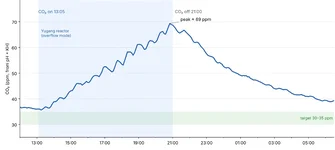
When I set up a system like this, trying to achieve a relatively constant "plateau" CO2 level for the photoperiod, I aim for enough injection rate to achieve the plateau level within around 2-3 hours (minimum) of CO2 injection starting, and then enough surface agitation to degas it again in roughly the same amount of time at the end of the day. The quicker the rates of injection and degassing are (matching each other), the more constant the plateau CO2 levels will generally be. However, this will often require a lot of surface agitation (and higher levels of CO2 use). Achieving the plateau CO2 levels around 2 hrs from injection seems like a good compromise for most folks.

Dennis explains it better than me (I expect) in his article ...... https://www.2hraquarist.com/blogs/choosing-co2-why/how-to-push-the-limits-of-co2-safely

I know doing it differently can work really well for some folks, but I think as a general rule of thumb the 2-3 hrs degassing time is a good thing to roughly aim for.

Yugang's ratio numbers are a good start as a baseline for guessing a required reactor bubble diffusion area, but each tank will be different and there are so many variables in play. For example the presence of a lid or not can make a vast difference in CO2 loss at the water surface of a tank.

In general, good surface agitation also provides more of a safety mechanism for avoiding any chances of over-gassing the system, if for some reason the CO2 input is increased.

I'd also advise getting a Hanna CO2 test if its not prohibitively expensive. It just takes all the guesswork out of actual CO2 levels. I will add that these systems are absolutely fantastic when set up nicely, but can be tricky to get there !

What I'm talking about achieves a CO2 graph something like this. THis is for my 500 litre ....
CO2 graph.webp
 
However, for a decent measure of surface agitaion I'd look at how long the tank takes to degas from peak CO2 levels to around 90-95% of the way to its baseline degassed level.

For the most controllable techniques of CO2 injection system, it always seems to me to require a tank to be able to degas roughly to baseline within at least 3-4 hrs of the CO2 input stopping, at the very most. If that doesn't happen then IMO there is not really enough surface agitation. If degassing is slow then the rate of CO2 rise at the beginning of the day will generally also be slow and peak CO2 levels not achieved early on in the photoperiod, unless injection is started many hours before lights on.

When I set up a system like this, trying to achieve a relatively constant "plateau" CO2 level for the photoperiod, I aim for enough injection rate to achieve the plateau level within around 2-3 hours (minimum) of CO2 injection starting, and then enough surface agitation to degas it again in roughly the same amount of time at the end of the day. The quicker the rates of injection and degassing are (matching each other), the more constant the plateau CO2 levels will generally be. However, this will often require a lot of surface agitation (and higher levels of CO2 use). Achieving the plateau CO2 levels around 2 hrs from injection seems like a good compromise for most folks.

Dennis explains it better than me (I expect) in his article ...... https://www.2hraquarist.com/blogs/choosing-co2-why/how-to-push-the-limits-of-co2-safely

I know doing it differently can work really well for some folks, but I think as a general rule of thumb the 2-3 hrs degassing time is a good thing to roughly aim for.

Yugang's ratio numbers are a good start as a baseline for guessing a required reactor bubble diffusion area, but each tank will be different and there are so many variables in play. For example the presence of a lid or not can make a vast difference in CO2 loss at the water surface of a tank.

In general, good surface agitation also provides more of a safety mechanism for avoiding any chances of over-gassing the system, if for some reason the CO2 input is increased.

I'd also advise getting a Hanna CO2 test if its not prohibitively expensive. It just takes all the guesswork out of actual CO2 levels. I will add that these systems are absolutely fantastic when set up nicely, but can be tricky to get there !

What I'm talking about achieves a CO2 graph something like this. THis is for my 500 litre ....
Great stuff. Thank you for the detailed response, it gives me a lot to think about.

My curve is definitely a lot slower than 3-4 hours to baseline which I really did not expect with the overflow and sump (even with a loose lid on the sump).

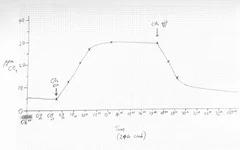
Here is my latest co2 curve estimated from pH and my current Kh. Granted I started off injecting above my target, but I'm averaging only about 3ppm loss per hour right now.

co2_forum~2.webp

From Dennis' article:

Having a huge amount of flow in the tank environment, but no circulation between the surface layer of water and deeper layers of water in the tank, does not help gaseous exchange much, as gaseous exchange takes place in the layer in contact with the air.

I suspect it is this biting me. Under the surface I have a lot of movement, and am averaging about 4x turnovers per hour.

I will try adding another jet pointing at the surface in the display today and then maybe cutting the secondary drain pipe a little shorter of the surface for a bit more agitation in my sump.

I wasn't able to find a Hannah co2 kit locally, but did find a Salifert one, but it seemed to not work at all on my tank water, not sure if it's because of my high Kh or if the salifert ones aren't as good as the Hanna.
 

Top 10 Trending Threads

Back
Top