Welcome to ScapeCrunch

We are ScapeCrunch, the place where planted aquarium hobbyists come to build relationships and support each other. When you're tired of doom scrolling, you've found your home here.

The Great Big Filter Thread

  • Thread starter Thread starter JayP
  • Start date Start date
  • Tagged users Tagged users None
Hi! About the pump I have chosen the Sicce syncra SDC 3.0, not cheap and maybe not enough for large tanks, but for my 55 Gal it definitely should be. As you said, the more powerful models (6.0 etc) are all geared toward PVC in /out, while the 3.0 comes with hose fittings.
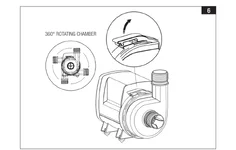
It has a rotating chamber that is convenient if you don't have much spaceScreenshot_20260521-094535_Chrome~2.webp
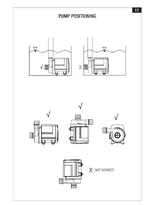
Plus, they say I could install it with the inlet on top. Do you think it could give me any trouble? It could be more convenient. Screenshot_20260521-094546_Chrome~3.webp
Last question: When I do my 75% WC I usually get a lot of air going into the filter, because the water level gets lower than the filter inlet. I have to use the prime button to help the filter push out so much air, since the impeller can't do it alone and it runs "dry". Should I avoid it? How? I am afraid to damage this pump, which is not cheap to me. I am thinking I could disconnect the inlet fitting of the filter and open it in a bucket to remove the big air pocket in it.
 
Last edited:
Hi! About the pump I have chosen the Sicce syncra SDC 3.0, not cheap and maybe not enough for large tanks, but for my 55 Gal it definitely should be. As you said, the more powerful models (6.0 etc) are all geared toward PVC in /out, while the 3.0 comes with hose fittings.
It has a rotating chamber that is convenient if you don't have much spaceView attachment 17230
Plus, they say I could install it with the inlet on top. Do you think it could give me any trouble? It could be more convenient. View attachment 17231

Last question: When I do my 75% WC I usually get a lot of air going into the filter, because the water level gets lower than the filter inlet. I have to use the prime button to help the filter push out so much air, since the impeller can't do it alone and it runs "dry". Should I avoid it? How? I am afraid to damage this pump, which is not cheap to me. I am thinking I could disconnect the inlet fitting of the filter and open it in a bucket to remove the big air pocket in it.
Unplug on WC, then on refill before you plug the pump in lift the outlet and suck on the end to create a vacuum and purge air. This is a manual prime. We had to do that to prime a lot of the ADA canisters this last weekend.
 
I finally got around to testing the Jebao DC 6500 pump and netlea filters. Also part of the delay was waiting nearly 3 weeks for a basic order from Amazon of barbs to fit on the end!

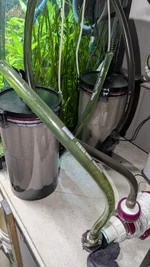
Anyways, I set it up in a temp position in the shed for testing.
  1. As @JayP mentioned in an earlier post, the input side is not good to go out of the box. I went to the local hardware store and picked up 4 plumbing fittings (as I didn't use the supplied first connection. Don't ask me why. I think I just had to use what the hardware store had in front of me at the time to make it all work). Then the barb at the end. The outlet, I just used standard 16/22 vinyl tubing with the boiling water trick to connect. Once the tubing reverts back to normal form, its a great connection though.
  2. Having to pull water through 2 netlea filters certainly didn't help with priming. It took a bit but got there in the end. Once it started though it was fine. I've only tested with the default sponges but may take one of them out of the second netlea and replace with bio media. Not sure yet. Maybe I'll leave the sponges in who knows. Not 100% sure on the density rating either.
  3. Even after running for hours, there must be still a bit of air which I'm not sure yet how to get out. I'm not going to go crazy trying to work it out as its final position will be under a tank, not next to it like this one for a start so that will help a bit. Still I'll try. Could be the new foam still trapping a bit of air, not sure.
  4. The 16/22 tubing definitely restricts the ability of the pump to output what it is capable of. But for now it is what it is. A quick test on a ~20 litre bucket (which is a bit more than 5G) gave me 1:30 at the lowest and 1 min at the highest flow. The bit of air in the system might have influenced those results too. Still, results don't sound that great I know. You could see at the highest flow it was pushing what it could, much faster than my current cannister filter anyways. Problem is you could easily convert the output to 1" tubing but that isn't going to help much when the input still has to go through 2 netlea filters with 16/22 connections. I guess, technically you could use 1" tubing throughout and just have the adapters but it starts to get more messy then.
  5. To complete the picture I would love to get hold of the official connectors from netlea which has custom plumbing to join multiple netleas together for a nicer more secure finish. However, finding where to purchase them from maybe a challenge.
Anyways, clearly more playing around and experimenting to do.

PXL_20260614_091401758.webp
 
Last edited:
Wow this thread has really put me into a spin. I'm actually lucky to be starting a build from scratch but there are so many options.

I'm returning to planted tanks after not having any tanks for a little over a decade. While a lot has changed and there are more brands etc on the market, the principles of filtration and the nitrogen cycle are still the same (obviously) perhaps with some increased knowledge and interpretation. I am setting up a 120P and looking to have as little as possible in the tank (heater included).

I have been considering the FX2 as a primary filter due to;
  1. Previously owned the FX5 on a larger tank and it was flawless
  2. Large capacity
  3. Great flow rate - I am going to run this into a Yugang reactor with bypass, followed by UVC with bypass. Then into a Chihiros inline heater if possible. Plan is that I can adjust the flow rate through the reactor and only run the UVC if needed to polish water or help with green water/disease etc. I'd love to think I wont use it but with a foray into the higher energy style tanks this time, things can go off centre.
  4. Self purging - couple of times a day plus after cleaning.
  5. Availability and parts/replacements are not too bad. I can get everything from impellers to an entire pump unit that bolts on the side to replace if needed.
I do however, love the idea of setting up Netlea units. Customisable and interchangable. A pre-filter also seems an awesome idea to I am leaning toward installing a foam prefilter Netlea G2 on the in-flow prior to the FX2 which I will switch to media and coarse filtration for bio.
Whats thoughts?
This should reduce the need to clean out the FX2 as often, a good thing as they are heavy so carrying the unit to a wash area is an effort. The prefilter and heater being the strongest points on the OASE units, they seem to suffer from reduced flow and an addtional powerhead in the tank would defeat the purpose of inline heater.

Appreciate the advice!!

Chimera
 
Wow this thread has really put me into a spin. I'm actually lucky to be starting a build from scratch but there are so many options.

I'm returning to planted tanks after not having any tanks for a little over a decade. While a lot has changed and there are more brands etc on the market, the principles of filtration and the nitrogen cycle are still the same (obviously) perhaps with some increased knowledge and interpretation. I am setting up a 120P and looking to have as little as possible in the tank (heater included).

I have been considering the FX2 as a primary filter due to;
  1. Previously owned the FX5 on a larger tank and it was flawless
  2. Large capacity
  3. Great flow rate - I am going to run this into a Yugang reactor with bypass, followed by UVC with bypass. Then into a Chihiros inline heater if possible. Plan is that I can adjust the flow rate through the reactor and only run the UVC if needed to polish water or help with green water/disease etc. I'd love to think I wont use it but with a foray into the higher energy style tanks this time, things can go off centre.
  4. Self purging - couple of times a day plus after cleaning.
  5. Availability and parts/replacements are not too bad. I can get everything from impellers to an entire pump unit that bolts on the side to replace if needed.
I do however, love the idea of setting up Netlea units. Customisable and interchangable. A pre-filter also seems an awesome idea to I am leaning toward installing a foam prefilter Netlea G2 on the in-flow prior to the FX2 which I will switch to media and coarse filtration for bio.
Whats thoughts?
This should reduce the need to clean out the FX2 as often, a good thing as they are heavy so carrying the unit to a wash area is an effort. The prefilter and heater being the strongest points on the OASE units, they seem to suffer from reduced flow and an addtional powerhead in the tank would defeat the purpose of inline heater.

Appreciate the advice!!

Chimera

It sounds like a great project and a decent plan. Honestly I would hold off on the UV though. I'd be surprised if you found it necessary and it can always be added later if needed. A genuinely appropriately sized and effective UV for a 120 would not be particularly cheap or small either.
There are so many filtration strategies that do work very well. I think a FLuval FX plus a prefilter sounds like a decent choice. Others may disagree but I'd consider the FX4 as having a more appropriate flow rate for the size of tank though compared to the FX2.
 
an addtional powerhead in the tank would defeat the purpose of inline heater

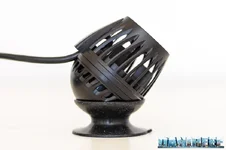
I think you'll find that Nano-wavemakers have come a very long way since the powerheads you're thinking of. I have this egg-sized 1050GPH pump, running at 10% speed, in several of my small tanks, works a treat 💯💯

1000052160.webp

I also refuse to have heaters cluttering up my tanks 👍 Tiny form factor in these pumps is absolutely a thing now, much less intrusive than an in-tank heater.

This particular brand, Aqamai / Hydor KPS has been discontinued but you can still get them on ebay, and there are plenty of other options, especially for bigger tanks. Look for a DC nano wavemaker pump that has an app, so that you can fine-control the flow 👍
 
Last edited:
A genuinely appropriately sized and effective UV for a 120 would not be particularly cheap or small either.
Not necessarily. :) Many people believe UVC needs to do its job in a single pass of the aquarium water. That would indeed mean having to use large, high wattage systems. But what really matters with UVC is the amount of energy output per time period, rather than per one pass. Multiple passes of a lower wattage can achieve the same effect.


A good article I found on this: UV in depth

According to that author, 1 watt per 10 gallons can be enough for aquarium filtering purposes.

Now, I don't know exactly which tank is meant with "120P", but Google tells me that for both ADA and UNS that would mean an 80 gallon tank. In that case a mere 8W of UVC could theoretically be enough, assuming it's possible to get the full filter flow through the corresponding small UVC unit.

I do agree UVC is not normally necessary. It's more like a complementary thing, with biofiltration being much more important than UVC in most respects.
 
Hey Gino,
A 120P means standard proportion in ADA speak. Term probably isn’t used any more! 1200mm x 450mm x 450mm or a standard 48inch tank I think in some places. 4 foot by one and a half?
I’ll read that link shortly about UV but experience tells me a 9W UV will clean up green water in a 4x2x2 foot tank beautifully. I think there is sometimes confusion over clarification and sterilisation but it does depend on what is being achieved.
 
Good article @hamfist - The findings certainly line up with what I have experienced.
I have used UV on large ponds and certainly a multi-pass approach is sufficient to clear green water that can then be removed through the process of filtration etc, provided the system can handle the resulting bioload. Noting of course that this is for clarification and not sterilization.
On the other end of the scale I have used it in production of drinking water - one pass of a massive dose for safety.
 
I usually have clear water in my tanks, but when I run UV setups it's REALLY clear water. I only run them at night, and in the morning the timers turn them off a few minutes before dosing Micros, as UV destroys any chelates (protective molecules around your micros).

I don't run them much at the moment; more equipment usually = more headache, and UV light will break down the plastic housing over time and that introduces more microplastics into the tank. I think they're great to keep on standby for greenwater emergencies; they seem to complicate micros dosing a bit, and I would say in the freshwater hobby, very VERY few professional galleries (ADA, Green Aqua, Liquid Nature) ever run inline UV, which should tell you what you need to know! Most don't use them, most don't need them. When you do use one, you'll probably notice a bit clearer water; If you have a heavy green water or bacterial outbreak, they're a godsend and will clear your water up faster than any chemical solution.
 

Top 10 Trending Threads

Back
Top