I recently set up my first big (to me) tank. I've been into this hobby for a couple of years but limited to a 20 gallon and a couple 10 gallon tanks in my office. I decided it was time to splurge and set up a nice 75 gallon system that can become a more appropriately-scaled Dutch tank. Here it is shortly after planting:
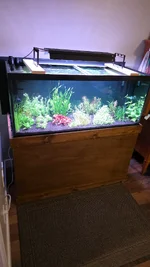
I like to save money where possible, so I ended up building my own tank stand as well as a Yugang reactor . I wanted to document these things to show everyone that it is quite attainable with a set of tools and a weekend of work.
So, here is the first post. Tank Stand Build:
When researching simple lumber stands, I found this great video:
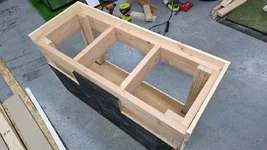
I used it as a guideline to build a simple dimensional lumber stand. My stand is 49" long, 19" wide, and 28" tall. This gives approximately 1/2" of clearance around the 75 gallon aquarium footprint and keeps the tank low enough that I can reach over the rim and touch the bottom substrate without straining. As shown in the photo, I used 2x6 lumber for the upper frame so that I could avoid using a centerspan support. This makes it so much easier to access the space under the tank. I used two 8ft 2x6 and six 8ft 2x4 studs. Total cost at home depot was under $50.
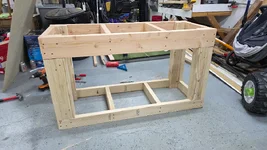
Once the structural frame was complete, I started thinking about how to dress it up as a piece of furniture that I didnt hate to have in my home. I ended up deciding to do a very simple trim with 1x3 boards on the bottom and 1x4 on the top. The top trim is offset upwards from the frame such that it covers the plastic trim on the tank when it is on the stand. I also used a piece of scrap plywood from my garage to act as a back panel and shear support to prevent racking of the frame. The 1x3 and 1x4 boards came out to $15
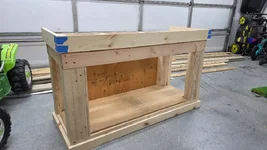
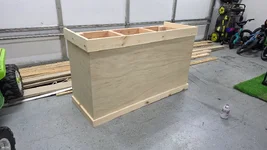
To finish it off, I bought a sheet of 1/8" "utility board" plywood for another $15. I cut it to wrap around the sides and front.
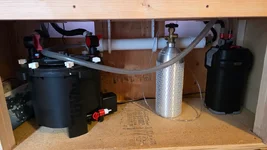
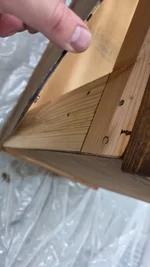
Now how to access the bottom? I thought about this a lot and ultimately decided on the cheapest/simplest/most lame approach. I bought some magnets from Harbor Freight for $5. I lucked out and these magnets were nearly the same size as the heads on the screws I used, so I simply put them on 4 corner screws and then added matching magnets on the front plywood panel at the 4 corners. It actually works really well and makes it simple to take the front panel off for filter access. It saved me hours of work and the cost of building actual cabinet doors, and I like how clean the final product ends up looking.
Lastly, I stained using dark walnut stain. Pine needs conditioner, so I did that first and then did one coat of stain. I then did about 4 coats of spray on oil-based polyurethane to seal it up.
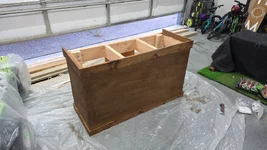
The last thing I did was add a sheet of styrofoam insulation on top of the frame to help even out any bumps in the lumber. I made it as flat as possible, but dimensional lumber is not meant for this kind of thing and has imperfections. The styrofoam is peace of mind for me to make sure the tank rim gets fully supported all the way around.
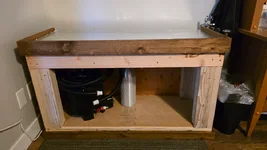
I'm really happy with how it turned out. Total cost for me was around $110, but I had some scrap plywood at home for the back panel and the bottom shelf where my filters sit. If you need to buy a sheet, figure another $40 bucks or so. Total time investment was maybe like 8 hours over the weekend and then the hours of waiting between coats of stain and poly. Tools used were a miter saw, circular saw, drill, driver, nailer, and sander.
I like to save money where possible, so I ended up building my own tank stand as well as a Yugang reactor . I wanted to document these things to show everyone that it is quite attainable with a set of tools and a weekend of work.
So, here is the first post. Tank Stand Build:
When researching simple lumber stands, I found this great video:
I used it as a guideline to build a simple dimensional lumber stand. My stand is 49" long, 19" wide, and 28" tall. This gives approximately 1/2" of clearance around the 75 gallon aquarium footprint and keeps the tank low enough that I can reach over the rim and touch the bottom substrate without straining. As shown in the photo, I used 2x6 lumber for the upper frame so that I could avoid using a centerspan support. This makes it so much easier to access the space under the tank. I used two 8ft 2x6 and six 8ft 2x4 studs. Total cost at home depot was under $50.
Once the structural frame was complete, I started thinking about how to dress it up as a piece of furniture that I didnt hate to have in my home. I ended up deciding to do a very simple trim with 1x3 boards on the bottom and 1x4 on the top. The top trim is offset upwards from the frame such that it covers the plastic trim on the tank when it is on the stand. I also used a piece of scrap plywood from my garage to act as a back panel and shear support to prevent racking of the frame. The 1x3 and 1x4 boards came out to $15
To finish it off, I bought a sheet of 1/8" "utility board" plywood for another $15. I cut it to wrap around the sides and front.
Now how to access the bottom? I thought about this a lot and ultimately decided on the cheapest/simplest/most lame approach. I bought some magnets from Harbor Freight for $5. I lucked out and these magnets were nearly the same size as the heads on the screws I used, so I simply put them on 4 corner screws and then added matching magnets on the front plywood panel at the 4 corners. It actually works really well and makes it simple to take the front panel off for filter access. It saved me hours of work and the cost of building actual cabinet doors, and I like how clean the final product ends up looking.
Lastly, I stained using dark walnut stain. Pine needs conditioner, so I did that first and then did one coat of stain. I then did about 4 coats of spray on oil-based polyurethane to seal it up.
The last thing I did was add a sheet of styrofoam insulation on top of the frame to help even out any bumps in the lumber. I made it as flat as possible, but dimensional lumber is not meant for this kind of thing and has imperfections. The styrofoam is peace of mind for me to make sure the tank rim gets fully supported all the way around.
I'm really happy with how it turned out. Total cost for me was around $110, but I had some scrap plywood at home for the back panel and the bottom shelf where my filters sit. If you need to buy a sheet, figure another $40 bucks or so. Total time investment was maybe like 8 hours over the weekend and then the hours of waiting between coats of stain and poly. Tools used were a miter saw, circular saw, drill, driver, nailer, and sander.
Last edited: