



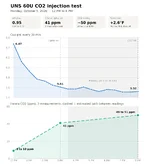
Got inspired by @Naturescapes_Rocco So I decided to do a full day of testing on my CO₂ levels yesterday for my UNS 60U before I add livestock, and I put together a graph. It was a pretty interesting test. My CO₂ comes on at 12 PM (3 hours before lights), lights run between 3–9 PM, and CO₂ shuts off at 8 PM. Injection during this test was 66 bubbles in 30 seconds, which equates to roughly (2.2 BPS)
I used an Apera PH60 for the pH curve and a Hanna HI3818 CO₂ titration kit to independently check CO₂ concentration
Current water parameters are GH 5 and KH 0
Hanna results:
12 PM (pre-injection): 8–10 ppm
3 PM (lights on): 41 ppm
8 PM: 49–51 ppm
pH went from 6.47 pre-injection → 5.61 by lights on, giving me a 0.86 pH drop by the start of the photoperiod. From there, it continued down into the ~5.5x range and plateaued through the rest of the photoperiod, putting the total drop at roughly 0.9–1.0 pH
Planned livestock is Cardinal Tetras, Pygmy cories, a few Amano shrimp, and eventually Caridina shrimp as the tank matures
What was interesting about this test was that as the photoperiod started, I was right where I wanted to be. It held a pretty steady curve, but later in the evening, just as the lights were about to go off, levels reached a little higher than I'd like. Ideally, I'd like to be somewhere around 40–45 ppm throughout the entire photoperiod, so I slightly adjusted my injection rate down to about 60 bubbles every 30 seconds, which equates to roughly (2 BPS)
I probably could've done just fine with livestock at my current rate, as I know guys like @Dennis Wong and Tom Barr run their tanks around ~50 ppm peak, but I know some shrimp, especially Caridina, can be sensitive to higher CO₂ levels. I'd rather be a little more conservative and play it safe. Plants are all doing very well
I'm going to do another full-day test at the new injection rate and see how the tank reacts. Hopefully I can balance the curve a little better and stay closer to that 40–45 ppm range throughout the entire photoperiod
I may also need to increase the CO₂ duration and start injection about 3½ hours before lights on instead of 3 hours. Ideally, I'd like CO₂ to already be around my target concentration when the lights come on rather than continuing to build afterward
Curious what those of you who run higher CO₂ with livestock think about this approach, especially those keeping shrimp. Has anyone else ever done a similar test?
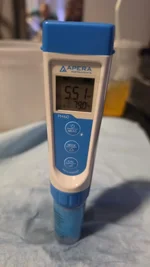
I used an Apera PH60 for the pH curve and a Hanna HI3818 CO₂ titration kit to independently check CO₂ concentration
Current water parameters are GH 5 and KH 0
Hanna results:
12 PM (pre-injection): 8–10 ppm
3 PM (lights on): 41 ppm
8 PM: 49–51 ppm
pH went from 6.47 pre-injection → 5.61 by lights on, giving me a 0.86 pH drop by the start of the photoperiod. From there, it continued down into the ~5.5x range and plateaued through the rest of the photoperiod, putting the total drop at roughly 0.9–1.0 pH
Planned livestock is Cardinal Tetras, Pygmy cories, a few Amano shrimp, and eventually Caridina shrimp as the tank matures
What was interesting about this test was that as the photoperiod started, I was right where I wanted to be. It held a pretty steady curve, but later in the evening, just as the lights were about to go off, levels reached a little higher than I'd like. Ideally, I'd like to be somewhere around 40–45 ppm throughout the entire photoperiod, so I slightly adjusted my injection rate down to about 60 bubbles every 30 seconds, which equates to roughly (2 BPS)
I probably could've done just fine with livestock at my current rate, as I know guys like @Dennis Wong and Tom Barr run their tanks around ~50 ppm peak, but I know some shrimp, especially Caridina, can be sensitive to higher CO₂ levels. I'd rather be a little more conservative and play it safe. Plants are all doing very well
I'm going to do another full-day test at the new injection rate and see how the tank reacts. Hopefully I can balance the curve a little better and stay closer to that 40–45 ppm range throughout the entire photoperiod
I may also need to increase the CO₂ duration and start injection about 3½ hours before lights on instead of 3 hours. Ideally, I'd like CO₂ to already be around my target concentration when the lights come on rather than continuing to build afterward
Curious what those of you who run higher CO₂ with livestock think about this approach, especially those keeping shrimp. Has anyone else ever done a similar test?







 . I wasn't aware the Hanna kit could overestimate by that much at 0


