Welcome to ScapeCrunch

We are ScapeCrunch, the place where planted aquarium hobbyists come to build relationships and support each other. When you're tired of doom scrolling, you've found your home here.

Help Looking for opinions on measuring CO₂ via pH drop

Joined
May 25, 2026
Messages
56
Reaction score
54
Location
Italy
I'd like to hear other people's thoughts on using pH drop to estimate CO₂ levels.


I'm in a rather strange situation. First of all, I use two good-quality digital pH meters, both properly calibrated and well maintained. I've been using this type of equipment for years because, before getting into aquariums, I was (and still am) heavily involved in hydroponics.


Anyway, here's the situation:


My fully degassed pH (water left degassing indoors for 72 hours) is 7.6. I know that degassing indoors theoretically results in a higher equilibrium CO₂ concentration than the commonly referenced 0.6 ppm achieved outdoors, but let's use that as a reference point.


With CO₂ running, the aquarium reaches a pH of 5.6, giving me a pH drop of 2.0.


Using the standard ph drop relationship and assuming 0.6 ppm CO₂ at equilibrium, that would suggest roughly 60 ppm CO₂.


However, both on this forum and in various Facebook groups, I often see people reporting pH drops of around 1.0–1.4. Some have even claimed to measure about 60 ppm CO₂ with a Hanna meter while having only a 1.4 pH drop, using water degassed outdoors.


If that were true, then extrapolating from those numbers would suggest that my tank is running at something like 240 ppm CO₂, which seems highly unlikely. My fish appear perfectly fine, and my drop checkers aren't even yellow. In fact, I have three different drop checkers in the tank, using different indicator solutions and placed in different locations, just out of curiosity.


So I'm wondering:


  • Do you think the pH drop method is being misinterpreted by many hobbyists?
  • Could there be something fundamentally wrong with the assumptions behind comparing pH drops between different tanks?
  • Has anyone here measured dissolved CO₂ directly and compared it against pH drop calculations?

I'd really be interested to hear your thoughts on this rather confusing situation.
 
After experimenting with the hanna test kit vs my pH meter, I have come to realize that if you extract water from your tank and degas it overnight indoors (I have degassed outdoors and gotten an extra 0.2 increase in pH), you have to hit a pH drop of 1.5 in order to hit 30 ppm of CO₂ with reference to your degassed sample (1.7 pH drop if you've degassed outdoors). So if you want to hit 60 ppm, you would have to go 1.7-1.8 pH drop from your indoor degassed sample or about 2.0 pH drop from your outdoor degassed sample.
I think most people don't actually degas their sample so meticulously; neither do they have good pH pens to record pH (most use API liquid tests). So for them, if they have a partially degassed sample from their tank (tank water in the morning before CO₂ injection) and they drop their pH about 1 point, it puts them pretty close to 30 ppm. Just my two cents on the topic.
 
After experimenting with the hanna test kit vs my pH meter, I have come to realize that if you extract water from your tank and degas it overnight indoors (I have degassed outdoors and gotten an extra 0.2 increase in pH), you have to hit a pH drop of 1.5 in order to hit 30 ppm of CO₂ with reference to your degassed sample (1.7 pH drop if you've degassed outdoors). So if you want to hit 60 ppm, you would have to go 1.7-1.8 pH drop from your indoor degassed sample or about 2.0 pH drop from your outdoor degassed sample.
I think most people don't actually degas their sample so meticulously; neither do they have good pH pens to record pH (most use API liquid tests). So for them, if they have a partially degassed sample from their tank (tank water in the morning before CO₂ injection) and they drop their pH about 1 point, it puts them pretty close to 30 ppm. Just my two cents on the topic.
There are a number of other posts here regarding this, but I believe this is dependent on your kh, specifically if kh is below 1. @Naturescapes_Rocco can explain it better than I, though.
 
There are a number of other posts here regarding this, but I believe this is dependent on your kh, specifically if kh is below 1. @Naturescapes_Rocco can explain it better than I, though.
From what I've always understood, KH shouldn't affect the magnitude of the pH drop itself. In theory, if you start at the same dissolved CO₂ concentration (for example 0.6 ppm) and increase it to 60 ppm, the pH should drop by roughly the same amount regardless of KH.

KH would affect the absolute pH values, but not the relationship between the starting and ending CO₂ concentrations when looking at the pH drop alone.

That said, this is exactly why I'm opening this discussion. There seems to be a lot of conflicting information on the topic, especially when KH gets very low, so I'd genuinely like to understand the chemistry behind it better if there's something I'm missing.
 
There are a number of other posts here regarding this, but I believe this is dependent on your kh, specifically if kh is below 1. @Naturescapes_Rocco can explain it better than I, though.
I did read some of that content. I think one of the points made was that phosphates affect pH and hence pH drop. I don’t know how accurate that is, as we’re looking at the delta pH and not the absolute value of pH itself. I’m thinking of conducting some experiments myself this summer, when I’m able to free some tanks up. But for now, I subscribe to Dennis’s outlook which suggests that KH doesn’t significantly affect pH drop unless you’re in the very high range.
 
Here is @Naturescapes_Rocco 's take

I did in fact read his article and I do agree with him on starting CO2 as early as 5 hours before lights on. But I don’t think his article presents the data for CO2 ppm for given pH drops for tanks with high and low KH. I would love to see the data so that I could try and replicate it this summer.
 
The gist is this: the way pH probes work means that at super low KH, other acids and molecules can affect readings. For example, PO4 concentration can affect pH readings when KH is 0-1.

pH methods for determining CO2 (like hanna titration, or pH drop methods) will usually overestimate CO2 amounts when the KH is 0-1 because of this.

Not too big of a deal; I had no problem aiming for 50ppm CO2 with the hanna kit when running a zero KH aquasoil system. Was it 50ppm CO2? No. Did the test kit measure 50? yes! It worked just fine, didn't gas my fish, had plenty of CO2 available for my tank's needs.

That's part of why people underestimate drop checkers -- they function independently of KH because of the air pocket, so use them! A combination of pH drop via quality pen/probe, Hanna CO2 titration test kit, and properly placed 4dKH drop checker is chefs kiss the perfect trifecta for estimating CO2 in your aquarium. And once you get the hang of it, it becomes super easy to do.
 
The gist is this: the way pH probes work means that at super low KH, other acids and molecules can affect readings. For example, PO4 concentration can affect pH readings when KH is 0-1.

pH methods for determining CO2 (like hanna titration, or pH drop methods) will usually overestimate CO2 amounts when the KH is 0-1 because of this.

Not too big of a deal; I had no problem aiming for 50ppm CO2 with the hanna kit when running a zero KH aquasoil system. Was it 50ppm CO2? No. Did the test kit measure 50? yes! It worked just fine, didn't gas my fish, had plenty of CO2 available for my tank's needs.

That's part of why people underestimate drop checkers -- they function independently of KH because of the air pocket, so use them! A combination of pH drop via quality pen/probe, Hanna CO2 titration test kit, and properly placed 4dKH drop checker is chefs kiss the perfect trifecta for estimating CO2 in your aquarium. And once you get the hang of it, it becomes super easy to do.
What do you think about using a pH meter not necessarily to estimate the absolute CO₂ concentration, but simply to verify CO₂ stability throughout the photoperiod?

For example, if I reach a pH of 5.6 at lights on and then measure 5.6 again (or very close to it) several hours later, could I reasonably conclude that the dissolved CO₂ concentration has remained stable, even if the absolute CO₂ value derived from the pH is not entirely accurate because of low KH and the influence of other acids?

In other words, even if pH-based methods may overestimate the actual CO₂ concentration at very low KH, can pH still be used as a reliable relative indicator to determine whether CO₂ is stable or drifting during the day, or would the same limitations make that approach unreliable as well?
 
What do you think about using a pH meter not necessarily to estimate the absolute CO₂ concentration, but simply to verify CO₂ stability throughout the photoperiod?
Read through my journals, I run pH meters on all of my tanks for this exact reason!
While they can't reliably tell you what the CO2 ppm is exactly, they CAN indeed tell you when you've reached CO2 equilibrium, how long it takes, etc.
For example, if I reach a pH of 5.6 at lights on and then measure 5.6 again (or very close to it) several hours later, could I reasonably conclude that the dissolved CO₂ concentration has remained stable, even if the absolute CO₂ value derived from the pH is not entirely accurate because of low KH and the influence of other acids?
Yes, you can definitely conclude that!

In other words, even if pH-based methods may overestimate the actual CO₂ concentration at very low KH, can pH still be used as a reliable relative indicator to determine whether CO₂ is stable or drifting during the day, or would the same limitations make that approach unreliable as well?
Yes, absolutely. This is exactly how I dial in my CO2 -- I use the Hanna titration meter in combination with a 4dKH drop checker to help determine actual CO2 ppm, and a constant-reading pH meter to graph the pH changes over time.

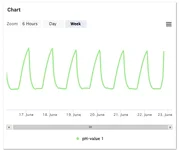
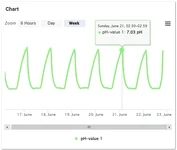
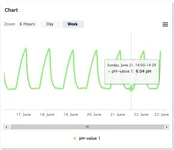
Here's my pH readings from the last week, shows you just how stable my CO2 injection is!
1782180954775.webp
1782180998957.webp1782180977149.webp

At a KH of ~3, my pH drops a full point from the morning to the evening. Probably drops 1.3-1.4 points pH from a fully degassed sample to fully injected, approx 40ppm CO2 usually.

Having a pH reading/meter helps me make sure all is well, though I run drop checkers for quick visual checking, too.
 
A combination of pH drop via quality pen/probe, Hanna CO2 titration test kit, and properly placed 4dKH drop checker is chefs kiss the perfect trifecta for estimating CO2 in your aquarium. And once you get the hang of it, it becomes super easy to do.

In other words, even if pH-based methods may overestimate the actual CO₂ concentration at very low KH, can pH still be used as a reliable relative indicator to determine whether CO₂ is stable or drifting during the day...?

I just went through this with my current tank setup. First time using a Yugang, and slightly anxious about controlling the influx and outgassing of CO2, to ensure safe levels for livestock, and sufficient and stable levels for plant growth during the photoperiod.

While I am not new to aquariums, I am new (8 months) to using CO2 in my tanks, as only hardcore aquarists were doing that the last time I was in the hobby, and I was too broke back then for the level of equipment I can use now.

My first foray into CO2 was a simple shrimp tank aquascape, and after watching too many ‘beginner’ Youtube videos I only used a drop checker to ‘eyeball it’ to a medium green. That tank had more stem plants in it, and they actually grew fairly well, but I did have some persistent CO2 related algae issues (I think mostly due to a drifting needle valve). I couldn’t tell you how many ppms of CO2 I had in the tank, but it seemed ‘sufficient’ for plant growth (sand capped aquasoil). It was a good CO2 entry level tank, but beyond just not having a drop checker that was blue or yellow, I couldn’t really tell you anything else about the chemistry of that setup.

For my current build, leap-frogging from a 10 gallon, to 142 gallons, I needed to up my knowledge game a bit. Thanks to Dennis Wong’s articles on his website, Rocco’s Dialing in CO2 articles, and following some threads here on SC, I was able to get a better grip on what I was actually doing to my tank, and what was important to focus on during setup.

I started by setting up the Yugang to get the CO2 flow (with no livestock in the tank) to push the DC to a subjective ‘lime green’. Trying to get to a ‘high enough’ level that I could then adjust downward as needed. I had exposed active substrate, <1 kH, and (mostly) slow growing plants.

At lime green titration testing (LaMotte) gave a reading of 70 ppm. I was surprised it was quite that high, so to avoid testing error I also ordered the Hanna titration kit. For a tank this size, though, I had no idea how much CO2 I was injecting into the tank, as bubble counters are useless at flow rates that high, and I had to empty the bubble counter of any fluid as it was blasting fluid into the CO2 lines. A Dwyer flow meter solved that problem, so now I had a quantifiable level of CO2 entering the tank.

After adjusting the size of the Yugang gas pocket, and injection flow rate, I dialed back the CO2 a little, to a more medium green, again being cautious due to the incoming livestock. Once I was comfortable with the sufficient level of CO2 entering the tank, balancing the needs of the plants, with the limits of the impending livestock, now I was focusing more on reaching CO2 equilibrium during the photoperiod. Here the DC is useless as it can’t tell me anything about equilibrium due to the delay in color change, and the subjectiveness of the color/range of ppm. Enter the pH probe.

I started out by mounting the Apera pH 60Z pen to the tank, and setup the data logger in the app to track 5 minutes values throughout the 24 hour period. The Apera lives in that tank, and was crucial for the first couple of weeks of setup. Not so much for telling me about absolute CO2 levels in the tank, but in regards to stability, and consistency, both throughout the photoperiod, and from day-to-day.

While the pH pen tells me the in-tank pH delta over a 24 hour cycle, the most valuable data from the probe was to tell me if there was any change in pH during the photoperiod. I expect some minor fluctuations from plant respiration during photosynthesis, but this helped me dial in WHEN to start CO2 injection, and when to turn it off, ensuring CO2 levels were consistent through the photoperiod. The Weekend Aquarist interviewing Dennis Wong several weeks ago really drove that concept home to me. We always hear about ‘CO2 stability’ being so important, but I think most of us when we are starting out using CO2 don’t actually understand that it really means stability throughout the length of the photoperiod. It’s not as simple as the ‘one bubble per second, CO2 on 1 hour before lights on, and off 1 hour before lights off’ mantra that the Youtube world is espousing, or is your drop checker green. Right now injection in this large tank starts four hours before lights on, and ends 90 minutes before lights off, and for my current tank, that was dialed in by plotting the data day to day pH values from the data logger, and recognizing when equilibrium was reached.

When I started this process, and the tank was in its ‘idea stage’, I figured the drop checker would be good enough. Now, I don’t see how I could have set up this tank without the ‘trifecta’ Rocco refers to. The drop checker to visually verify I have reached my approximate target ‘color level’ of desired CO2. I use the DC more as a too low/good enough/too high indicator. No more, no less. The DC I use in tandem with the titration kit to verify I have reached the relative concentration I am aiming for in this tank (with the caveat that it may overestimate the actual value depending on my tank conditions - substrate/ferts etc.), and the pH probe to verify that the levels are stable during the critical period of active plant carbon consumption. I just had to accept that NONE of these methods provide me with an ABSOLUTE VALUE of CO2 in this tank in ppm CO2. For that, I may need an Oxyguard. But do I really need to know an absolute? That was the difficult part for my brain to let go of.

As the tank has been running for a month, and I am more comfortable with the whole setup, and control of CO2 injection into this tank, which now has livestock in it, I can see that I am maybe being a little conservative with CO2 levels based on plant growth. Titration levels read around 32 ppm (which of course is slightly subjective, as all colorimetric titration tests are), with a 1.4 pH drop from a fully degassed sample using a magnetic stirrer, and a medium green drop checker. Livestock are fine, plants are growing ok, maybe a little slow based on the couple of stem plants I have in this tank, but overall the tank is seemingly stable, and doing ok so far. Plant growth and health will now become more of an indicator for me as to whether I need to adjust tank inputs.

Honestly, my take home from going through all this with my current build, is that unless you have a high end analyzer, all we can really do is estimate a relative CO2 value for our tanks with consideration for our tank chemistry. My analytical brain wasn’t comfortable with this concept at first, but in reality, as Dennis points out in his How to Measure CO2 article, the variables from tank to tank, from substrates, to fertilizers, make none of the tools and methods we have accessible to us as hobbyists completely perfect. However, using the DC, pH probe, titration testing, AND plant health it does get us close enough.
 

Top 10 Trending Threads

Back
Top