Welcome to ScapeCrunch

We are ScapeCrunch, the place where planted aquarium hobbyists come to build relationships and support each other. When you're tired of doom scrolling, you've found your home here.

Light-dependent chlorosis (white under light, green in dark) – Mg/Ca transport issue?

  • Thread starter Thread starter mrtank50
  • Start date Start date
  • Tagged users Tagged users None
Joined
Dec 30, 2025
Messages
15
Reaction score
23
Location
TÜRKİYE
Hi all,

I’m experiencing a persistent issue in a high-tech planted aquarium and would appreciate advanced input.


Main symptom (very consistent):

  • New growth turns white under light
  • The same tissue regains green coloration in darkness
  • Older leaves are mostly unaffected

Plants most affected:

  • Eriocaulon species
  • Limnophila aromatica
  • Rotala macrandra variegated
Interestingly, most red plant groups are less affected, while green plant groups are clearly more affected.


System overview:

  • CO₂: high and stable
  • Hanna CO₂ test kit + pH checks used regularly
  • CO₂ estimated around 30–35 ppm
  • I do not think this is caused by pH instability
  • pH: low (~5.2–5.4), KH ~0
  • Light: high (WRGB, ~6 hours)
  • Substrate: ADA Amazonia (~6 months old)
  • Flow: moderate to good

Dosing routine (daily):

  • NO₃: ~2.5 ppm(%50 urea-%40 mgno3 - %10 kno3)
  • PO₄: ~0.25 ppm(kh2po4)
  • K: ~1 ppm (kcl-k2so4)
  • Fe (DTPA): ~0.025 ppm (mn 0,007-0,01)
GH is adjusted using CaCl₂ and MgSO₄.


Ca–Mg testing:
Tested multiple combinations:

  • 30 ppm Ca / 10 ppm Mg
  • 30 ppm Ca / 15 ppm Mg
  • 5 ppm Ca / 2 ppm Mg
  • 18 ppm Ca / 6 ppm Mg
  • 18 ppm Ca / 12 ppm Mg
  • 15 ppm Ca / 5 ppm Mg
  • 24 ppm Ca / 8 ppm Mg
→ Issue persists in all cases.


Iron testing:

  • Tested Fe forms: gluconate, DTPA, EDDHA, EDTA
  • Increased Fe dosing from ~0.025 ppm up to ~0.3 ppm
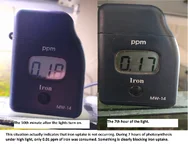
  • Photometer confirms ≥0.01 ppm Fe present
→ No improvement with any Fe form or level.


Fertilizers tested:

  • APT
  • MasterLine
  • Tropica
→ No meaningful difference.


Toxicity check:

  • No clear toxicity symptoms
  • Tested removal approaches (e.g. carbon)
→ No improvement


Additional observations (important):

  • Increasing overall fertilization (up to ~3×) made the issue worse
  • Increasing potassium made symptoms more pronounced
  • Reducing potassium slightly improved the situation
  • Plants do not show typical potassium deficiency symptoms
I also increased daily dosing from roughly:

  • 2.5 ppm NO₃ / 0.25 ppm PO₄ / 1 ppm K
    to as high as:
  • 6 ppm NO₃ / 0.6 ppm PO₄ / 3 ppm K
→ Plants became noticeably worse, not better.

Growth is not especially fast, and even with increased fertilization growth does not accelerate.

To me, this strongly suggests that this is not a simple nutrient shortage, but rather some form of transport / uptake limitation or ionic blockage.


Key observation:

  • Whitening occurs only under light
  • The same tissue partially recovers in darkness

Interpretation:
This does not behave like a typical deficiency, but rather a functional/transport limitation.

Possible explanation:

  • Under high light, Mg demand increases sharply
  • Mg cannot be delivered fast enough (possibly due to low pH or ionic competition)
  • In darkness, demand drops → color returns

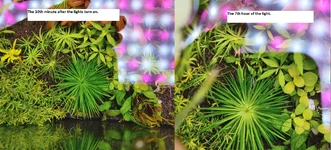
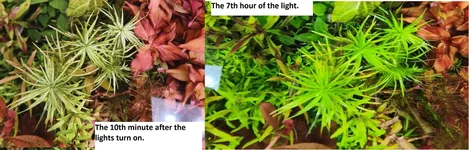
Photos:
Included comparison photos showing:

  • ~10 minutes after lights on
  • ~7 hours into photoperiod
→ Clear visual difference in the same plants
The photo will be taken and added just before the lights go out.


Questions:

  1. Has anyone observed similar light/dark reversible chlorosis?
  2. Can very low pH (~5.2) significantly affect Mg transport?
  3. Could potassium be interfering with Mg uptake even at relatively low dosing?
  4. Why would green species be more affected than many red species?
  5. Any similar experiences in high-light / lean setups?

Currently testing:

  • Slightly higher Ca
  • Reduced light intensity
  • Controlled potassium
Will update results.

Thanks in advance.
 
I actually have a similar scenario -- some plants plants look great first thing in the morning, but become EXTREMELY pale by the end of the photoperiod. Now, some plants just "do" this even when healthy, but I'm pretty sure this is a health issue in my case (sounds like yours too).

To me, this strongly suggests that this is not a simple nutrient shortage, but rather some form of transport / uptake limitation or ionic blockage.
I'd agree with this, too.

Questions:

  1. Has anyone observed similar light/dark reversible chlorosis?
Yes, for sure!
  1. Can very low pH (~5.2) significantly affect Mg transport?
This is pretty complex nuance, but I don't think this is the issue. I began raising my pH via KHCO3, keeping potassium levels the same. I went from 5.2pH with CO2 at peak, to about 6.0pH with CO2 injection. Issue persists completely, even with dosing 10ppm Mg.
  1. Could potassium be interfering with Mg uptake even at relatively low dosing?
It's possible, best way to test is simply lower potassium levels for a few weeks while keeping everything else the same.
Currently testing:
  • Slightly higher Ca
  • Reduced light intensity
  • Controlled potassium
Will update results.
Please do update!

Unfortunately the specific answers you might be looking for are not really answerable by us hobbyists. It turns out that in these aquatic environments, where ions of all nutrient types (and non nutrient Organics) are interacting/synergizing/competing, it's almost impossible for us to know the answers. Imagine a fully complex 3D spider web, with points running from all elements connecting to other elements. Untangling the web 1 by 1 for every element is almost impossible, because so many of them are interconnected in ways that even the most advanced nutrient scientists still don't understand. All we have is trial and error, and reporting our results.

For example, what if you decrease your ppm K and it "fixes" this scenario?

Is that because K was competing with Mg?

Or... was it because: K was encouraging a different pathway of PO4 uptake that took energy from the Mo/NO3 uptake pathway (but ONLY in the presence of 30ppm+ Ca, where it doesn't happen in lower Ca scenarios) that caused the issue? Or did reducing K actually increase the availability of Zn, which in turn helps promote Mg uptake, but only if there's enough Zn present? What happens if reducing K helps pale growth in one person's case, but not in a different aquarium? Is it because it wasn't K, or is it because of the complex relationships these elements have?

(that's just a made-up example, but it's likely how many of these pathways work). It's so hard to "narrow" these issues down, because there is no narrow path of connection. It's actually far, far more complex than the human brain can handle. I'm sure future AI will have the capacity to unravel some of the mystery.

My point is, very few of us will have element/nutrient-specific answers, because it really is INSANELY complex. All we have is trial and error, note taking, and reporting. I can't tell you exactly WHY my tanks need 9ppm PO4 per week with 73% water changes, only that it works for me, and I've noted it clearly.
 
I’m currently preparing a manganese EDTA solution. I hope it works. I will dose 0.05 ppm directly. There is already 0.17 ppm of DTPA-chelated iron remaining in the tank from yesterday. In addition to manganese, I will dose 4 ppm NO₃, 0.5 ppm PO₄, and 2 ppm K.
 
Last edited:
What happens if you reduce your light intensity a bit? I know light stress causes chloroplast rearrangement and activates secondary pigments that could explain what you're seeing, maybe? What temperature is your water? This reads more like stress than a true nutrient issue to me, but I'm not sure.
 
"(Mn) plays a key role in photosynthesis and in the synthesis and maintenance of chlorophyll stability in plants.

Synthesis and stability: Manganese is crucial for chlorophyll formation and protects it from degradation under the influence of strong light."

We've been working on this topic for a while at UKAPS.
Manganese and its stability are key.
 
Last edited:
"(Mn) plays a key role in photosynthesis and in the synthesis and maintenance of chlorophyll stability in plants.

Synthesis and stability: Manganese is crucial for chlorophyll formation and protects it from degradation under the influence of strong light."

We've been working on this topic for a while at UKAPS.
Manganese and its stability are key.
Interesting, post some links! The symptoms here are so rapid and reversible, very distinctive. I'd love to read more.
 

Top 10 Trending Threads

Back
Top