We are ScapeCrunch, the place where planted aquarium hobbyists come to build relationships and support each other. When you're tired of doom scrolling, you've found your home here.
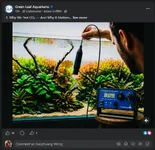
Era of AI slop is truly upon us. Firstly, no one holds the Oxyguard analyzer's probe as it takes 15-20mins to get a reading.
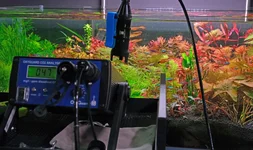
Size of the box is wrong and no shadows below the box, caps missing and a strap that goes nowhere. Aquarium looks fake as well. Real pic below for comparison.
The CO2 data I've gathered using the Oxyguard is possibly the most valuable set of data I've gathered in the last 10 years. But I guess data is only as useful as the person's ability to interpret and use it.
Yeah they post AI often, so do a couple other pages. It sucks because sometimes the info they share is good, and its like, couldn't they have just spent an extra few minutes making the infographic without AI?
The CO2 data I've gathered using the Oxyguard is possibly the most valuable set of data I've gathered in the last 10 years. But I guess data is only as useful as the person's ability to interpret and use it.
I mentioned because there's been a used analyzer (this older model in your photo) listed on Ebay for quite some time at $1000 and the seller has even offered a discount down to $800. My research on it indicates that the sensors need replaced over time so the cost of that and a calibration kit would bring the price up closer to $2000. That's better than the cost of a new one but still a lot for the typical hobbyist, though I can see the value for professionals such as yourself.
I mentioned because there's been a used analyzer (this older model in your photo) listed on Ebay for quite some time at $1000 and the seller has even offered a discount down to $800. My research on it indicates that the sensors need replaced over time so the cost of that and a calibration kit would bring the price up closer to $2000. That's better than the cost of a new one but still a lot for the typical hobbyist, though I can see the value for professionals such as yourself.
Hmm it can be a sensitive piece of equipment, I'm not sure of buying stuff like that second hand, unless one could get it checked out by a technician? The price is a bit silly from most hobbyists stand point. On the other hand, most businesses that are in this at any professional level should consider it I think.
For folks that are super deep into the technical of the hobby, like some life-time forumers here where planted tanks are their main hobby. I think it could be argued that its quite valuable as well. Kinda like the cost of an overseas trip
I'm going to start boycotting any aquascaping companies that are using AI, especially the ones that are using it and LYING about it to promote their products.
The CO2 data I've gathered using the Oxyguard is possibly the most valuable set of data I've gathered in the last 10 years. But I guess data is only as useful as the person's ability to interpret and use it.
Yeah they post AI often, so do a couple other pages. It sucks because sometimes the info they share is good, and its like, couldn't they have just spent an extra few minutes making the infographic without AI?
With regard to the Oxyguard unit - I was reading Dennis’s article in the AGA magazine, got drunk and bought the newer Oxyguard unit with the cal kit. It was somewhere around $3K. I’ve been glad I’ve had it. I have no trouble calibrating it, however I spent my career building test equipment that needed to be calibrated. It takes on the order of 20 minutes and the instrument tells you what to do step by step. It’s easy to use. I wish it took measurements faster but I just leave the probe in the water, walk away and check it again when it’s convenient. I do keep it plugged into the power source (USBc) while using it as it only holds a charge so long. I’ve never had an instance where I doubted a measurement.
I mentioned because there's been a used analyzer (this older model in your photo) listed on Ebay for quite some time at $1000 and the seller has even offered a discount down to $800. My research on it indicates that the sensors need replaced over time so the cost of that and a calibration kit would bring the price up closer to $2000. That's better than the cost of a new one but still a lot for the typical hobbyist, though I can see the value for professionals such as yourself.
So......what do YOU think the sensors use to measure the partial pressure of a gas in solution? pH and a reference alkalinity ppm solution. They made the probe's flat surface fairly large. You can also buy flat tipped pH probes.
I showed folks how to DIY their own CO2 meter and probe. As well as using a duplicate pH probe along with to measure the lag times between the pH change across the O2 gas membrane screw on cap. Now if folks want to buy an 800-2000+$ CO2 probe, that's up to them.
But even with that, I still used a pH probe to measure and adjust the lag times.
Key aspects to reduce lag times: tiny KH/Alkalinity reference solution volume inside the pH probe tip and O2 membrane and good flow across the membrane surface. No air bubbles inside the DIY cap.
pH probes like the American Marine are 1/2" so a threaded female brass 1/2 long nut can be heated and then used to melt the threads into the pH AM's probe. This also fits the Dissolved O2 membrane replacement caps. Alk/KH reference solutions, also DIY. Pick what ever range you wish, say 4 dKH .
Caps should last 1-2 years at least. Reference solutions can be changed if the lag times increase or change one way or another. Calibrate both pH probes monthly. Yes, you will refill the cap and screw back on a few times.
partial pressure is how we measure the gas independent of the alkalinity or other possible effects.
Only gasses will travel across the membrane(not just say, O2).
A good dissolved O2 meter is also very useful when used in conjunction with a CO2 probe. Those are more difficult to DIY.
I have a Hach LDO. I used the Oxygard about 20 some years ago for an obsessed client in LA. I took most of it apart. Spoke with the Team at Oxygard in the NL's.
Anyways, there are some fairly straight forward options and solutions most folks can do or do and sell if they are crafty.
I suppose someone could ask a Chinese lab manufacturer to make a probe like I described and sell the membranes, ref solutions and the probe along with a simple monitor that converts the pH to ppm of CO2. Buy say 1000 of them, might cost 100$, sell for 250$ etc.
I made DIY heating cables when they were a thing, mostly to prove George Booth wrong(which I finally did hehe), so this was much easier. Most hobbyist can make this DIY CO2 probe. Guess what I use, hehe.
I'll say this, most of the numbers match my results from 15 years ago.
I'll also say many could not believe how high the CO2 was.
Neither did I at the time. So being never certain about anything, I rechecked and used a few different methods.
Always use a pH probe that's recently calibrated in conjunction with any CO2 probe.
I've used the Oxygard about 20 years ago. Then made a DIY CO2 probe and posted it all over the place.
Mine had a faster response time vs the Oxygard. Cost 10X less. I found most tetras and smaller tropicals were fine at 70 ppm of CO2. Most of my tanks target about 55 ppm. Discus had a threshold for color and spunky behavior at 45 ppm. Any higher, they turned dark and slowed down. O2 was 7.2 ppm and temp was 84F. And DO measures need the temp and the O2 ppms. My O2 levels went up to about 9.4 ppm at 80 and 9.1 ppm at 82F. This was due to plant growth and the max time of day lighting cycles. Night, it dropped back to the low 7's. I made the CO2, O2 thresh hold graphes and showed how good O2 can fix many things in the tank.
Dennis is reconfirming what I did. That way he knows.
If you do good careful research, folks should get similar results.
If not, something is amiss.
With regard to the Oxyguard unit - I was reading Dennis’s article in the AGA magazine, got drunk and bought the newer Oxyguard unit with the cal kit. It was somewhere around $3K. I’ve been glad I’ve had it. I have no trouble calibrating it, however I spent my career building test equipment that needed to be calibrated. It takes on the order of 20 minutes and the instrument tells you what to do step by step. It’s easy to use. I wish it took measurements faster but I just leave the probe in the water, walk away and check it again when it’s convenient. I do keep it plugged into the power source (USBc) while using it as it only holds a charge so long. I’ve never had an instance where I doubted a measurement.
So you can use a reference pH probe along with the Oxygard.
I'm suspicious of any test method by nature.
I always doubt a measure unless I can fully prove to myself I'm wrong.
Test kits for NO3, NH4, PO4, K+ etc......... I use a reference set of solutions.
So I ended up making my own using a pH probe that I modified the tip to accept screw on DO membranes. Added a ref KH solution, then converted the pH readings to CO2 ppm's based on the reference KH solution inside the pH tip. Gasses flow across the membrane via the partial pressures.
Then not trusting that and wanting to know how long it takes for the lag time to go across the gas membrane via PP's, I used the exact same pH probe as a zero lag time reference(it's not, but it's the fastest response time we can get, so it's a good base line).
So you can do the same thing with the oxygard. Use a pH probe along with it.
Take the pH probe's readings over that 20 minutes. DIY CO2 probe, same thing.
Data logging pH and Oxygard are useful here.
You can also cross reference: Degas your tank water with strong aeration in a glass(1-2 hours if you want to be extra extra safe).
Then use that for the relative CO2 method.
That will give a couple of methods to check if things are in agreement.
Dennis sells ferts, so it pays to know all the attributes and test methods. Same for GLA. ADA, I think they hired someone, it was not Amano himself. Amano, like myself, set CO2 by eye and the plants, a relative pH base point, then tweaked from there. THEN...............we go back and critically measure the CO2 with something that's growign really well, at high light, fast growing weeds etc. That'll be the upper bounds(a positive known control).
You can also take the positive control and then lower just the CO2 slowly and methodically(as measured by volume added to the tank along with changes and reduction in ppm's) till you see negative plant growth and note the species and effects. Keep going farther, then algae species(green hair most common) and finally longer term low CO2, our good friend BBA .
Use these same tools for a non CO2 tank next, measure the flux of CO2 over a week, same for O2.
You can keep going and trying different test with CO2 and you can focus say on just one species, or a group.
Plenty of stuff to research, few bother. Get your $ worth out of the item.
I researched this instrument a few years ago, wanted to understand the physics and benefits. Here is my take away, and perhaps I just miss the point and welcome any feedback.
The target market for the Oxyguard seems to be aquaculture, example large scale commercial fish farming. Its fish production, revenue and profit are a function of varying water parameters and CO2. The 3000 USD would be a no brainer investment for a routine check and an immediate CO2 ppm result.
For research-oriented semi-professional planted tank specialists, I can imagine the investment paying off, as any tool is welcome if only to compare to other methods and gain some confidence that all is good.
But correct me if I missed something, I have NEVER seen a planted tank article, or experimental results, where the Oxyguard was needed for the job. In other words, I just don’t understand the use case for 99.9% of hobbyist as we can do same for a fraction of the cost. Did I miss anything?
Naturally, as hobbyists we enjoy playing with our toys so a purchase decision isn’t always rational. Personally, I wouldn’t buy it at 90% discount until I’ve seen its use case.
This is an instructional post to show how to make a DIY CO2 probe. This can be done in order to avoid tannins, water treatment phosphate buffers to prop up the alkalinity during seasonal tap water changes or any other non carbonate alkalinity interferences to the system. the trade off is that it...
This is an instructional post to show how to make a DIY CO2 probe. This can be done in order to avoid tannins, water treatment phosphate buffers to prop up the alkalinity during seasonal tap water changes or any other non carbonate alkalinity interferences to the system. the trade off is that it...
I showed folks how to DIY their own CO2 meter and probe. As well as using a duplicate pH probe along with to measure the lag times between the pH change across the O2 gas membrane screw on cap. Now if folks want to buy an 800-2000+$ CO2 probe, that's up to them.
Although I learned of your contributions early on when I got into the hobby a couple years ago, I didn't learn about The Barr Report until after joining this forum a year ago. I've barely scratched the surface of reading through all the good stuff there. Some good info on the DIY probes but it will have to go well down the list of To-Do projects which is crazy long right now.
I showed folks how to DIY their own CO2 meter and probe. As well as using a duplicate pH probe along with to measure the lag times between the pH change across the O2 gas membrane screw on cap. Now if folks want to buy an 800-2000+$ CO2 probe, that's up to them.
This site uses cookies to help personalise content, tailor your experience and to keep you logged in if you register.
By continuing to use this site, you are consenting to our use of cookies.