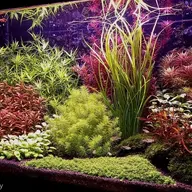
You can see the old leaves as very blue ish. Recently swapped to apt complete levels and got a lot more purple leaves.
Excuse the holes, I think the change in nutrient levels (from Estimative index) caused it to lose some lower leaves.
Follow along with the video below to see how to install our site as a web app on your home screen.
Note: This feature may not be available in some browsers.


Hmm fair.Those old leaves arent happy, otherwise snails/shrimp couldnt damage them like that. Most buces can display a few different colors at one time, especially new leaves. A change in ferts is likely to cause a change in colors, but whether its a good thing or not you'll have to wait and see if the plant can support its existing leaves as they mature and get older. If not the plant will reabsorb its older leaves to fuel new growth. It appears thats whats happening
Even the newest leaf that is fully developed isnt healthy, its already showing a pinhole or two, and those abnormally bright red "spots" is not a sign of good health. If that is inert substrate, epiphytes such as buces or anubias are going to need more ferts than any other plants. Seems like itd be the other way around but its not. Agian Im speaking of inert substrate
The problems with that buce in the pic isnt necessarily fert related, but at a glance I would say it is not a plant that needs ferts reduced. If anything it needs more
Yup. I appreciate the straight forwardness.Old aquasoil can still be pretty good, it just doesnt have the extra N. The new ferts might help, was just pointing out that its current state isnt very healthy atm

Did the new leaf develop after the change in fertilizer dosing or had it already sprouted ? If not it might be worth just trimming it off and waiting to see if the Buce would adapt to a new baseline.Yup. I appreciate the straight forwardness.
I have rotala wallichi in the same tank converting over well so I didn't assume nitrogen deficiency.
Im not sure personally if nitrate is the main issue. Both are planted into the substrate.
Testing nitrates in a nitrate limiting dosing is kinda pointless so I'm left to guess for a bit.
Its funny to me, and always seemed backwards, but epihpytes in a high energy tank are always the first ones to show a macro deficiency. I mean when attached to hardscape or with inert/old sub. I realize yours are planted in the sub. But to my point, even with relatively high macros in the water, fast growing stems all doing wonderful, slow growing anubias and buces will be quick to look bad if macros arent high enough for themYup. I appreciate the straight forwardness.
I have rotala wallichi in the same tank converting over well so I didn't assume nitrogen deficiency.
Im not sure personally if nitrate is the main issue. Both are planted into the substrate.
Testing nitrates in a nitrate limiting dosing is kinda pointless so I'm left to guess for a bit.
Could you elaborate a little more on the why of this? Especially when you refer to the “pressure” of having enough of a nutrient to encourage absorption?Its why Ca needs typically to be in the 30s (for example) when plants only take up maybe a couple ppm per week at most. But everybody knows you cant run a high energy tank with 2 ppm Ca in the water. A crude way to put it is there has to be 30 in the water to exert enough "pressure" for plants to be able to absorb the 1 or 2 they need. The presence of N/P/K and also Mg are all relative to this process and influence what happens inside the plant, beyond what the plants actually use
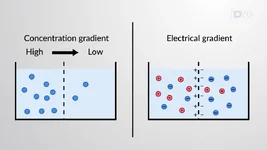
Ions across any membrane will try to reach a stable equivalent concentration over time ("concentration gradient" image on the left):Could you elaborate a little more on the why of this? Especially when you refer to the “pressure” of having enough of a nutrient to encourage absorption?
Rocco explained it. "Pressure" is just a figurative term I used to illustrate the pushing/pulling action between whats inside the plant vs outside. Not that its literally to do with actual pressure. Thats why I prefaced with "a crude way to put it would be..." But I can see how that would be confusing lolCould you elaborate a little more on the why of this? Especially when you refer to the “pressure” of having enough of a nutrient to encourage absorption?
Haha I should have explained myself better, I meant the process as has been explained and how the ratios mattered.Rocco explained it. "Pressure" is just a figurative term I used to illustrate the pushing/pulling action between whats inside the plant vs outside. Not that its literally to do with actual pressure. Thats why I prefaced with "a crude way to put it would be..." But I can see how that would be confusing lol

Ions across any membrane will try to reach a stable equivalent concentration over time ("concentration gradient" image on the left):
View attachment 11960
It gets more complicated when it's not only gradients, but also involves charges:
View attachment 11961
Plants want a slightly negative ionic balance because it helps drive their nutrient transport. This creates an electrical pull that attracts positively charged ions to move into the cell. Plants need this because they evolved the ability to quite easily absorb negatively-charged ions, but need more energy to move cations.
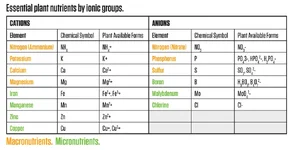
See the chart above for anions; recognize anything? NO3, PO4, two hugely important macros. In fact, NO3 is THE most important/consumed macro by far.
By creating this negative potential, plants can actively pump necessary nutrients across the membrane, even when the concentration of those nutrients is higher inside the cell than outside.
By having a gradient across their membrane that causes a charge differential, they are able to access the cations that are a bit more difficult for them to inherently absorb, like K, Ca, Mg, Fe.
To answer the "Why":
Plants have to spend extra energy to absorb cations compared to absorbing anions. If you provide a large concentration of cations (Ca, Mg, K, Fe) in the water, that gradient difference helps "push" ions across the cell membrane, and makes absorption easier (left image above).

That actually makes a lot of sense. This is probably why my ephyphites andIons across any membrane will try to reach a stable equivalent concentration over time ("concentration gradient" image on the left):
View attachment 11960
It gets more complicated when it's not only gradients, but also involves charges:
View attachment 11961
Plants want a slightly negative ionic balance because it helps drive their nutrient transport. This creates an electrical pull that attracts positively charged ions to move into the cell. Plants need this because they evolved the ability to quite easily absorb negatively-charged ions, but need more energy to move cations.
See the chart above for anions; recognize anything? NO3, PO4, two hugely important macros. In fact, NO3 is THE most important/consumed macro by far.
By creating this negative potential, plants can actively pump necessary nutrients across the membrane, even when the concentration of those nutrients is higher inside the cell than outside.
By having a gradient across their membrane that causes a charge differential, they are able to access the cations that are a bit more difficult for them to inherently absorb, like K, Ca, Mg, Fe.
To answer the "Why":
Plants have to spend extra energy to absorb cations compared to absorbing anions. If you provide a large concentration of cations (Ca, Mg, K, Fe) in the water, that gradient difference helps "push" ions across the cell membrane, and makes absorption easier (left image above).
ah that makes a lot of sense.Ions across any membrane will try to reach a stable equivalent concentration over time ("concentration gradient" image on the left):
View attachment 11960
It gets more complicated when it's not only gradients, but also involves charges:
View attachment 11961
Plants want a slightly negative ionic balance because it helps drive their nutrient transport. This creates an electrical pull that attracts positively charged ions to move into the cell. Plants need this because they evolved the ability to quite easily absorb negatively-charged ions, but need more energy to move cations.
See the chart above for anions; recognize anything? NO3, PO4, two hugely important macros. In fact, NO3 is THE most important/consumed macro by far.
By creating this negative potential, plants can actively pump necessary nutrients across the membrane, even when the concentration of those nutrients is higher inside the cell than outside.
By having a gradient across their membrane that causes a charge differential, they are able to access the cations that are a bit more difficult for them to inherently absorb, like K, Ca, Mg, Fe.
To answer the "Why":
Plants have to spend extra energy to absorb cations compared to absorbing anions. If you provide a large concentration of cations (Ca, Mg, K, Fe) in the water, that gradient difference helps "push" ions across the cell membrane, and makes absorption easier (left image above).
I run my tanks at ~27ppm Ca by adding 20ppm after WC each week with 70% WC:I just remembered i am also doing lean GH, like 2-3.
I'll bump gh back up to 8-10 and hopefully see some improvements.
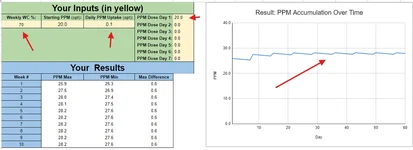
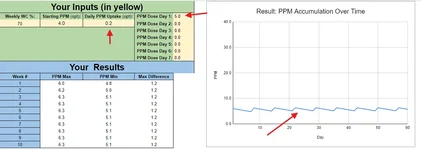
I have like 5 10 gallon tanks, so I prefer to dose higher and do a water change every 2 weeks instead.I run my tanks at ~27ppm Ca by adding 20ppm after WC each week with 70% WC:
View attachment 11968
And do the same for Mg, which hovers likely between 5-6.5ppm Mg:
View attachment 11969
27ppm Ca and ~5.5ppm Mg is about 5dGH.
I also dose ~15ppm K with the CaSO4 and MgSO4 after WC each week. K doesn't affect GH.
Just letting you know that you might not need to go all the way to GH8-10, which is just adding more Ca and Mg.