Cyanobacteria is back. I used Fritz slime out to treat it last time, but I’m out of that now.
Should I use that again or should I try something else?
Should I use that again or should I try something else?
Follow along with the video below to see how to install our site as a web app on your home screen.
Note: This feature may not be available in some browsers.


What's the water agitation, flow and water change regime in your tank like?Cyanobacteria is back. I used Fritz slime out to treat it last time, but I’m out of that now.
Should I use that again or should I try something else?
I’ve got a lot of water flow, and I’m currently doing about 3 50% water changes each week because of the algae and cyanoWhat's the water agitation, flow and water change regime in your tank like?
I haven't had much luck eradicating the cyanobacteria in my tank but I noticed that it goes away when there is good flow and surface agitation. It returns in force whenever the skimmer gets clogged by plant debris and film appears on the water surface.
I’ll check it out. And my nitrates, I’m guessing 0ppm because I dose 1 ppm daily.See my post here:
Understanding Cyanobacteria (blue-green slime algae, BGA)
My first question is, what are your nitrates at by the end of the week?
So, I’m dosing a diy fertilizer based on apt3 and the weekly nutrient dosage recommended in a 2hr aquarist article. So I’m dosing about 1 ppm N and .3 ppm P daily. And 4ppm K. Plus micros.See my post here:
Understanding Cyanobacteria (blue-green slime algae, BGA)
My first question is, what are your nitrates at by the end of the week?

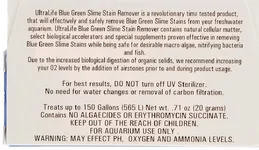

It looks (and even smells lol) identical to Cyano RX which is, but maybe it's not!@Naturescapes_Rocco one point - I don't think Ultralife Blue Green Slime remover is an antibiotic unless the UK market has a different product
This means that you can safely treat cyanobactera with gram-negative antibiotics without affecting your tank's main bacterial health.


 and not down a drain.
except one time it DEFINITELY melted my Vals

I just remembered that I upped the P dosage recently. I wasn’t dosing enough and had GSA.From that post:
If water changes alone don't help, how do I treat BGA? It's killing my plants, or it's on my substrate!
Because it's a bacteria, BGA can (and should) be initially treated with an aquarium-specific antibiotic. Nearly all species of cyanobacteria are gram-negative bacteria (source). In our aquarium, the "good" bacteria that are part of the nitrogen-cycling bacteria in our filters and substrate are gram-positive bacteria (source). This means that you can safely treat cyanobactera with gram-negative antibiotics without affecting your tank's main bacterial health. I have done this many, many times and the only effect I noticed was some potential melting of Vals with a 4x strength dose. However, in 90% of my cases all plants, shrimp, fish, and filter bacteria were fine while the cyanobacteria disappeared for a few days.
Some will suggest a blackout to treat it, which might work -- BGA do need light to survive and to grow, but so do your plants. Blackouts are pretty outdated treatment methods for algae issues. We know better now: Healthy plants prevent algae, and a blackout hurts plants the same as it hurts BGA. You might kill the BGA with a blackout only to keep getting algae issues down the road.
Increasing oxygen has also been reported to help some, but I got BGA in my extremely surface-agitated 150p aquarium with TONS of dissolved oxygen. Remember, these might have some effect on BGA, but are not the main cause and shouldn't be considered the main treatment.
How to treat BGA in the short term:
- You need to first use a hose/siphon to remove as much BGA as possible. If infected leaves are heavy with BGA, trim them. They will usually not recover well, and trimming will encourage new BGA-free growth.
- After manual removal, treat with a trusted gram-negative antibiotic. I have tried multiple:

Blue Life Green Cyano Rx works, but I prefer:

Ultralife Blue-Green Slime Remover. I have used this product to great success over the years on countless tanks I let bottom-out of NO3 with the presence of PO4.
How do I keep BGA from coming back again and again and again?
The simple answer is: stop creating NO3-limited environments.
Manually remove the BGA first, then dose with a recommended BGA antibiotic. Don't let your aquarium bottom-out of NO3, or Increase your NO3 dose and slighly decrease your PO4 dose. Don't do big water changes without re-adding the NO3 your plants need, or cyanobacteria will consume the PO4 left behind. Water changes are supposed to help balance nutrients, not "remove" them. Excess nutrients have never really caused algae -- specifically, nutrients in excess in the presence of one or more nutrient-limited environments cause algae (as well as dead/rotting plants and poor waste management).
Understanding how to create a non-limited environment for ALL nutrients our plants need (C,N,K,P,Ca,Mg,SO4,Fe,Traces in that order) is the key to success. You can do this through nutrient-rich aquasoil, root tabs, fish waste, or liquid fertilizers -- but understand that anytime you create imbalances of nutrients through limited environments, you will get algae.
If you have PO4 present but absolutely zero NO3, you get cyanobacteria (BGA) and/or Green Hair Algae (GHA) (depending on CO2 concentration and K concentration).
If you have plenty of NO3 but absolutely bottomed-out PO4, you get Green Spot Algae (GSA).
If you have fluctuating CO2 levels and lots of complex waste organics from fish waste, rotting plants, or a generally unclean tank, you get Black Beard Algae (BBA ).
Healthy plants do not get algae. In an aquarium where there is essentially greater-than-zero of "C,N,K,P,Ca,Mg,SO4,Fe,Traces" at all times (nothing bottomed-out), your plants will never be starved for anything and will almost always outcompete/prevent algae growth.
You can do this through aquasoil, root tabs, fish waste, or liquid/dry fertilizers. Learning to test/observe and understand these scenarios will help you diagnose what's actually going on in your aquarium. BGA is no different -- when your NO3 hits near zero, plants can't consume PO4, and BGA uses the N from the atmosphere to grow in your aquarium.
It's not about specific amounts or even specific ratios -- as long as your NO3 and PO4 are anything BUT zero, and they are somewhere between 5:1 and 20:1, you will not get cyanobacteria, period.
My summary of Cyanobacteria and how to treat it:
- BGA is a photosynthetic bacteria that has the ability to get the nitrogen it needs from either the atmosphere or our aquarium.
- Plants cannot consume 1 PO4 if there isn't ~10x NO3 available.
- When plants can't consume PO4 due to NO3 limitation, BGA can take N2 from the atmosphere and consume the PO4.
- Water changes don't help if they are only making the NO3 limitation worse
- To treat, remove as much manually as you can. Trim heavily affected leaves if necessary.
- While not required, using an aquarium-safe gram-negative antibiotic like UltraLife Blue Green Slime remover will melt most BGA.
- Once removed/treated, prevent recurring outbreaks by either increasing your NO3 concentration in your tank, or reducing your PO4.
In most cases, your plants are likely starving for NO3, so that's the easiest once to increase -- your plants will thank you!
Quel horreur !Greggz makes a good point on this: the bulk of the working biofilter population we depend on is actually archaea not bacteria. It is true that Archaea cell walls are structured in such a way as to be unaffected by our pharmaceutical antibiotics.
Nitrospira bacteria are also meaningful participants, and pharmaceutical antibiotic treatment will, temporarily, stomp on this portion of your biofilter.
Unfortunately Cyanobacteria are not a single beast, but a category of many species of weird creatures that have varied sensitivity to pharmaceuticals, evidently designed by a loving Creator to cause us to pull our hair out
Translation: your slimy blue-green mess is not necessarily my slimy blue-green mess
And if that wasn't enough fun, cyanobacteria also serve as an environmental reservoir for ARGs or antibiotic resistance genes. Meaning that when our water changes go down the drain into the water system, we send an amplified colony of surviving cyanobacteria out to pass their genetic antibiotic resistance to other categories and species of bacteria that impact our own human health.
Sigh.
If you have P present, but no N, plants can't grow.I just remembered that I upped the P dosage recently. I wasn’t dosing enough and had GSA.
So maybe the plants are still adjusting to that.
would that be possible?

Is having the N in the substrate fine?If you have P present, but no N, plants can't grow.
But Cyanobacteria can.
Plants consume a lot more N than P, so if you add extra P without enough N available, plants can't use it!
This would make total sense as to why you got Cyanobacteria. I'll add it to the list of Nitrate-limited examples for tanks with Cyanobacteria
To fix, don't reduce your P dose, just mildly increase your N dose.
For plants, absolutely! N in the substrate with P dosing is pretty common, but it also explains why some people do get cyanobacteria in this situation.Is having the N in the substrate fine?
I dose .3ppm P daily and 1 ppm N. But I do have ammonia rich aquasoil.