Welcome to ScapeCrunch

We are ScapeCrunch, the place where planted aquarium hobbyists come to build relationships and support each other. When you're tired of doom scrolling, you've found your home here.

Aquasoil basics

Joined
Jun 18, 2025
Messages
662
Reaction score
1,058
Location
Cincinnati, OH, USA
With all the talk on Amazonia pro, I wanted to get some basic understanding of rich aquasoil.

- everyone seems to agree that the richer the aquasoil is, the more the amount of water changes you would have to do initially. Basically meaning that aquasoil leaches its contents into the water and you replace the water. Now….. doesn’t that just mean that you are throwing away what you paid for ? Even if one does a dark start, and minimize the number of water changes one still has to do a water change after the dark start and still end up wasting the nitrate/phosphate?

—— trying to ask then does that mean the only person who benefits from a super rich aquasoil is someone like an insta or YouTube person who wants a quick burst of growth with the initial leaching of nutrition. For everyone else wanting a stable long term system, a not so rich aquasoil which might help the plants a little bit in the beginning but being used more for long term stability and buffering capacity?

- do the plants actually get the boost initially from the root zone or is it more from the leaching that happens and ultimately from the WC? The later makes sense since their roots have not yet developed.

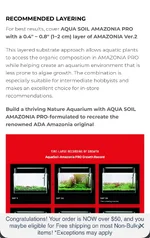
- if one has the whole substrate inside a container with water, wouldn’t water touch all aspects of the substrate regardless of it being capped or not ? How does capping a aquasoil actually help? Green aqua stated that ada recommends capping the Amazonia pro with Amazonia 2.

Curious on people’s thoughts on this.
 
How does capping a aquasoil actually help? Green aqua stated that ada recommends capping the Amazonia pro with Amazonia 2.
During the masterclass at Aquashella, the cap of Amazonia 2 was specifically the powder version. It's primary purpose is just aesthetics and easier planting due to it's finer grain size.
 
During the masterclass at Aquashella, the cap of Amazonia 2 was specifically the powder version. Its primary purpose is just aesthetics and easier planting due to its finer grain size.
That makes sense. Both green aqua and AFA, makes it seem to decrease leaching since they comment on decreasing algae risk, or I am just interpreting wrong. IMG_7874.webp
 
Last edited:
I’ve seen that claim a lot, especially from people that like to cap with sand. I suppose if it’s a deep enough layer of cap, and you don’t ever disturb it, it might lower the amount or rate of leaching. Then I’ve seen others say that it just breaks down the aquasoil faster and that it shouldn’t ever be capped. Any insights on that?
 
With all the talk on Amazonia pro, I wanted to get some basic understanding of rich aquasoil.

- everyone seems to agree that the richer the aquasoil is, the more the amount of water changes you would have to do initially. Basically meaning that aquasoil leaches its contents into the water and you replace the water. Now….. doesn’t that just mean that you are throwing away what you paid for ?
To some extent, yes. But the initial leaching of ammonia that occurs is a small fraction of the included nutrients in aquasoil.

Even if one does a dark start, and minimize the number of water changes one still has to do a water change after the dark start and still end up wasting the nitrate/phosphate?
Yes, you're wasting some of what the product initially had, but again, in most aquasoil-based systems, it's a small price to pay for the benefits of what you get with these rich soils.

—— trying to ask then does that mean the only person who benefits from a super rich aquasoil is someone like an insta or YouTube person who wants a quick burst of growth with the initial leaching of nutrition.
I think Aquasoil is responsible for allowing the modern aquascaping hobby/industry to exist. I have seen beginners (myself included) who didn't fertilize, or barely fertilized, be able to keep beautiful and enjoyable tanks for 6-8 months just because they used aquasoil. In many instances, that would be almost impossible for beginners if they were using just inert substrate.

For everyone else wanting a stable long term system, a not so rich aquasoil which might help the plants a little bit in the beginning but being used more for long term stability and buffering capacity?
This is one I'm in full disagreement with, in the sense that if you want a longer-term system that uses aquasoil, you might as well start with the richest soil you can (ADA Amazonia V2, ADA Amazonia Pro, APT Feast, Netlea, etc).

- do the plants actually get the boost initially from the root zone or is it more from the leaching that happens and ultimately from the WC?
Yes :) It's definitely both. But remember, aquasoil isn't only just about nutrients, it's also about the amazing microbiome it produces for plant roots to thrive, as well as helping support a super robust bacterial population.
- if one has the whole substrate inside a container with water, wouldn’t water touch all aspects of the substrate regardless of it being capped or not ?
Water flow still matters, and if a cap is thick enough, it can prevent leaching. It would likely also prevent healthy amounts of oxygen, but I don't personally understand why you'd cap aquasoil unless it was for aesthetics.

Curious on people’s thoughts on this.

If you know my posts/tanks, you know I've been in love with inert sand tanks and EI dosing, for a fraction of what aquasoil costs in the long run. My systems usually stay pretty stable and healthy, for less money and with a substrate that never changes or breaks down. BUT, if it weren't for aquasoil, I wouldn't have gotten to this point. The first 10 years of my aquascaping journey, I only used aquasoil and never really fertilized... at all... and still had mostly enjoyable tanks.

The only true part of aquasoil we should all be wary of is the price tag relevant to what it actually is. Rich soil and clay is harvested by large tractors in nature, washed/filtered/cleaned, then partially baked into small balls, then soaked with an ammonium solution, dried, and finished baking. Large particles are filtered out, the rest is bagged and sold at $70USD per bag. If you have a 120cm tank, you're gonna need hundreds of dollars worth.

But it works, and usually works REALLY REALLY well. It's not snake oil, it's kinda the best substrate we have in this hobby. The most beautiful hardscape tanks on earth all use it. The most incredible aquascaping galleries all use it.

I've had a hard time maintaining a truly steady water change and fertilizer schedule these last few months, and it's making me want to go back to using aquasoil just for the buffer and ease of use. It's way, way harder to F up a high energy aquasoil tank, than a high energy inert sand tank.
 
@Naturescapes_Rocco
I think you misunderstood my post. Just responding so that this does not go into an aquasoil vs inert question, which it is not. As you know I have been very happy with APT feast in my tank.

I wanted to discuss the difference between richer aquasoil vs less rich aquasoil.
 
As someone who did the dance with many tanks using Amazonia v1, it just works. Keep in mind if you are dark starting or doing the recommended water change schedule that it’s essentially massively boosting the tank cycle and biome too. No need to use anything else or feed the tank to cycle.
After the initial ammonia burn it has nutrients to carry a tank for quite a long time although with the light levels folks are pumping these days I’d still keep an eye on levels and supplement as needed.

FWIW I’m still using my original Amazonia from 20 years ago. When I downsized my tanks I dried it and kept it in sealed 5G buckets in the basement. Supplemented with fresh apt feast it helps offset some of the cost. Surely the ph buffering capacity etc is spent but I’m using ro/distilled and water column dosing. I did sift old bits of powersand and very fine particulate before reusing.
 
I think the only really good reason to use less rich aquasoil (fluval, controsoil, etc) would be if you were in a time/effort constraint to avoid melting plants early on due to missing water changes or not having enough time for a partial/full dark start period.

In the long run I think plants really appreciate good quality aquasoil. The best tank I've ever kept was ADA Amazonia V2 soil, and I could genuinely feel the difference from my previous fluval and controsoil tanks.

If you're a youtuber who needs to plant plants in your aquasoil at the same time as filling the tank, I guess I'd understand using less rich aquasoil types. But for us at home (who aren't generally restricted to the same scenarios), having a few weeks of patience for a partial/full dark start would be more than enough to avoid major melting, or just putting in the bit of extra time and effort for more frequent water changes would be totally worth the long-term benefits of richer aquasoil IMO!
 
I'd like to know what's your experience guys with recharging the aquasoil full of nitrogen. I'm thinking of pure N osmocote capsules. I assume the high CEC of aquasoil means it would absorb it and be back to its prime. I'm really not concerned about ammonia leaks in an old dutch type tank with healthy plants as long as N is plentiful in the substrate. Currently I'm replacing some of the soil with new ADA v.2 but there has to be another (cheaper) way.
 
I'd like to know what's your experience guys with recharging the aquasoil full of nitrogen. I'm thinking of pure N osmocote capsules. I assume the high CEC of aquasoil means it would absorb it and be back to its prime. I'm really not concerned about ammonia leaks in an old dutch type tank with healthy plants as long as N is plentiful in the substrate. Currently I'm replacing some of the soil with new ADA v.2 but there has to be another (cheaper) way.
I brought up the question about reusing aquasoil in this post: Reusing Aquasoil

There are articles about recharging it and @Dennis Wong mentions that Tom Barr discussed it on the Barr Report. I think the question still is, is it worth the time and effort for what you get.
 

Top 10 Trending Threads

Back
Top