Welcome to ScapeCrunch

We are ScapeCrunch, the place where planted aquarium hobbyists come to build relationships and support each other. When you're tired of doom scrolling, you've found your home here.

Journal 200 Gallon Jungle: Notes on the SWCR Method

I prefer to use alkalinity to adjust the CO2 because I prefer not to operate my aquarium below pH 6.7.
I'm curious as to what benefit you perceive from keeping the pH no lower than 6.7? Most plants prefer lower dKH . Many people like myself run very low to no dKH tanks where pH is dropped into the 4's via CO2 on a daily basis. Do you think that is somehow detrimental? And if so, how?

I also noticed your TDS is 340 which seems high given the other readings. Any idea what is driving up that value? Do you ever vacuum the gravel to remove the accumulated detritus trapped there. I notice a fair amount of algae on the substrate and hardscape which many times is due to too many accumulated dissolved organics.

And I'm also curious why you run this tank with high light? Most all of those plants will thrive with very low light and low/moderate water column nutrients. Again curious as to what benefit you perceive from the high light levels given the species of plants in the tank.
 
Last edited:
Nitrification efficiency goes down with pH. There is more science to be done on this, but that is the current thinking in environmental engineering. I know aquarists have been running biofilters at lower pH values with no apparent problems. However, I do not wish to explore the boundaries on this because there is no need. I can hit CO2 targets with alkalinity increase.

Most plants prefer lower dKH ? I can agree that many plants are native to waters with pH characteristics wherein low alkalinity is a normal feature. That would generally be the natural condition you would expect to find. The plants in question will certainly have a range of pH values they will tolerate. But does this mean that they have a specific preference for KH? Is the range of a plant's adaptability to KH more highly restricted than to pH?The answer is in plant physiology and I would like to see that. If true, it would alter my methodology.

My emphasis is on stability. I use a pH monitor to meter CO2 delivery; it's homeostatic and KH is the control. Clearly, it works for you to see pH drop into the 4s on a daily basis. Does that normally happen in a rain forest primary stream? I emphasize "normally." If not, I won't do it.

What I think is "somehow detrimental" is not important. Whatever is yielding the desired results is all that counts. I do think that differences between tanks, types of habitats, stocking levels, acceptance criteria for appearance, gross size, and practical manageability can account for differences in aquaristic methods. In the long run, certain techniques in certain situations can be demonstrably superior. Just because I propose something different doesn't mean I regard some other established thing is invalid or detrimental.

I have noticed that the TDS is especially sensitive to anion concentration, so it probably seems out of kilter to those unaccustomed to high KH. I believe it is working correctly, but I can give no certain explanation.

I gravel vac the foreground gravel, occasionally not often. A densely planted tank this size is not conducive. There is particulate organic matter (POM), which penetrates the benthos. Decomposition of this to recalcitrant fraction yields what we commonly call mulm. In an inert substrate with large root feeders that is not necessarily a bad thing. But let's be practical here. The only way I can remove any significant quantity of detritus from my gravel bed is to do a tear-down, or what I call a turnaround. The question for the Jungle becomes, not whether I should do a gravel vac, but whether it's time for a turnaround.

Dissolved organics is another matter. The DOM produced is exported by the SWCR. Whatever you might think about the exact accuracy of my ORP monitors, the redox in this tank is high and that reflects low DOM. Could I do even better? Probably, but do I have a problem here?

The algae is another story.
 
Nitrification efficiency goes down with pH. There is more science to be done on this, but that is the current thinking in environmental engineering. I know aquarists have been running biofilters at lower pH values with no apparent problems. However, I do not wish to explore the boundaries on this because there is no need. I can hit CO2 targets with alkalinity increase.

Most plants prefer lower dKH? I can agree that many plants are native to waters with pH characteristics wherein low alkalinity is a normal feature. That would generally be the natural condition you would expect to find. The plants in question will certainly have a range of pH values they will tolerate. But does this mean that they have a specific preference for KH? Is the range of a plant's adaptability to KH more highly restricted than to pH?The answer is in plant physiology and I would like to see that. If true, it would alter my methodology.

My emphasis is on stability. I use a pH monitor to meter CO2 delivery; it's homeostatic and KH is the control. Clearly, it works for you to see pH drop into the 4s on a daily basis. Does that normally happen in a rain forest primary stream? I emphasize "normally." If not, I won't do it.

What I think is "somehow detrimental" is not important. Whatever is yielding the desired results is all that counts. I do think that differences between tanks, types of habitats, stocking levels, acceptance criteria for appearance, gross size, and practical manageability can account for differences in aquaristic methods. In the long run, certain techniques in certain situations can be demonstrably superior. Just because I propose something different doesn't mean I regard some other established thing is invalid or detrimental.

I have noticed that the TDS is especially sensitive to anion concentration, so it probably seems out of kilter to those unaccustomed to high KH. I believe it is working correctly, but I can give no certain explanation.

I gravel vac the foreground gravel, occasionally not often. A densely planted tank this size is not conducive. There is particulate organic matter (POM), which penetrates the benthos. Decomposition of this to recalcitrant fraction yields what we commonly call mulm. In an inert substrate with large root feeders that is not necessarily a bad thing. But let's be practical here. The only way I can remove any significant quantity of detritus from my gravel bed is to do a tear-down, or what I call a turnaround. The question for the Jungle becomes, not whether I should do a gravel vac, but whether it's time for a turnaround.

Dissolved organics is another matter. The DOM produced is exported by the SWCR. Whatever you might think about the exact accuracy of my ORP monitors, the redox in this tank is high and that reflects low DOM. Could I do even better? Probably, but do I have a problem here?

The algae is another story.
Thanks for the detailed reply @Graham. I find this tank very interesting and am trying to wrap my head around your methods. You've got a lot going on and a lot to absorb.

Would you see any benefit to occasional large water changes to "reset' the water column and remove accumulated dissolved organics?

Since you start with RO water, have you ever tested the TDS of your water dosed to your parameters outside of the tank? I am just wondering if the tank is adding TDS outside of your dosing and dKH /dKH scheme.

Do you ever experiment with things like CO3 dosing to see if you notice any difference at various alkalinity levels? Both higher and lower? I am curious as to how you settled on dKH at 6.5 or so to be optimum.

I noticed you are dosing Excel. Is this for the benefit of the plants or for algae reduction?

Lastly I see you are dosing Flourish but also have a container marked "Trace"? Are you dosing additional micros to add things in that you see the Flourish as missing?

I hope you don't mind more questions as I am trying grasp everything.
 
Again, the largest, by far, source of KH is CO3. Not only have I experimented with it, it's what I'm doing. That is what I am using to set the KH level. I dose K2CO3 on a schedule calibrated to maintain the system alkalinity automatically. I settled on KH 6.5 - 7 because that is where the target CO2 ppm occurs at the desired pH. This is the carbonate buffer system. I'm sure you've seen the chart of CO2 concentrations for KH plotted against pH. There is more than one way to get 40 ppm CO2. You can adjust the KH with buffer to 4 degrees and set the CO2 delivery threshold to pH 6.5. Or you can set KH to 7 degrees and the CO2 to pH 6.7. Or KH = 2 and pH = 6.2, etc. Any function on this continuum will get you 40 ppm CO2. The buffer system maintains pH stability when CO2 is injected. A specific alkalinity will allow a specific pH for a specific quantity of CO2. And the great beauty of a buffer system is that it prevents your pH from plunging in the middle of the day when CO2 is flowing. What a buffer does is resist pH change until a threshold is met. It promotes stability of the pH even as CO2 content is increasing. Those not using a pH controller are less familiar with the concept of the buffer system, and those having 0 dKH evidently tolerate pH swings that would give me the willies. Injecting CO2 without homeostasis is an art. It is a skill, admirable to be sure, I don't have to develop because I use the homeostatic method. It's iron-fisted pH control 24/7 automatically. Drop checkers and bubble counters? No need. This is why I have a relatively high KH. I can pour on the CO2 and my pH won't crash. It changes slowly in response to the CO2 concentration, of course. The pH controller turns the CO2 on and off. It's not high KH that would offend an organism's metabolic sensibilities. It's out-of-bounds pH and large pH swings I would worry about. This goes for fish, plants, inverts, fungi, and bacteria - everything in the community - pH affects them all. I simply doubt that a stable KH of 7 degrees is harmful in any way, but I'm open to legitimate argument on that.

The RO/DI produces pure water. The little TDS monitor used on the effluent is always 1 ppm. Even if it's not a very good TDS monitor, off by an order of magnitude is still pure water for all practical purposes. All the TDS in the aquarium water column is from the total of allochthonous substances and autochthonous substances in the water, wherever they originated from.

I do on occasion what I call a "big gulp" water change. This amounts to a 12% water change, usually less. When I change mechanical filters a "big gulp" happens because I drain the canisters all the way down. It never hurts to do a "big gulp". But this is 200 gallons of water. "Resets" in the way meant by those using it in estimative index dosing is not practical or desirable. It may be great for smaller tanks, but I view EI as a blunt instrument. A 12% "big gulp" is 24 gallons in this tank and it can have salutary effects. But it's not EI.

I have a reservoir that can support the daily demand of the SWCR. The SWCR changes 4 liters sixteen times a day. This exports DOM effectively and it promotes water chemistry stability. It's different from changing 24 gallons in one go but it virtually avoids sudden changes in composition. Just as does daily dosing instead of larger less frequent doses. SWCR is effective and super stable.

I dose label direction maximums of SeaChem Flourish Excel and SeaChem Flourish Trace. The Excel is to bump carbon availability. To the extent that it is an algacide - bearing in mind SeaChem does not advertise it as such - I'll take it. Trace does include micros that Flourish Comprehensive does not, and also supplies any shortfall as well. I also fortify the Flourish Comprehensive with additional ferrous gluconate. This mix is dosed to test, not label directions. I think liberally about this because of the plant density and size of the plants, but I am cautious about metal toxicity.

Lights. Well I disagree about light demands with respect to Echinodorus. These swordplants do best with bright light. I really like Java fern, especially when it grows long. While it doesn't demand bright light, it does grow faster with it. I have been keeping these plants for years and managed to find the compromise that suits both. All the Crypts are C wendtii and have become accustomed to brighter light. I think scaling the light down to the minimum tolerance of the plant is backward. Light it up. If algae don't become problematic, give the plants their energy. It's not as if they mind.

In any case, these lights are not on 100% of capacity. I have said I would cover this subject in detail but it, too, is another story.
 
I need to reiterate something that I stated at the top of this thread. My methodology is not for everyone. For certain types of habitats, stocking levels, and management preferences, and especially in the case of large tanks with large plants, I believe it has advantages. I logged in here to describe it and naturally I will point out these advantages. This should not be construed as advocating it unconditionally for the keeping of all glass boxes. It is hoped that others will have been given a few things to think about, but I insist on nothing.

To anyone following this: if you are succeeding, if you are one with your tank, make no changes. My methodology will not work for you. Conversely, you may have succeeded spectacularly with a different methodology, but do not assume that this validates a presumption that the rules of your methodology have universal application. I welcome discourse about this, but successes with my methods do not confer on me expertise in your methods. I do not want that responsibility, nor should anyone.

I'm just indulging in a little thinking outside the box, so take it as you find it. We can have some informative discussions but in the end how you run your tank is on you.

For Christmas I got myself a spanking new Iwaki MD70RLT. I'm very anxious now to complete the circulatory system redo. I hope everyone had as pleasant a holiday as did I. Happy New Year.
 
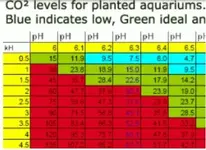
I'm sure you've seen the chart of CO2 concentrations for KH plotted against pH. There is more than one way to get 40 ppm CO2. You can adjust the KH with buffer to 4 degrees and set the CO2 delivery threshold to pH 6.5. Or you can set KH to 7 degrees and the CO2 to pH 6.7. Or KH = 2 and pH = 6.2, etc. Any function on this continuum will get you 40 ppm CO2. The buffer system maintains pH stability when CO2 is injected. A specific alkalinity will allow a specific pH for a specific quantity of CO2.
Yes I understand the charts. In my opinion many times they do more harm than good. There are other forces at play beside CO2 affecting pH. For instance when I kept a dKH of 2, I drove down pH to 5.75 via CO2 injection. The charts or calculators would say that is 107 ppm CO2. Is it really? I highly doubt it. Truth is when people say my CO2 concentration is 30 ppm, it's nothing more than a guess as to the absolute value. The only way to be sure would be to use expensive test equipment that actually measures CO2. Of course, one can argue that the absolute value is meaningless, it's the relative value that matters. This is true, but finding that optimum relative value means throwing out the charts and thinking outside the box a bit.

And the great beauty of a buffer system is that it prevents your pH from plunging in the middle of the day when CO2 is flowing
I'm not sure I understand this? When you say "plunge" do you mean to say a pH crash?

If so I would not agree. Much of the rest of the world has VERY soft source water. Folks inject CO2 daily all over the world with no "plunge" or pH crash. I know dozens of the best plant growers in the world who have very low to zero dKH and have VERY stable pH levels, both with and without CO2 injection. It's one of the reasons that Aquasoils are so popular, as they pretty much strip out all dKH and help create a low pH environment.

Those not using a pH controller are less familiar with the concept of the buffer system, and those having 0 dKH evidently tolerate pH swings that would give me the willies.
I think you are overcomplicating this a bit. It's not hard to reach a desired or optimum pH drop in any tank regardless of dKH. The key is understanding how to get a proper fully degassed reading of pH. Once you know that you can use a pH controller to set the desired pH drop via CO2. For instance in my tank my fully degassed is rock solid at 6.25. I use a pH controller to drop pH to 4.85 daily. No need for the willies, this is easy stuff that people do every day.

The Excel is to bump carbon availability.

I'm curious how much carbon do you believe Excel provides? You might be surprised that it's barely more than nothing. And it is fleeting. Just saying if you are injecting CO2 then Excel is nothing more than an algaecide. This is has been discussed in great detail over the years.

It's different from changing 24 gallons in one go but it virtually avoids sudden changes in composition. Just as does daily dosing instead of larger less frequent doses. SWCR is effective and super stable.
I completely agree that plants prefer a stable environment. But you can change large amounts of water and maintain that stability. You simply replace the nutrients that you remove after a large water change. That is what I do and my readings for nutrients (and TDS) are almost exactly the same any day that I test them. This would be referred to as front end loading and target dosing. This method is being used quite extensively and the entire idea is to promote nutrient stability. Just saying there are more than one way to think outside the box and create a stable environment.

I'm just indulging in a little thinking outside the box, so take it as you find it. We can have some informative discussions but in the end how you run your tank is on you.
I couldn't agree more. Thinking outside the box is how the hobby keeps advancing. And I have seen tanks run in wildly different fashions and demonstrate great success.

I really enjoy discussions like this as this is how the hobby progresses. And I have really enjoyed your contributions here describing your system. I hope you take the conversation in the spirit that it is being offered. In the end this is how we all learn and evolve.
 
Okay, but I don't want my pH to drop. This is what I refer to as a "plunge". I understand that this is done in accordance with known principles, deliberate, and well-conceived. As you say, it's done this way by dozens of people all over the world, many with professional interests. I do not disparage it, it's just that it lacks appeal for me. I ask again, what is the objection to elevated KH? I am not overcomplicating this. If anything I am simplifying it. I don't want my pH switching around, by accident OR by design. A sufficient buffering capacity prevents any pH change other than that being performed under the supervision of the controller, including movement away from the reference centerline. I need it explained to me why I should not want this?

The Chart: two things

1) Any value for CO2 concentration, whether tested directly or interpreted from the chart, is derivative. It is not necessary to know this value in order to run the planted tank. Making note of it is simply recording a mere point of interest, a scientific factoid. It is not information that is actually used.
2) The chart is based on empirical data. In perfect conditions, the values on the chart are accurate. The degree to which conditions are not perfect determines the deviation.

I get the point that a fully degassed sample will give a baseline pH value. Residual acidity is due to tannins and related polycyclic organic acids that occur naturally in the background chemistry. I expect to see it at least in trace amounts in any water that has supported biological activity, particularly with plants. In tinted water, intentionally dystrophic, this acid content will be high; then yes, this slews the chart data too much and the chart becomes unusable.

Accepting an approximation is not quite the same thing as a guess. You say it takes a test procedure beyond the reach of most hobbyists to test accurately for CO2, and anyone who says the CO2 in the tank is definitely any specific value is just guessing. That's a very broad-sweeping generalization. The chart gives no idea whatsoever of the ppm CO2? The chart is completely useless because it is not precise for any test in every aquarium all the time? It is stipulated that this is an approximation in every instance or we don't speak of ppm CO2 at all. That I can accept - I will so stipulate.

My only reason for bringing the chart into it was to explain how the buffer system figures into my methodology. It really isn't important to know the absolute value of ppm CO2 so we are not actually considering a point of material significance.

About Excel: I am aware of the controversy.

The methods you are using are working well for you. I prefer not to do big, big water changes and front-end load supplements. I have an alternative method here which appears to be working out, so I'll stick with it for awhile.
 
Okay, but I don't want my pH to drop. This is what I refer to as a "plunge".
Forgive me if I am just missing something.

You said your dKH is 6.5. That equates to a fully degassed pH of about 7.7 or so. And then with CO2 injection your pH drops to 6.75. Isn't that by definition a pH drop from CO2 injection?

I want to be clear I am not being argumentative, I just don't understand what you mean when you say you don't want your pH to drop. From everything you have posted your pH is dropping about a point from CO2 injection, correct?

And if so how is that different than a dKH of 2, with a degassed pH of 7.2, that drops the pH to 6.2 with CO2 injection? Is that different from a pH drop and considered a pH plunge?

Again I am just trying to figure out what you mean. Forgive me if I am dense and missing something completely.

Accepting an approximation is not quite the same thing as a guess. You say it takes a test procedure beyond the reach of most hobbyists to test accurately for CO2, and anyone who says the CO2 in the tank is definitely any specific value is just guessing. That's a very broad-sweeping generalization. The chart gives no idea whatsoever of the ppm CO2? The chart is completely useless because it is not precise for any test in every aquarium all the time? It is stipulated that this is an approximation in every instance or we don't speak of ppm CO2 at all. That I can accept - I will so stipulate.

If the chart says the best tanks in the world are at 100+ CO2 ppm and fish are alive, then it's little more than a guess. Sure it has some linear hints, but is well short of absolute values. So the problem is that people see the chart and say my CO2 is optimized. This is a fallacy that needs to be better understood. I can tell you there are many, many ways to get CO2 wrong. People get complacent because they see the chart and are confident their CO2 is maximized..........but they are wrong. This kind of misinformation holds back the hobby in many ways. Like you have said, think outside the box, and don't believe everything you read.
 
Last edited:
You said your dKH is 6.5. That equates to a fully degassed pH of about 7.7 or so. And then with CO2 injection your pH drops to 6.75. Isn't that by definition a pH drop from CO2 injection.
Yes and no. The normalized pH is 6.75. If the pH rises above 6.75 the CO2 turns on and the pH subsequently drops below 6.75, whereupon the CO2 turns off. The pH change through this process may be a few hundredths of a pH point due to transient effects such as injection overshoot coupled with motion times for detection at the probe. But the running average pH value in the system will be a solid 6.75. If at dKH 6.5 the CO2 does not turn on, the CO2 in the system will soon equilibrate and the pH will rise to 7.7 (or something very close) just as you observe. But this does not happen. The tank's pH does not return to 7.7. It stays at 6.75. Therefore, there is no drop in pH, ignoring transients. That is, the tank does not experience a change in pH away from its normalized centerline value. The pH controller dictates CO2 content by turning the CO2 delivery on and off, and I can program the pH threshold. By establishing a stable KH I am pre-determining the CO2 content. A theoretical numerical value for CO2 will result from this KH/pH relationship. The Chart will tell. This is a physical-chemical relationship and the chart data is empirically based. I am granting that certain practical issues can compromise its accuracy. But there must be a reference point somewhere and this endeavor is rife with uncertainties anyway. So this is a good place to start, and I'll concede that the CO2 value is an approximation. But the accuracy of the chart still is not the point. Whatever the true value, the KH/pH system is working to hold the CO2 content constant.

The pH in the Jungle is 6.75. It will be 6.75 throughout the night and all day tomorrow, and so on. It will be 6.75 until I change the program. I don't know where you are seeing that I am getting a drop of about 1 pH point. I didn't say that and I can't tell how you inferred it.
If the chart says the best tanks in the world are at 100+ CO2 ppm and fish are alive, then it's little more than a guess.
I have pondered this sentence for the better part of an hour and I don't know its meaning.
 
Last edited:
But the running average pH value in the system will be a solid 6.75. If at dKH 6.5 the CO2 does not turn on, the CO2 in the system will soon equilibrate and the pH will rise to 7.7 (or something very close) just as you observe. But this does not happen. The tank's pH does not return to 7.7. It stays at 6.75. Therefore, there is no drop in pH, ignoring transients. That is, the tank does not experience a change in pH away from its normalized centerline value. The pH controller dictates CO2 content by turning the CO2 delivery on and off, and I can program the pH threshold
OK now I get it. You are saying your pH is stable as it is a constant 1 point drop from fully degassed. So you are dropping pH via CO2 injection, you are just keeping it there constantly vs most people who only drop the pH via CO2 injection during the lighting period. Lots of debate on this topic over the years with no clean winner. Some run CO2 24/7, others run it during lighting period, I haven't seen any big difference but some swear by both methods.

I have pondered this sentence for the better part of an hour and I don't know its meaning.
Let's take the example of a 2 dKH tank. The fully degassed pH should be at about 7.2 at equilibrium with the atmosphere. It's common in high tech high light tanks for people to drop their pH as much as 1.4 with no harm to fish. If you look at the pH/dKH chart a tank with dKH of 2 and a pH drop to 5.8 is off the charts.

Untitled.webp

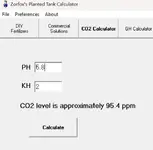
So instead of the charts we can use a calculator. You can see the calculator would indicate a CO2 concentration of 95 ppm. If that value is correct then no fish would survive. Yet people do it all the time. So my point is strictly following the charts often leads to people having poor CO2, which in turn makes every single other thing harder. I hope that makes sense.

Untitled2.webp
 
Much prefer calculator to table look-up. Rotala Butterfly has one also.

Yes, the controller operates continuously. It is fully automatic; there is no need to turn it off at night. The CO2 demand drops off of course, so the solenoid doesn't come on. It does occasionally come on in the dark because it is compensating for normal outgassing (and aeration). This is the advantage of set-and-forget CO2 management.

The other homeostatic parameter system in use is managing DO. The plants create over 100% O2 saturation (9 - 10 ppm) during the photoperiod. DO starts to fall off at lights-out and the O2 pushes down to 6 ppm whereupon Apex turns on the airpump, usually at about 02:00. The DO floor is programmable; right now I have it at 6 ppm. The aeration runs intermittently until about 08:00 when the plants take over again. Active aeration will tend to blow off CO2, so leaving the CO2 in automatic will keep pH stable overnight.

The high KH is calculated for a liberal target CO2 while keeping the desired pH. Turning CO2 on in the photoperiod, deliberately dropping by well over 1 point may work without doing harm (I wonder), and, again, I recognize the skill required for this, but it just seems primitive to me. For those operating with 0 KH, there is no buffer in there at all! This is flirting with pH instability, and that is why I say the idea of it gives me the willies. Daily pH fluctuations like this don't happen in rain forest primary streams (do they?), so no-to-low buffer is unnatural as well. It should be clear that I raise the KH as required so I can avoid pushing down pH. It is not necessary to accept a very low pH to hit target CO2 when it can be done by adjusting KH up, which is very easy to do. There is no downside to higher KH (until I get credible evidence to the contrary).

Full-auto operation provides true homeostasis. There is no improving on this.

About SeaChem Flourish Excel: I wanted to avoid having this talk until now because I foresaw us having other balls in the air. I know this "controversy" consisted essentially of thoughtful research unanimously critical versus no real counterargument of equal scientific scope. The only affirmative argument for use of this product is anecdotal. There are satisfied users, but no convincing evidence. I have been using it for at least four years, dosing according to label maximum. I had every intention of giving SeaChem a fair trial on the basis of their product description, and I felt the need to be convincing about this lack of bias before publishing my verdict. I have not seen any benefit, but I am now stopping it and will look for any sign of a follow-on effect. Honestly, I don't expect I'll resume using Excel except in the holding/quarantine tank where I keep Anubias with no CO2.
 
Turning CO2 on in the photoperiod, deliberately dropping by well over 1 point may work without doing harm (I wonder), and, again, I recognize the skill required for this, but it just seems primitive to me. For those operating with 0 KH, there is no buffer in there at all! This is flirting with pH instability, and that is why I say the idea of it gives me the willies.
I understand you are firm in your beliefs about low pH and are not likely to change them. And I know there are many out there who feel the same way. Here is a link to an article by my friend Xiaozhuang Wong you might find interesting. This not to try to change your mind but just to provide another point of view from someone who is very well regarded in the hobby.

Low pH Aquasoil Tanks

Honestly, I don't expect I'll resume using Excel except in the holding/quarantine tank where I keep Anubias with no CO2.
You are not alone. Myself and many others went down the Excel road over the years. Most have found that in a well run tank it makes absolutely no difference, and in some cases is detrimental to certain types of plants.
 
I have been giving some thought to simplifying the dosing system and rethinking the whole dosing strategy a bit. The current scheme goes back about five years in one form or another when I was using the PPS Pro dosing strategy. Separating the supplements and dosing them independently has been informative.

Getting feedback on this forum is timely. You guys have given me some things to ponder and I am encouraged to go ahead with some changes. This will begin a period of more experimentation and I'll keep it to myself until I arrive at some conclusions worth sharing.

Or until I need advice. Planthead hasn't gotten back to me, but I think he's right about supplement concentrations being too high. I don't know about 2 or 3 times too high, but I think I should attempt to be more conservative generally.

I ran some CO2 calculations using lower KH and pH inputs for 40 ppm CO2. I am not averse to trying out pH 6.62 and dKH 5.5 if only because I really don't believe the higher acidity will harm the biofilter or impair its efficiency significantly. Below this I will not go.
 
Or until I need advice. Planthead hasn't gotten back to me, but I think he's right about supplement concentrations being too high. I don't know about 2 or 3 times too high, but I think I should attempt to be more conservative generally.
I can't speak for @plantbrain (Tom Barr), but I would guess what he meant was that the species of plants you are growing are not nutrient hogs. That is those plants are mostly slow growers that can get by on pretty low dosing.

But as always there is only one way to find out. If you do start adjusting be sure to have lots of patience. It can take weeks/months to fully understand nutrient changes.

Good luck and keep up the updates coming. I am really looking forward to seeing where things go from here.
 
Well, gotta say...

It's early days yet on the lower pH experiment, so I will not say that anything has changed nor would I have expected to see any differences. But I am asking myself "Why am I doing this?" I have a connection to this aquarium, as probably many of us do, that is intuitive and highly subjective. So it's probably just a completely psychological reaction, a reluctance to depart from the ways to which I have become accustomed, but it can't be helped. Having no compelling reason to pursue this further, I have returned to the high-buffer strategy. I will, however, be looking to keep dKH closer to 6. If potassium's new normal comes in around 30 ppm as a result, that would be okay.

I have indicated that a few topics remain to be discussed. If I am to continue here, I suppose I'd better get to it. This spring I am making big changes to the entire circulatory system. The pump, filters, temp control, and CO2 injection are relevant and should be properly described as a matter of record. The arrangement in use now has been in place and served very well in its present configuration for six years. It is pointless to give details now because this will all change as soon as I can make it happen. I have learned how to make it much simpler, easier to service, and more efficient. I will document this build here.

The lighting system is being updated and there is more work to be done. So I defer on this as well, but not for much longer.

Now about my algae problem. The primary cause of this was an attempt to maintain strict oligotrophy, particularly non-zero nitrate. Trying to determine the adequacy of the contribution of environmental metabolism alone - primarily feeding of fish - the plants were nitrogen limited for quite some time; the SWCR removed autochthonous NO3. This was made manifest by a halt in growth despite the abundance of carbon, followed by onset of nuisance algae. That, I think, was exacerbated by the repeated spikes in DOM due to episodic overfeeding. The SWCR, then at 24 ODEs per day, was rigidly holding the dilution rate. NO3 supplement was used sparingly just to assure non-zero concentration. The SWCR in connection with auto-dosing works to obtain any concentration of nearly anything. An adjustment in the ODE and dosing pump schedules can result in practically any set of solute values desired.

This experiment ended when I suspected nitrogen limitation. There is no such thing as a low-nutrient planted aquarium. I proved this by increasing Ca(NO3)2 / KNO3. After two weeks of NO3 at 10 ppm or better, the plants sprang back to life and much of the algae present spontaneously abated. Pulling up the NO3 was what mattered. PO4 and micros were unchanged. GH, KH and pH were unchanged. Only NO3. So I am able to say from this experiment that this jungle aquarium will not thrive in oligotrophy; it must be mesotrophic. Risk of algal infestation is at least as high in oligotrophy as it would be in eutrophy. Again, the key to success is keeping the plants growing.

The tank has been in mesotrophy now for over a month. The photos earlier in this thread show the plants doing well I think, and I continue to see improvement. Today I have returned to 24 ODEs per day and I will be calibrating NO3 supplementation to maintain between 10 and 20 ppm. The algae on the hardscape and the top surface of the gravel is old and dormant and appears to be slowly fading away. I have no immediate plans regarding this as I really don't want to move those rocks, whereas I ordinarily would do a bleach soak. As long as the hardscape has a natural look its appearance is not objectionable to me. I think it will be interesting to see how the bacteria and fungi in this ecosystem work on this residual algae over time.
 
There is no such thing as a low-nutrient planted aquarium. I proved this by increasing Ca(NO3)2 / KNO3. After two weeks of NO3 at 10 ppm or better, the plants sprang back to life and much of the algae present spontaneously abated
Nice update and agreed.

Weak underfed plants = algae.

For many people the first instinct when they see algae to is to "starve" it. That is impossible. Then usually it just gets worse. Healthy growing plants are easily the best defense.

Over the years I have seen more problems from people under dosing than from underdosing, that is for sure.
 
Lighting system update completed. Tank day is equatorial and has no seasonal variations. Tank time lags real time by two hours to suit my personal schedule. These drawings describe the whole system.

The Kessil A360WE LED lights were the first changes made when the old strip lights came out. Kessil discontinued this model, but this was my first experience with point source lighting and I was immediately impressed with the shimmer effect. So I continued the project with their A80 lights. The Kessils are Tuna Suns for planted freshwater. They have brightness and spectrum controls. All spectra are adjusted for 6000 Kelvin, the longest wavelength available from the LEDs, and their controls removed from the Apex dashboard. The brightness controls set the illumination curves through the day. SUN1 is the main high light assembly of nine A80 LEDS. Their ON-OFF point is at 10% power. SUN2 is the mid-day supplementation by three A360WE LEDs. Their ON-OFF point is at 30% power. The A80s are thus far superior with respect to the ramping range, but 10% is still pretty sudden. I am using six small 12 V LED strips for DAWN and DUSK to smooth this out.

The number of lights used are to improve the spread more than to pile on brightness. The physical constraint of limited overhead height prevents elevating the light cones to a more ideal distance, possibly two or three more inches. All else being equal there would be an increase in intensity per unit area, but this is compensated by the brightness controls barely exceeding 50% for only four hours per day. I had some expectation that the additional point sources would have the cumulative effect of washing out the shimmer, but this proved not to be the case. The dappling is more affected by shading from the large leaf plants.

1insfb9l.jpg
zvmDtzNl.jpg

bzYySqel.jpg


PqszXSnl.png

7EqHNq0l.png
 
Today's numbers

pH: 6.74
TDS: 310 ppm
NO3: 18 ppm
PO4: 2.50 ppm
K: 40 ppm
Fe: 0.11 ppm
dGH: 3.6
Ca: 17.6 ppm
Mg: 4.9 ppm
Ca/Mg: 3.6
dKH: 5.9
CO2: 32 ppm

I have done a full battery of tests every morning since 12/18 to monitor adjustments in the dosing schedule. Potassium is tested weekly. These values have been highly stable for the last two weeks. Holding dKH at 6, CO2 remains above 30 ppm and plants are doing fine. The illumination cycle for the last seven days plotted with DO shows carbon fixation proceeding apace, as the daily O2 saturation indicates. At my elevation, 100% saturation is 8 ppm. Daytime energy peak input averages 250 watts.

With all the N : P : K limits off, and the new lighting installed, growth is noticeably stimulated and appearance of new algae is suppressed. In the last post I laid down the pertinent info on the lighting system but neglected to include photos. Not that it's particularly important, but just for the record I present them here.
xB4OLqo.png

mgqalW7.jpg

XauShCM.jpg
 

Top 10 Trending Threads

Back
Top