
Welcome to ScapeCrunch
We are ScapeCrunch, the place where planted aquarium hobbyists come to build relationships and support each other. When you're tired of doom scrolling, you've found your home here.
Social Feed

Staff member
I Donated 2026
Founding Member
Question of the Day Nitrifying bacteria are undesirable in a planted aquarium
This is a topic that is currently being discussed in the reefing world. I think it is interesting in the freshwater planted aquarium world also.
Randy Holmes-Farley says the following. I've made a change from reefing to planted aquariums.
What do you think? Should we have smaller filters?
Randy Holmes-Farley says the following. I've made a change from reefing to planted aquariums.
What do you think? Should we have smaller filters?
24 Replies
·
5243 views
Staff member
I Donated 2026
Founding Member
There is A LOT of history to this that is tied to some of the biggest names in the hobby's past. I tried to get them into the USA with Clause Christensen back in the 90s but no-go.
This would be big news for US hobbyists as availability of healthy, aquarium-ready plants is THE limiting factor in expanding the hobby in the USA.
31 Replies
·
954 views


Staff member
I Donated 2026
Founding Member
Hello Welcome, Jacob D'angelo
Welcome to ScapeCrunch, @Jacob D'angelo!
We would love to get to know you. Please tell us about yourself. What tank do you have?
We would love to get to know you. Please tell us about yourself. What tank do you have?
0 Replies
·
8 views
Staff member
I Donated 2026
Founding Member

This is A River... Somewhere, the amazing IAPLC 2025 Grand Prize winning work of Josh Sim. I think this is a wonderful aquascape to use to start the Learning From Series. I hope you would agree.
The Learning From Series
I have no talent when it comes to aquascaping. If I'm honest, this is also true for almost all forms of art.... So, I am in awe of people like Josh, our friend @Jeff Miotke and @Naturescapes_Rocco, along with many others that we are privileged to count among our community. I am also so thankful that they have the talent and choose to share it with the rest of us.
The reality is that although I can't create these works of art, I can certainly appreciate them. My talents lie more in keen observation, critical thinking and curiosity. You know, stuff that will never make me a millionaire but that do come in handy when you're trying to learn something new.
As I'm in the back nine of life, I've decided that I want to take some time to appreciate and learn from aquascaping artists such as Josh. Thus, the idea for this series was born. I'm calling it the Learning From Series because that's exactly what it is. And, I'll be documenting my thought process and learnings here as a series of articles.
We are a community and sharing is part of the fun. So, I do hope you jump in and participate even if it's to tell me that I've completely missed something important. Maybe we learn together.
Finally, given that I have a day job (unfortunately, it's quite inconvenient when I'm trying to spend most of my time here), these articles will likely come in pieces. My MO is deconstructing the aquascape so that I can understand it. I'm a savor the wine type of guy rather than chug the beer.
Initial impressions of A River... Somewhere
This aquascape is multifaceted. It hits me with a lot of first impressions.
It's so real, almost biotopy. Yet, it is perfect. A lot to digest. For now though, dinner is calling. More tomorrow.
-- Update September 18, 2026
Observations continued
Amano used to say that the plants were the paint in an aquascape. I usually try to step back from the details and look at the forest, if you will. I focus on just color. This aquascape is very strongly skewed towards green. The green mostly rests on dark wood tones and black shades.
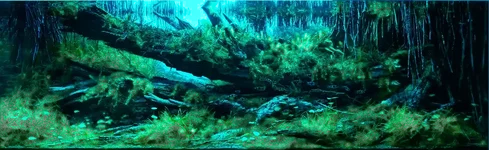
In this image above, I've blurred slightly and then punched up the greens to make them more obvious. Green is about 75% of the color, would you say?
This makes me think about focal point. Usually we are told to have a focal point in our aquascapes and this should be made quite obvious through the use of a pop of color (usually red) and/or different leaf texture or style of plant. Do you see that here?
Also, thinking compositionally again, the use of a "vanishing point" is also highly recommended. Do you see one here? I'm struggling to find it. There is certainly depth here making it seem like the river continues well beyond this image. But, how does Josh accomplish this without an obvious vanishing point?
I think his expert use of very clear foreground items versus smaller, blurred background items gives the impression of depth without needing a vanish point. This tricks our minds into thinking the things in the background a far away. This, it seems, is where details matter.
Another observation is just how natural this looks. I can truly believe that this could be a scene in "some river... somewhere." The downed tree rests very naturally and appears naturally weathered. Has a natural patina created by skillful trimming of moss and plants. Notice that the moss is not an even carpet of green. It's different shades and textures.
Nature doesn't create golf courses of green. Nature is wabi-sabi and does not favor only one species.
The hanging roots on either side also pull on my attention and constantly fight to pull me away from the center of the aquascape. There are more on the right side than on the left. Why is that? I think it will be more obvious when we analyze the composition.
Finally, what would you say is more dominant in this aquascape, if anything? Is this more plant-focused or hardscape-focused?
I will have more thoughts as I continue to deconstruct this wonderful aquascape in my mind. Again, this is really an intentional stream of consciousness, folks. And please don't misinterpret my breakdown as any sort of criticism. This is how I learn, by peeling the onion one layer at a time.
More tomorrow. Composition is next.
-- Update September 21, 2026
Composition
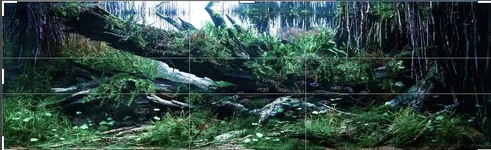
Here is the famous "golden ratio" superimposed onto the aquascape. Here are some of my initial thoughts but would love to hear what you see as well.
The idea of the golden ratio is to help you position focal points in a place that makes the overall composition seem more natural and pleasing. As you can see on the right side, the vertical line falls right on the pinky grouping of plants in the background. Interestingly, the fish grouping is also on that line. Do you think he did it on purpose?
You can also see balance by using the golden ratio. Here, the right 2/3 is definitely "fuller" or "heavy" compared to the left 1/3. I would say this aquascape is therefore "heavier" on the right side and "lighter" on the left. However, if I recall my "Amano", empty space is not necessarily lighter. Empty space can balance as much, if not more, than a completely planted area. Would you agree?
In this case, the left "emptier" side not only provides that needed empty space (called "Ma" in Japanese), but it also serves to create depth. You can see here how Josh uses the empty space to show those plants in the background that give that impression of a long distance behind the fallen tree.
Speaking of that fallen tree, it is drawing a diagonal across the entire aquascape. This creates a lower and higher triangle and again, one side is balancing the other well. Again, one is emptier with the other fuller.
Triangles are actually pleasing to our brains as it subconsciously provides a sense of order. It offers a subtle pattern that makes us comfortable. Do you think Josh knows this and has positioned that tree just so?
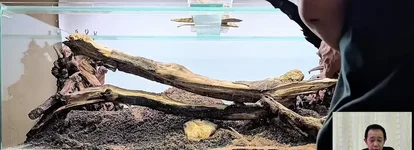
When you look at how Josh put this together, see the video linked in the posts below, it's amazing and should give you and me some hope that we too can eventually end up with something that looks great. It's hard to believe he went from the above to the final aquascape.
So, for me, the composition is the bones of the aquascape. I am trying hard to find a vanishing point and I don't see it still. I am learning that maybe this is not a requirement.
Next I will cover impressions which is really what aquascaping, and art, is about.
-- Update September 22, 2026
I probably should have started with this but better late than never. Let's talk about the impression A River... Somewhere gives you. How does it make you feel?
At the end of the day, all art should speak to its viewer. It should have something to say and evoke in the viewer a feeling. That is the goal. You are conveying something similar to telling a story.
Let's look at A River... Somewhere and just take some deep breaths and ponder what you are seeing.

To me, this aquascape conveys a very strong story. It conveys peace, impermanence, imperfection, transcendence, nature, the passing of time. I can go on an on, like peeling an onion, the more you look, the more you see.
It feels so natural, like this could really be a river somewhere in nature. Idyllic, sure, but possible. Disbelief is suspended. I can almost smell the forest.
At a deeper level, I do get that same awe feeling I get when I'm in nature. Amano used to refer to it as our souls longing for nature. BTW, if you've never read The Nature Aquarium Book 1, the descriptions are worth the price of the book.
In the end, I think Josh is a master aquascaper with a special talent for creating an idealized version of nature and capturing its very real essence. Very deserving of its ranking and I'm in awe of such talent and hard work.
Now... let's talk about our own aquariums...
Sorry, that feels like a cold bucket of water hitting you. At least for me.
Does your aquarium tell a story and inspire a feeling when you are looking at it? Does its bones (the hardscape) build an intentional composition using perspective, the golden ratio, strong focal points that work well with the overall scene?
Alas, mine most certainly does not. However, rather than lamenting it, I am inspired because it gives me a reason to re-do it. I will use more intention and the lessons gained from this little exercise. Improvement is what I'm after, not the Grand Prize at the IAPLC.
I hope you learned a nugget or two from my ramblings. At the very least, I hope you enjoyed reading along.
I'm off to find the next aquascape that I can deconstruct in the Learning From Series.
All the best, Art
10 Replies
·
310 views

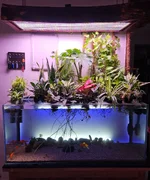
This is my goldfish tank. I usually do a 50–60% water change once a month, but not because NO3, PO4, etc. become an issue.
Even after 4 weeks, NO3 is usually around 5–6 ppm and PO4 around 0.2–0.4 ppm.
The main reason I settled on doing water changes once a month was that, at around the 4-week mark, I would usually start seeing some brown diatom algae and green dust algae.
I dose ferts daily in this tank—macros in the morning and micros in the evening.
My weekly dosing is roughly:
Now, I understand that water changes aren't just about NO3 and PO4. They also help dilute/remove DOCs, hormones and other things that may accumulate over time. but i think DOCs cause diatom algae hence the appearance of diatom would mean ( for me) water change
So I basically have two questions:
1. Is there any practical way to measure DOCs in aquarium water?
If there is, I’m thinking that might give me a better idea of when the tank actually needs a water change rather than just following a fixed schedule.
2. Could I realistically stretch my water changes to once every 2 months or so?
It’s only 4 goldfish, around 3–4 inches each, in roughly 300 L of water. Nutrients don’t seem to be building up, and the tank seems perfectly fine even after 6 weeks.
What do you guys reckon? Would you be comfortable running it for 2 months between water changes?
Even after 4 weeks, NO3 is usually around 5–6 ppm and PO4 around 0.2–0.4 ppm.
The main reason I settled on doing water changes once a month was that, at around the 4-week mark, I would usually start seeing some brown diatom algae and green dust algae.
I dose ferts daily in this tank—macros in the morning and micros in the evening.
My weekly dosing is roughly:
- NO3: 8 ppm
- PO4: 2.8 ppm
- K: 40 ppm
- Fe: 0.17 ppm
- Ca: 30 ppm
- Mg: 10 ppm
- pH: around 7.6–7.7
- KH: 3 dKH
Now, I understand that water changes aren't just about NO3 and PO4. They also help dilute/remove DOCs, hormones and other things that may accumulate over time. but i think DOCs cause diatom algae hence the appearance of diatom would mean ( for me) water change
So I basically have two questions:
1. Is there any practical way to measure DOCs in aquarium water?
If there is, I’m thinking that might give me a better idea of when the tank actually needs a water change rather than just following a fixed schedule.
2. Could I realistically stretch my water changes to once every 2 months or so?
It’s only 4 goldfish, around 3–4 inches each, in roughly 300 L of water. Nutrients don’t seem to be building up, and the tank seems perfectly fine even after 6 weeks.
What do you guys reckon? Would you be comfortable running it for 2 months between water changes?
3 Replies
·
60 views

Supporting
I Donated 2026
Rockstar
Plant Nymphoides sp. Taiwan

CO2 injected 1.4 pH drop (50 ppm per Hanna test)
Light 50-60 par at substrate
PPS-pro ferts for high tech tanks
50% water change weekly
8 dgH
0-1 dkH
14 Replies
·
941 views

Supporting
I Donated 2026
Rockstar
I was thinking about getting a DOOA Cell to go along with the DOOA Shizuku I'll be making at Aquashella. Does anyone have one of these? If so, what do you think? Is it worth the cost. I was thinking about placing it on one side of my TV and the Shizuku on the other (bumping the still empty fish bowl out of that spot). Then I would also have to decide on a base color: clear, amber, or emerald.
2 Replies
·
51 views

Sounds like a joke question but for reasons unknown I cant get moss to grow period, Got a huge baseball of moss for free from shrimp breeder. I put some in 5g shrimp tank, low light no heater around 74 its dead. 3 other tanks 76 degree low to medium light its all dead or looks dead its grey color I'd say it's dead. water parms are pretty spot on no big shifts or other plants would have issues imo.
what do I need to do to grow java moss ? grew it for years no issues would take over now im lost! I can grow anything but moss?
what do I need to do to grow java moss
? grew it for years no issues would take over now im lost! I can grow anything but moss?
5 Replies
·
191 views

About me:
I've been keeping planted aquariums and shrimp breeding tanks for almost a decade and for the majority of that time aquariums were my primary hobby. In 2021 I had ~30 tanks running simultaneously containing almost 200 types of plants that I had collected over a 5 year period and more than a dozen types of shrimp. In this time, it was harder for me to not setup new tanks than it was to grow any aquatic plant sent my way. Below are some of the tanks I've kept over the years.


At the end of 2021 I moved from Texas to Massachusetts and gave away all of my plants, tanks, and shrimp to friends I had made over the years. It took some time to find a permanent place to live so I didn't have any tanks until I was unexpectedly given an ADA 120P in summer of 2023.
The early days of the 120P:
I went through the typical tank start growing pains with a diatoms phase, green hair algae, and every other issue one would expect from a new tank. Even with the new tank difficulties, it only took me 2 months to get to a healthy tank again. For the next 1.5 years, everything went smoothly and the tank went through many iterations.

Setup on June 28th

Diatoms outbreak on July 19th

Green hair algae outbreak by August 18th

Everything was cleaned up and growing great by September 1st
The start of the disaster:
In February 2025, I started running into issues. BBA started growing in small tufts on the substrate and green hair algae started attacking the old growth on the plants. I'd run into this issue in the past and was usually able to fix it pretty quickly by dialing in the CO2, cleaning the substrate, cleaning filters, and replanting only the most healthy tops of the plants. Even after doing this multiple times, I haven't had any luck fixing the algae. It always comes back


The start of the algae

Multiple trim and replant cycles along with some new plants

Relatively clean after a trim and replant cycle

10 days later
Where I am today:
I'm getting so frustrated by the persistent issues that I'm about ready to shut down this tank. As a last ditch effort, I purchased a pack of healthy plants from Burr740 to see if healthy plants can help me get through the algae phase and get back into a good place.

The tank as of January 2nd 2026. The healthiest plants in the tank were received earlier this week from Burr740.

Really poor color on my plants with a lot of green algae on the lower leaves. The nice looking bacopa is from Burr740. The original stems of Bacopa have barely grown in the last month. If I pull them up, there are very few roots.

Another example of the old growth issues. The Limnophila mini vietnam also has not grown at all in the last month. Lots of algae grows on the substrate as well.

Another comparison of Burr's Ludwigia sp. red vs mine. Very slow growth and poor rooting.

Really weak older growth on Rotala sp. singapore and poor coloration compared to Burr's plants. This plant has always been very easy for me to keep and this is part of why I'm thinking there is something big that I'm missing. Didiplis diandra is another easy plant that keeps melting at the base and its making very little progress because of this.
Below is the key information about the tank.
Tank size: ADA 120P (120 cm x 45 cm x 45 cm)
Lighting: 3x NiloCG Prizms ran at the lowest setting for each channel. Lights are on for 7 hours a day. I want to increase the lighting, but any time I do the algae gets significantly worse
Filtration: Oase Biomaster 600 and a SunSun HW-303B. There's a spraybar on the bottom left that points along the length of the tank at substrate level and the other output is on the top right corner of the tank pushing the opposite direction.
CO2: Vertical reactor on the SunSun filter and a Sera reactor on the Oase. CO2 comes on 4 hours before lights on and turns off 1 hr before lights off. Drop checker is yellow when lights turn on. The pH drop is ~1.4-1.5 at lights on (5.8 at lights on and 7.3 when water is fully degassed). Plants start pearling within 10 minutes of the lights coming on.
Substrate: A mix of ADA aquasoil, Fluval stratum, and Controsoil. A bag of Controsoil was added ~2 months ago to try and give the plants a boost. The remaining substrate is from when I setup the tank and is almost certainly not providing much nutrition or buffering capacity.
Water change schedule: Weekly 70-80% water changes with tap water coming from the MWRA (water report here). KH is ~2. GH is less than 1(3.7 PPM Ca, 0.7 PPM Mg based on the report). Water is treated with sodium carbonate at the water treatment plant to increase the pH to ~9.2, but the pH rapidly decreases after the water comes out of the tap. One potential issue is the tap water is extremely cold. It comes out at ~50F and I add a mix of water from the tap along with heated water. The temperature drops to ~60F for 2-3 hours whenever I water change. I don't keep any livestock so I'm not sure if this is a problem. This was not something I needed to consider back in Texas.
Remineralization: I add 22 PPM calcium and 6 PPM magnesium at water change
Fertilization: 20N-6P-26K is added immediately after water change. A second dose at 10N-3P-13K is added halfway through the week. Micros are Burr740's most recent recipe dosed at 0.15 PPM Fe 3x per week.
Temperature: Tank is heated to 73F during the winter. During the more mild parts of the year I remove the heater and go with whatever the ambient temperature is.
It looks like I'm doing everything right on paper and based on my past experience keeping tanks, but there is clearly some major issue ongoing. Right now I'm thinking its inconsistency in the CO2 that I'm just not seeing (I just started the CO2 2 hours earlier last week because I was noticing the drop checker wasn't always yellow at lights on), not enough light, or too cold of water during water changes. I want to keep some records through this journal to keep myself engaged with the tank and to make sure I'm being consistent with everything. I'm also hoping some additional eyes can help me see where I'm going wrong because I really, really miss having a nice looking tank.
I've been keeping planted aquariums and shrimp breeding tanks for almost a decade and for the majority of that time aquariums were my primary hobby. In 2021 I had ~30 tanks running simultaneously containing almost 200 types of plants that I had collected over a 5 year period and more than a dozen types of shrimp. In this time, it was harder for me to not setup new tanks than it was to grow any aquatic plant sent my way. Below are some of the tanks I've kept over the years.
At the end of 2021 I moved from Texas to Massachusetts and gave away all of my plants, tanks, and shrimp to friends I had made over the years. It took some time to find a permanent place to live so I didn't have any tanks until I was unexpectedly given an ADA 120P in summer of 2023.
The early days of the 120P:
I went through the typical tank start growing pains with a diatoms phase, green hair algae, and every other issue one would expect from a new tank. Even with the new tank difficulties, it only took me 2 months to get to a healthy tank again. For the next 1.5 years, everything went smoothly and the tank went through many iterations.
Setup on June 28th
Diatoms outbreak on July 19th
Green hair algae outbreak by August 18th
Everything was cleaned up and growing great by September 1st
The start of the disaster:
In February 2025, I started running into issues. BBA started growing in small tufts on the substrate and green hair algae started attacking the old growth on the plants. I'd run into this issue in the past and was usually able to fix it pretty quickly by dialing in the CO2, cleaning the substrate, cleaning filters, and replanting only the most healthy tops of the plants. Even after doing this multiple times, I haven't had any luck fixing the algae. It always comes back
The start of the algae
Multiple trim and replant cycles along with some new plants
Relatively clean after a trim and replant cycle
10 days later
Where I am today:
I'm getting so frustrated by the persistent issues that I'm about ready to shut down this tank. As a last ditch effort, I purchased a pack of healthy plants from Burr740 to see if healthy plants can help me get through the algae phase and get back into a good place.
The tank as of January 2nd 2026. The healthiest plants in the tank were received earlier this week from Burr740.
Really poor color on my plants with a lot of green algae on the lower leaves. The nice looking bacopa is from Burr740. The original stems of Bacopa have barely grown in the last month. If I pull them up, there are very few roots.
Another example of the old growth issues. The Limnophila mini vietnam also has not grown at all in the last month. Lots of algae grows on the substrate as well.
Another comparison of Burr's Ludwigia sp. red vs mine. Very slow growth and poor rooting.
Really weak older growth on Rotala sp. singapore and poor coloration compared to Burr's plants. This plant has always been very easy for me to keep and this is part of why I'm thinking there is something big that I'm missing. Didiplis diandra is another easy plant that keeps melting at the base and its making very little progress because of this.
Below is the key information about the tank.
Tank size: ADA 120P (120 cm x 45 cm x 45 cm)
Lighting: 3x NiloCG Prizms ran at the lowest setting for each channel. Lights are on for 7 hours a day. I want to increase the lighting, but any time I do the algae gets significantly worse
Filtration: Oase Biomaster 600 and a SunSun HW-303B. There's a spraybar on the bottom left that points along the length of the tank at substrate level and the other output is on the top right corner of the tank pushing the opposite direction.
CO2: Vertical reactor on the SunSun filter and a Sera reactor on the Oase. CO2 comes on 4 hours before lights on and turns off 1 hr before lights off. Drop checker is yellow when lights turn on. The pH drop is ~1.4-1.5 at lights on (5.8 at lights on and 7.3 when water is fully degassed). Plants start pearling within 10 minutes of the lights coming on.
Substrate: A mix of ADA aquasoil, Fluval stratum, and Controsoil. A bag of Controsoil was added ~2 months ago to try and give the plants a boost. The remaining substrate is from when I setup the tank and is almost certainly not providing much nutrition or buffering capacity.
Water change schedule: Weekly 70-80% water changes with tap water coming from the MWRA (water report here). KH is ~2. GH is less than 1(3.7 PPM Ca, 0.7 PPM Mg based on the report). Water is treated with sodium carbonate at the water treatment plant to increase the pH to ~9.2, but the pH rapidly decreases after the water comes out of the tap. One potential issue is the tap water is extremely cold. It comes out at ~50F and I add a mix of water from the tap along with heated water. The temperature drops to ~60F for 2-3 hours whenever I water change. I don't keep any livestock so I'm not sure if this is a problem. This was not something I needed to consider back in Texas.
Remineralization: I add 22 PPM calcium and 6 PPM magnesium at water change
Fertilization: 20N-6P-26K is added immediately after water change. A second dose at 10N-3P-13K is added halfway through the week. Micros are Burr740's most recent recipe dosed at 0.15 PPM Fe 3x per week.
Temperature: Tank is heated to 73F during the winter. During the more mild parts of the year I remove the heater and go with whatever the ambient temperature is.
It looks like I'm doing everything right on paper and based on my past experience keeping tanks, but there is clearly some major issue ongoing. Right now I'm thinking its inconsistency in the CO2 that I'm just not seeing (I just started the CO2 2 hours earlier last week because I was noticing the drop checker wasn't always yellow at lights on), not enough light, or too cold of water during water changes. I want to keep some records through this journal to keep myself engaged with the tank and to make sure I'm being consistent with everything. I'm also hoping some additional eyes can help me see where I'm going wrong because I really, really miss having a nice looking tank.
118 Replies
·
11863 views

Considering stand/cabinet options for the 90x60x40cm Miotke 57 gallon tank from Hydra Aquatics. Other than the Hydra Pro Series cabinet that is matched to this tank, what are options that accommodate the 60cm depth of this tank? It doesn't appear that any of the Archaea cabinets are that deep.
@Jeff Miotke What is the piece of furniture that you are using as a stand for this tank in your fish room?
@Jeff Miotke What is the piece of furniture that you are using as a stand for this tank in your fish room?
3 Replies
·
63 views
Staff member
I Donated 2026
Founding Member
Hello Welcome, Shrimplover23
Welcome to ScapeCrunch, @Shrimplover23!
We would love to get to know you. Please tell us about yourself. What tank do you have?
We would love to get to know you. Please tell us about yourself. What tank do you have?
0 Replies
·
17 views