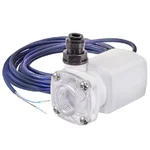
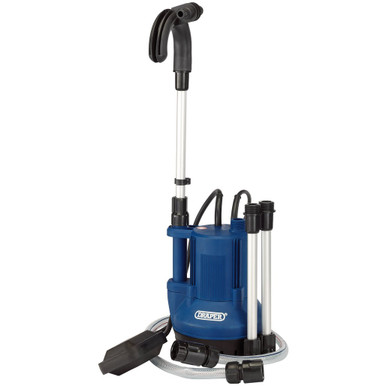
One thing to consider when looking at pumps. If you need to raise water 20 feet, you really do want a pump with more than 21 feet of head. A pump with 21 feet of head at 20 feet is going to have rather anemic flow.
Pumps will have a flow head curve. As the height you are requiring a pump to lift water increases the available flow if water falls off significantly…

Here we have pump head/ flow charts for various Taco circulators. The Taco 007 is probably the most commonly used circulator has a head of just under 10 feet. But if we look at 9 feet of head It flows at around 4 gallons per minute…. At 8 feet of head it flows 8 gpm, at 7 feet of head about 12 gpm.
One of the attractioons to the 007 is the relatively flat output of the curve as opposedto a steeper curve where flow drops off steeper with height.
Also, bear in mind that feet of head, or head loss does not only reflect height from water level in the feed tank when full…. Ie as your storage tank is pumped out of the holding tank your head you are pumping from will increase. Ie if it is a 33 gallon brute trash can in the basement and the waterline is 20 feet below where te outlet is, by the time you get near the bottom of the barrel you have added nearly 3 feet of head.
Head loss is also imposed by frictional losses for the length if the pipe and any fittings..
For example loss is typically given as so much reduction per 100 feet of pipe. A single fight angle fitting is the equivalent of adding 3 feet of tubing. 6 right angle fittings is the equivalent of 18 feet of tubing. Increasing tubing diameter significantly reduces frictional losses per 100 feet…
As a practical case in point I have an aquarium near floor height and drain it with a python into the bathtub. When the tank is full, the flow into the tub is fine. But as the water level gets within 8 inches of the level of the bathtub the flow drops to a trickle.
So your piping also increases the fuctional head loss you are trying to pump from.
Long and short if it you may well want a pump with more head capacity than 21 feet.
Looking at the specific pump you referenced, it does not have 21 feet of head. It actually has 20 feet 4 inches of head.
Reading the documentation it does not have a pump curve chart but states:
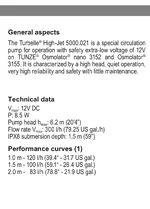
80 gph at 0 head, 21.9 gph at 78.8”.
How many gallons per hour flow do you think it is going to see at 20 feet of head?
Even 21 gallons per hour seems ridiculously low for refilling a tank. How many hours will you want to wait to refill 40 gallons of water in a 75 gallon aquarium?
This really highlights the incredible shortcomings of Artificial Large Language models. Chat GPT reccomended a pump that would be hopelessly under performing for your application. It simply recognized your input of 20 feet and chose a pump with feet of head just over 20 feet with absolutely no understanding of how feet of head impacts flow rates…
I will take real intelligence over artificial intelligence…
Would you rather have real coffee or coffee substitute? Postum anyone? Made from burnt wheat….?
Now is there really 20 feet from basement to tank on first floor?
Basements very typically are only 7 feet from floor to bottom of floor joists.. ad another for floor joists and flooring, then add maybe 5 fert to top of aquarium typically, my gut feeling is closer to 13 feet typically.. factor another 2 feet for plumbing frictional losses. 15 feet seems closer to the mark to me assuming the storage tanks being pumped from are pretty close to under your aquarium…