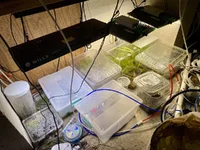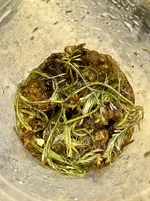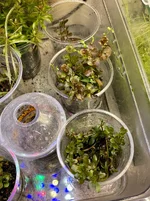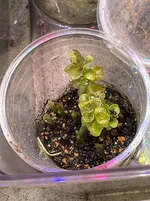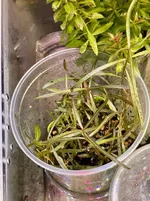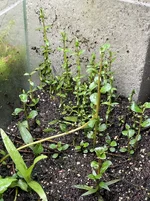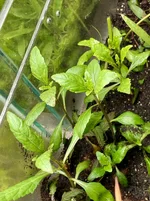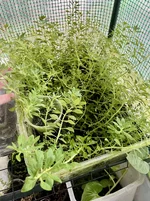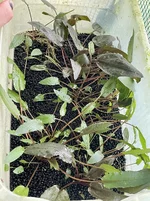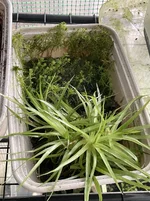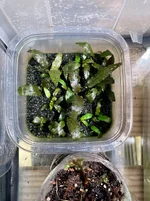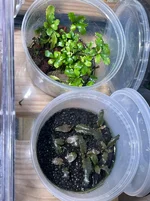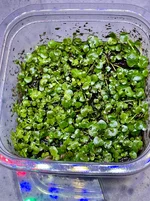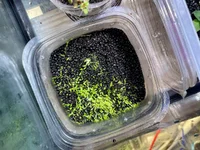


Since the tanks have been in such a state of disarray, I’ve been focusing on moving everything to emersed until life sorts itself out.
How I transition from submersed to emersed depends on the growth form of the plant.
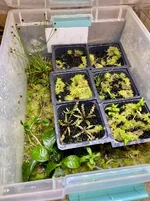
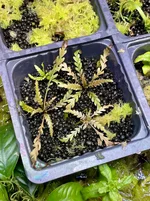
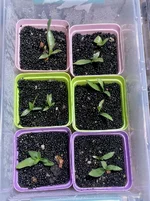
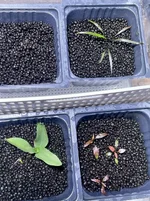
Plants that are primarily basal form (not stems) go in square nursery pots with one of two substrates. First choice is long fiber sphagnum (dried and then rehydrated) topped with aquasoil, straight aquasoil, or a mix of peat moss/perlite/coco coir/aquasoil. The sphagnum wicks better than aquasoil. Alternatively, I use straight aquasoil, I line the bottom of the pots with a coffee filter to keep the substrate from falling through. Both work equally well. The bin needs to be filled with a little more water than if dried sphagnum is used which is why the first method is preferable.
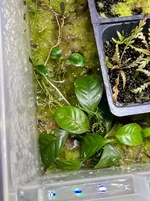
The nursery pots are kept in a clear plastic container. Sterilite are the typical go-to, but I actually prefer the tall clear shoe boxes from Walmart. They have built in ventilation holes which is handy because I need to drill holes in the sides of any other container near the lid rim. Ventilation is key.
The shoe boxes are cheap too. I fill the bins as much as possible but a little leftover space is okay.
After filling the bins with pots, I fill all the voids with live sphagnum and fill with enough distilled water to saturate the sphagnum. The sphagnum has antimicrobial properties (so I’ve read, and it seems to check out in practice). This keeps the water from developing algae almost entirely. I dress the tops with live sphagnum too if something needs a little help rooting. Depending on the space, I throw rhizome plants right into the sphagnum as well. They develop excellent root systems and are very easily removed and cleaned when needed compared to conventional soil.
I fertilize everything with a foliar spray of Maxsea 16-16-16 diluted to 1 teaspoon per gallon. It’s a kelp based fertilizer with micronutrients. I highly recommend it.
I’ll follow up with emersed stem plant propogation and other methods for the full greenhouse.
How I transition from submersed to emersed depends on the growth form of the plant.
Plants that are primarily basal form (not stems) go in square nursery pots with one of two substrates. First choice is long fiber sphagnum (dried and then rehydrated) topped with aquasoil, straight aquasoil, or a mix of peat moss/perlite/coco coir/aquasoil. The sphagnum wicks better than aquasoil. Alternatively, I use straight aquasoil, I line the bottom of the pots with a coffee filter to keep the substrate from falling through. Both work equally well. The bin needs to be filled with a little more water than if dried sphagnum is used which is why the first method is preferable.
The nursery pots are kept in a clear plastic container. Sterilite are the typical go-to, but I actually prefer the tall clear shoe boxes from Walmart. They have built in ventilation holes which is handy because I need to drill holes in the sides of any other container near the lid rim. Ventilation is key.
The shoe boxes are cheap too. I fill the bins as much as possible but a little leftover space is okay.
After filling the bins with pots, I fill all the voids with live sphagnum and fill with enough distilled water to saturate the sphagnum. The sphagnum has antimicrobial properties (so I’ve read, and it seems to check out in practice). This keeps the water from developing algae almost entirely. I dress the tops with live sphagnum too if something needs a little help rooting. Depending on the space, I throw rhizome plants right into the sphagnum as well. They develop excellent root systems and are very easily removed and cleaned when needed compared to conventional soil.
I fertilize everything with a foliar spray of Maxsea 16-16-16 diluted to 1 teaspoon per gallon. It’s a kelp based fertilizer with micronutrients. I highly recommend it.
I’ll follow up with emersed stem plant propogation and other methods for the full greenhouse.