Welcome to ScapeCrunch

We are ScapeCrunch, the place where planted aquarium hobbyists come to build relationships and support each other. When you're tired of doom scrolling, you've found your home here.

Does CO2 injection affect buffering capacity life of aquasoils - discuss .......

Joined
Oct 5, 2025
Messages
205
Reaction score
447
Location
Southampton, UK
On another forum, in discussion one member was adamant that CO2 injection reduces the buffering capacity life of active substrates. reducing the length of time they will buffer for. THis member directed me to Google, saying it would clear up any misunderstandings. However, I have done a reasonable amount of searching on the subject and can find nothing convincing apart from the theory that CO2 will increase plant growth over time and thus use nutrients up faster (which does seem very logical). I'm not sure even this would reduce the buffering capacity life of a substrate though.
Sadly, my chemistry is not up to approaching this from first principles. What are your experiences and theories on the matter ? Is there even actually any evidence for an effect ?
 
Here you go 👍👍


Short answer: the buffering capacity of any substrate is typically a function of the amount of relatively insoluble calcium carbonate, CaCO3, in it .

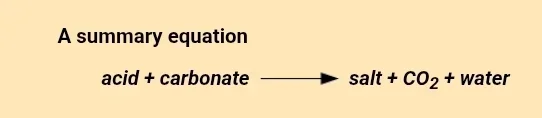
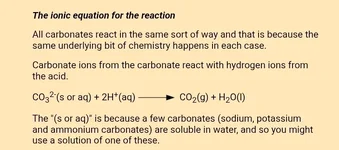
That calcium carbonate is gradually broken down, into calcium and carbonate as acidity rises. This freed up carbonate now attaches to the hydrogen ions of the acid and "buffers" the ph, absorbing those hydrogen ions out of solution and using them to create cO2 gas and water.

1000053144.webp

1000053149.webp

The carbonic acid from our injected CO2 will accelerate that process over what would happen without it.


So technically they're correct, cO2 injection accelerates the natural process of "using up" the buffering capacity of whatever substrate, Aquasoil or Seiyru rock etc.

Conversely if you add dissolved potassium carbonate to the water to raise the buffering capacity (the KH), some amount of that carbonate will also bind back to positive ions in the substrate , refreshing the buffering capacity to a degree.
 
Last edited:
I havent really understood the appeal to the buffering capacity of aquasoils personally.

I count myself as fortunate to have water coming out the tap with 6 ppm Calcium, 1 ppm Magnesium and 2 degrees KH year round with no variation. The source water is much lower on all 3 and does see some seasonal variation and the water district continually tests and boosts to target. I feel fortunate as it saves the expense and hassle of RO production. All I have to do is boost the calcium and magnesium levels to my target. 2DKH is low enough for me…

If I lived somewhere with harder water coming from the tap, I would be going the reverse osmosis route for consistency sake. I would not depend on aquasoil to soften my water.
 
If talking strictly about ph buffering...
I'm terrible at chemistry, but with my limited understanding, both lower ph the same way, by increasing hydrogen ions in the water. Therefore, why would one reduce the effect of the other? Higher KH on the other hand, does reduce the buffering life of aquasoil since it has to release more of those hydrogen ions to compensate. I'm calling bunk but I'll be happy to bow to one of our chemistry majors in the community. :)
 
My understanding is no, soils are unaffected by CO2. Carbonic acid that is generated from CO2 injection into water generates a weak acid, in equilibrium, and does not bind the substrate or affect a soil's CEC or the buffering lifespan of soil.

H2CO3 <-> H2O + CO2

It is a reversible equilibrium.

The simple way to think about it is that it alters pH through this equilibrium, but does NOT alter kH. The pH of our tanks is not high enough to generate enough bicarbonates to bind the active soil, or decrease buffering capacity like adding KH buffers directly to the tank would.

see...


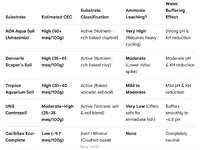
It is also important to remember that not all active soils are created equal, or have the same buffering/CEC capacity.

CEC Aquasoil.webp
 

Attachments

  • 1785869108799.webp
    1785869108799.webp
    72 bytes · Views: 1
Did this person explain the mechanism how that was supposed to work? Without more info, I think they were likely confusing the ph buffering provided by the carbonates/dissolved inorganic carbon and acidifying properties of the soil that we also call "buffering". As others have said, adding CO2 does not change the KH (alkalinity) of the water, but completely dissociated hydrogen ions will. (This is the idea behind strong acids to get rid of KH.) Eventually the soil runs out of H+ to give, but I don't see how CO2 is supposed to speed things up. Like many on this thread, my chemistry is pretty ok, but I'm not an expert and I'm happy to listen to someone who is.
 
Did this person explain the mechanism how that was supposed to work? Without more info, I think they were likely confusing the ph buffering provided by the carbonates/dissolved inorganic carbon and acidifying properties of the soil that we also call "buffering". As others have said, adding CO2 does not change the KH (alkalinity) of the water, but completely dissociated hydrogen ions will. (This is the idea behind strong acids to get rid of KH.) Eventually the soil runs out of H+ to give, but I don't see how CO2 is supposed to speed things up. Like many on this thread, my chemistry is pretty ok, but I'm not an expert and I'm happy to listen to someone who is.
I think you have hit the nail on the head.
I challenged the individual to provide evidence or suggest a mechanism and got no response.

I thought it was likely a spurious claim. Thanks for all (mostly) for clarifying !
 

Top 10 Trending Threads

Back
Top