Welcome to ScapeCrunch

We are ScapeCrunch, the place where planted aquarium hobbyists come to build relationships and support each other. When you're tired of doom scrolling, you've found your home here.

Competition to bury Java fern, Bucephalandra and Anubias rhizomes.

Did you start with a layer of ADA powersand? I used it in my farm tank and over time as the aquasoil gets stirred up from planting and removing, the small white pumice like material ends up strewn around the top. perhaps it turns brown over time.
I stopped using powersand for this reason, and never saw a difference!
 
I stopped using powersand for this reason, and never saw a difference!
I agree. I still have a bag of it I might use in a scape I have a really big slope, but I won't be purchasing anymore. It may help in some tiny way, but it's absolutely not worth the cost.
 
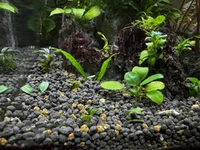
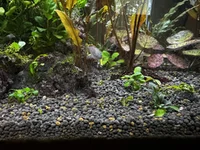
I've heard anti aquasoil people claim it turns to mud too fast. They should see this photo.

Thing is, aquasoil is not a uniform product. There are certainly batches that are manufactured poorly, and the instances of it crumbling within a year are well documented by many. Aquasoil manufacture occurs at a large scale and is very coarse production - these soil manufacturers typically work on soil products for large scale commercial farms with aquasoil as a side line. Aquasoil factories are less like a Lexus factory, and more like a messy construction/agriculture site. Think small number of rough laborers, no lab equipment in sight, farm site miles away from cities.

The smallest batch size that the machine produces is around 0.5 to 1 ton. Each machine cycle aims for around 20 tons, and there isn't actually any substantial QC (quality control) after the grains are produced. Perhaps a single sample is taken for every 20 tons (if this is done at all - I don't think most brands do). And while testing can be done for mineral content - it doesn't guarantee the structural soundness of the grains over a long horizon. All these can give rise to significant variation in product outcomes.

Why is it done this way - because of costs - most of the cost of aquasoil is in the shipping and transport/handling of material. No one in the supply chain makes enough margin to justify further QC in the end product (even at ADA's prices).
 
Thing is, aquasoil is not a uniform product. There are certainly batches that are manufactured poorly, and the instances of it crumbling within a year are well documented by many. Aquasoil manufacture occurs at a large scale and is very coarse production - these soil manufacturers typically work on soil products for large scale commercial farms with aquasoil as a side line. Aquasoil factories are less like a Lexus factory, and more like a messy construction/agriculture site. Think small number of rough laborers, no lab equipment in sight, farm site miles away from cities.

The smallest batch size that the machine produces is around 0.5 to 1 ton. Each machine cycle aims for around 20 tons, and there isn't actually any substantial QC (quality control) after the grains are produced. Perhaps a single sample is taken for every 20 tons (if this is done at all - I don't think most brands do). And while testing can be done for mineral content - it doesn't guarantee the structural soundness of the grains over a long horizon. All these can give rise to significant variation in product outcomes.

Why is it done this way - because of costs - most of the cost of aquasoil is in the shipping and transport/handling of material. No one in the supply chain makes enough margin to justify further QC in the end product (even at ADA's prices).

Wow, thats a very informative (and descriptive) account, and completely explains potentially enormous variations between batches.
 
I'm late to the party, but I was reading about the decomposition of organic matter in my soil science textbook (Elements of the Nature and Properties of Soils, Brady and Weil) and came across this relevant list:

View attachment 15215
For a frame of reference, I have pine bark bits in a substrate that is 6 years old that are still intact. These have a very high lignin content before they break down and at this point I assume it's only a lignin skeleton that remains. The substrate is still productive though.
This is why I tell everyone of my neighbors when they ask me about mulch why the pine bark nuggets are terrible mulch if you want to improve soil. Plus they float. Down to only one neighbor who uses them now.
 
Thing is, aquasoil is not a uniform product. There are certainly batches that are manufactured poorly, and the instances of it crumbling within a year are well documented by many. Aquasoil manufacture occurs at a large scale and is very coarse production - these soil manufacturers typically work on soil products for large scale commercial farms with aquasoil as a side line. Aquasoil factories are less like a Lexus factory, and more like a messy construction/agriculture site. Think small number of rough laborers, no lab equipment in sight, farm site miles away from cities.

The smallest batch size that the machine produces is around 0.5 to 1 ton. Each machine cycle aims for around 20 tons, and there isn't actually any substantial QC (quality control) after the grains are produced. Perhaps a single sample is taken for every 20 tons (if this is done at all - I don't think most brands do). And while testing can be done for mineral content - it doesn't guarantee the structural soundness of the grains over a long horizon. All these can give rise to significant variation in product outcomes.

Why is it done this way - because of costs - most of the cost of aquasoil is in the shipping and transport/handling of material. No one in the supply chain makes enough margin to justify further QC in the end product (even at ADA's prices).
Sounds a lot like mulch and compost production in traditional gardening.
 
This is why I tell everyone of my neighbors when they ask me about mulch why the pine bark nuggets are terrible mulch if you want to improve soil. Plus they float. Down to only one neighbor who uses them now.
I'm actually a big fan of pine bark as a component of a planted soil substrate and as a mulch outside, but like a lot of things it depends on your specific situation. It's a poor nitrogen source for sure, and wood-based mulches temporarily reduce available soil nitrogen when they are first applied, which can catch people by surprise.

But very small bark pieces won't float when they become fully waterlogged, and their slow decomposition rate is a good thing in a planted tank, especially a low tech one that relies on it for CO2. Substrates that have too much labile organic matter will consume too much oxygen and release all their carbon and nitrogen very quickly, which creates a very volatile environment. That fast decomposition is exactly what people are trying to avoid when they mineralize their soil, though they are losing a lot of carbon in the process. Even with just the lignin left over it's an excellent substrate for microbes and helps maintain pore space and resist compaction. I've been happy with the results at any rate.
 
Did you start with a layer of ADA powersand? I used it in my farm tank and over time as the aquasoil gets stirred up from planting and removing, the small white pumice like material ends up strewn around the top. perhaps it turns brown over time.
Haha so I looked up my old journal on pt.net. It’s Azoo plant bed, thread posted 2010 🤣 so I guess it’s held up pretty well considering.
 
I'm actually a big fan of pine bark as a component of a planted soil substrate and as a mulch outside, but like a lot of things it depends on your specific situation. It's a poor nitrogen source for sure, and wood-based mulches temporarily reduce available soil nitrogen when they are first applied, which can catch people by surprise.

But very small bark pieces won't float when they become fully waterlogged, and their slow decomposition rate is a good thing in a planted tank, especially a low tech one that relies on it for CO2. Substrates that have too much labile organic matter will consume too much oxygen and release all their carbon and nitrogen very quickly, which creates a very volatile environment. That fast decomposition is exactly what people are trying to avoid when they mineralize their soil, though they are losing a lot of carbon in the process. Even with just the lignin left over it's an excellent substrate for microbes and helps maintain pore space and resist compaction. I've been happy with the results at any rate.


Good points, I was focused purely on terrestrial uses. When saying pine bark as a mulch, I mean the nuggets which are chunky, not pine fines which are a essential in well draining potting and general soil mixes to allow drainage and prevent compaction. As for soil nitrogen demand that's more material to the not heavily shredded hardwood mulches where the nitrogen requirements are very often substantial. Say chip drop wood chips.,

Fully aligned on aquatic uses, pond compost uses pine fines for their stability and comprised 50% of the last bag I got.
 
So my ‘results’ might be more like see you in 2027 😂 This tank grows at a snails pace.

Having to replant a bit due to mts disturbing and moving things about but no issues thus far. I added a bunch of little buce ‘mini purple’ rhizomes and a Java ‘windelov’ into the mix so figured I’d update pics. The gudgeon was not impressed.

IMG_7289.webp

IMG_7291.webp
 

Top 10 Trending Threads

Back
Top