Welcome to ScapeCrunch

We are ScapeCrunch, the place where planted aquarium hobbyists come to build relationships and support each other. When you're tired of doom scrolling, you've found your home here.

Journal A New Beginning: 90 P High Energy Tank

  • Thread starter Thread starter TRyan
  • Start date Start date
  • Tagged users Tagged users None
Like the others have said above the tank is looking fantastic!

Very, very well done.

What do you think has been the key to getting it in this shape??
Thank you so much, @GreggZ! I appreciate the compliment!

There are two things I changed that I feel contributed to better tank health for my setup the most, I'll get to those in a moment.

There are a couple of other things that are also very important. They are CO2 consistency, trimming and good tank/substrate cleaning and maintenance.

The first is I switched to RO water. I just didn't know exactly what was in my water as far as calcium and magnesium. I knew there was elevated levels of copper and lead as well. There was definitely a problem there somewhere with my dosing of calcium and magnesium. Whether it was too much of one or not enough of the other, I don't know. I hated not knowing how much to dose it what was in my water.

The second is macro dosing. Turns out I was under dosing. One day I was ordering plants from @Burr740 and I decided to send him a few pictures and ask for advice. He said it looked like plants were unhappy due to lack of macros. Bottom line is I wasn't dosing enough.

That's when I switched to RO water and started following his method of 50%-60% water changes and using his liquid macros. I've used his micros solution for a while now. I dose .45 iron a week split into 3 doses.

Here's what I feel helped me the most:
55% water changes 1 time a week, consistently. I dose 2 doses macros at water change, using whole tank volume. Each dose of macros adds 4.7/1.2/5.5 NPK. I add 2 more doses split up during the week. TOTAL for the week is 18.8/4.8/22. So Friday gets 2 doses, Sunday gets 1 dose, Tuesday gets 1 dose. I add 30 ppm calcium and 10 ppm magnesium day of water change, using water change volume for the amount. My tank is 40 gallons. I remove 22 gallons. I dose 30/10 ppm Ca and Mg to 22 gallon amount. Macros are dosed to 40 gallon amount. I use Rotalla butterfly. It's really easy to use once you get used to it.

Edited to add that while I dose calcium and magnesium to water change amount, it's important to initially bring whole tank Ca and Mg amounts to 30/10 ppm, and then only dose to water change amount.

Water change on Friday, 2 doses macros
Saturday gets micros
Sunday 1 dose macros
Monday micros
Tuesday 1 dose macros
Wednesday micros
Thursday nothing
Friday repeat

I use a cheap CO2 regulator paired with a Dwyer RMA-151-SSV flow meter and also a Pinpoint Marine pH controller (although this is just a fail safe in case cheap regulator goes haywire). Think whether you dose 30ppm CO2 or 60 ppm CO2, it doesn't matter as much as daily consistency and, like @Naturescapes_Rocco says, getting that CO2 fully saturated by the time lights come on.
 
Last edited:
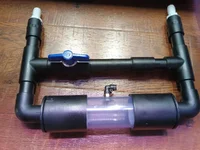
Not hating at all (you know I'm a big fan!!) but from my understanding of flow, I think this design would work even better if the reactor was in the middle, and the bypass on the outside.

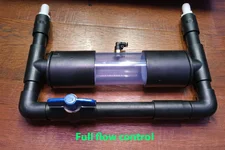
The current design:
1775177183550.webp
Water takes the "path of least resistance", which is mostly through the reactor. Probably 90% of the water flow goes through the reactor no matter what, and ~10% can be adjusted with the valve, in the current orientation, due to friction around the corner, etc. Not all, but most, flow goes through the reactor, so maybe not much can be adjusted with the valve.

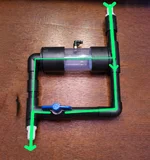
If you were to switch the orientation of bypass and reactor like this:
1775177320076.webp
Almost 100% of the flow could be controlled via the valve.

If your design works there's no need to change it, but if you ever wanted full flow control with a bypass, running it in series would be best!

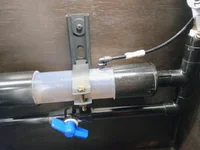
Another example of controlling via path of least resistance:
1775177873690.webp

This is less for you specifically, and more for anyone reading about these reactors!

Another design, you could have two exits and two different lily pipes for solid spiral flow in your tank:

1775178372188.webp
 
Last edited:
Not hating at all (you know I'm a big fan!!) but from my understanding of flow in "parallel" vs "series", I think this design would work even better if the reactor was in the middle, and the bypass on the outside.

The current design is a "parallel" flow system:
View attachment 15771
Water takes the "path of least resistance", which is mostly through the reactor. Probably 90% of the water flow goes through the reactor no matter what, and ~10% can be adjusted with the valve, in the current orientation, due to friction around the corner, etc. Not all, but most, flow goes through the reactor, so maybe not much can be adjusted with the valve.

If you were to make it in series, like this:
View attachment 15772
Almost 100% of the flow could be controlled via the valve.

If your design works there's no need to change it, but if you ever wanted full flow control with a bypass, running it in series would be best!


Another example of controlling via path of least resistance in series:
View attachment 15774

This is less for you specifically, and more for anyone reading about these reactors!

Another design, you could have two exits and two different lily pipes for solid spiral flow in your tank:

View attachment 15777
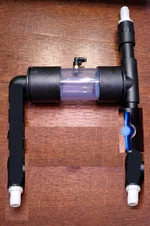
What you say makes a lot of sense. In fact, I built my first reactor just like you have arranged.
IMG_20260402_183142036_AE.webp
It works pretty well, but gets some large bubbles coming out a few times a minute. I thought it might mix a little better with the overflow above the reactor, but I see your point about path of least resistance.

I'll definitely be running it without fish or plants to test. If it doesn't work as well, I'll build a new one with overflow below reactor like I originally built.

Good points and thank you for drawing some different configurations for others to see and get some ideas!
 
The current design is a "parallel" flow system:
If you were to make it in series, like this:
Technically, both of the setups you pictured are "Parallel" circuits. A "series " circuit would have the output of one pipe connected to the input of the other. What terminology would best be used for each of those configurations in plumbing; I don't know. My expertise is electronics. ;)
 
Back
Top