Welcome to ScapeCrunch

We are ScapeCrunch, the place where planted aquarium hobbyists come to build relationships and support each other. When you're tired of doom scrolling, you've found your home here.

Journal 75L Hygrophila polysperma white display

Joined
May 21, 2023
Messages
399
Reaction score
1,705
Location
Singapore
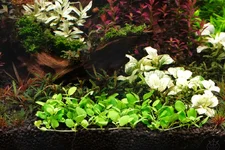
I came into some Hygrophila polysperma "white" by Tropica recently. Grew it out and it seems to be able to be shaped into good midground bushes so I decided to create a layout to showcase it. Contemplated whether to use it as the only white plant in the tank, but decided to use some Anubias white petite as well so that the white polysperma doesn't stand out awkwardly.

2hrAquaristDSCF1921 hygrophila white.webp
 
Mostly finalized the layout for this tank.

White plants are difficult to use in layouts. They tend to stick out awkwardly and often do not feel natural to neighboring plants. They also difficult to photograph. The twin peaks of the wood are too similar in height, I will try lowering the right one by sinking it further into the substrate during the next water change. At the same time, I'm testing to see if I can alter the structure of the left wood by growing plants on it.

2hrAquaristDSCF1968 start white.webp
 
What kind of moss do you use and what is your typical routine for taking care of those?
I'm using riccardia and possibly fissidens. Mosses are amongst the easiest plants to manage, after they are glued on, I trim them repeatedly until the bottoms are very aged or brittle, then I'll remove them from the wood (usually they will be loosely attached by then), then reglue them. The interval is much longer than stem plants replanting - months...
 
I'm using riccardia and possibly fissidens. Mosses are amongst the easiest plants to manage, after they are glued on, I trim them repeatedly until the bottoms are very aged or brittle, then I'll remove them from the wood (usually they will be loosely attached by then), then reglue them. The interval is much longer than stem plants replanting - months...
Thanks. I keep reading about how mosses get everywhere when trimming since they float and with densely planted tanks I thought this would be a major issue. How do you ensure that the moss trimmings don't get everywhere ? Might be a nice post for your website too since it is so commonly grown.
 
Thanks. I keep reading about how mosses get everywhere when trimming since they float and with densely planted tanks I thought this would be a major issue. How do you ensure that the moss trimmings don't get everywhere ? Might be a nice post for your website too since it is so commonly grown.
Same with uprooting - vacuuming with water siphon while trimming
Alternatively, clear up later on with large WC and kicking up spare trimmings with turkey baster
Haa, not much of a hack, but practiced hands make short work

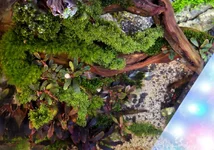
Mosses offer great synergy with wood/rock, would be a waste not to make use of them when hardscape is available

DSCF7954E.webp
 
Same with uprooting - vacuuming with water siphon while trimming
Alternatively, clear up later on with large WC and kicking up spare trimmings with turkey baster
Haa, not much of a hack, but practiced hands make short work

Mosses offer great synergy with wood/rock, would be a waste not to make use of them when hardscape is available
Wow, looks pristine on high light !
 
My last scape was moss heavy, pilo moss. It LOVED climbing my driftwood. However in terms of infecting the rest of the tank, not so much. It was easy to siphon up and I never had issue with it tangling up into plants. As Dennis mentioned, glue it and let it grow. It takes a long time before it gets too thick and separates from the glue point. Of course not all mosses behave the same, some are stringier and more infectious than others.
 
Riccardia stays compact but grows much slower than moss IME. You need a lot more of it to get the look you want where moss, once established, will spread at a quicker rate. I wouldn’t worry about the “mess” as much as which one you find more aesthetically pleasing for your scape. All three of those have different textures and appearances.
 
Thanks @Dennis Wong and @Mr.Shenanagins .

Among the Riccardia, fissidens and pilo moss, which one would be the least messy and the lowest maintenance?
I haven't figured out the trick or simply don't have the dexterity to trim and vacuum at the same time, at least in my heavy driftwood scape, as having both hands/arms in the tank simultaneously is a challenge. My experience with Java moss and Fissidens, is that they do get "messy" to put it mildly. If I didn't have a carpet of hair grass. I would say it was perfectly manageable, but once a few bits get into that carpet, it's just a ticking time bomb. Without a carpeting plant, It's likely easy to manage as has been described. I love the look of my Fissidens on both wood and rock. I don't really trim it as much as I simply remove chunks of it by hand when it gets too thick/heavy. On mine, when it becomes that thick, the bottom layers of it start to go brown. I can pull most of it out and the small bits left behind will grow back to cover the area again in short order. For Fissidens, the transition to submersed growth takes awhile so you think it's a slow grower, but once transitioned and established, with high light and CO2, it grows faster, just not so fast that I have to trim/remove very often. It depends how thick of mound of it you want. I think it looks good, quite thick.
 
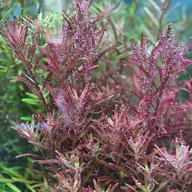
Close-up of Hygrophila serpyllum. Barr was right, its a very aggressive grower, he dubbed it "giant glosso", and it spreads as aggressively. The plus side is that the roots don't seem too go too deep?

Not really suitable for small patch usage, I'm cutting off runners every other day to contain it. Might be usable in larger tanks, or in nature style scapes as foreground accent.
2hrAquaristDSCF2167 Hygrophila serpyllum.webp
 
The plus side is that the roots don't seem too go too deep?
This is definitely a positive. I have it in my farm tank and the shallow rooting allows me to easily pull out chunks of it once a week to keep it under control. I like the look and color so I was thinking of using it in the new more organized garden style farm tank but don't know if I want to spend that much time maintaining it's growth and shape.
 
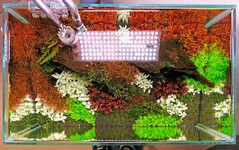
Top view and side views. Tank seems stable, the Hygrophila white and Rotala florida are really taking their time to settle in. Good thing is, no deterioration of older leaves. I guess slower growing plants mean less trimming work in future
2hrAquaristDSCF2208.webp
2hrAquaristDSCF2275E.webp
 
I came into some Hygrophila polysperma "white" by Tropica recently. Grew it out and it seems to be able to be shaped into good midground bushes so I decided to create a layout to showcase it. Contemplated whether to use it as the only white plant in the tank, but decided to use some Anubias white petite as well so that the white polysperma doesn't stand out awkwardly.

View attachment 16976
They look really good with the anubias and really pops out next to the red💯
 
I saw your post about doing 100% water changes on new tanks these days, which is very interesting. I saw where you said (in an interview, I believe) that you don't ever use buckets when doing water changes. What is your water draining setup for the show tanks?
I just use very long hoses, 10? 15? meters long to reach a drain. I add a tap to the end of the hose, so that I can keep it filled with water (even partially works) so that it is easy to restart the siphon. In cases where the drainage point cannot be fed by gravity, my long hose would be attached to a small pump permanently that draws water in when turned on. on the other end of the pipe, I may install a snap on connector that then connects to the water main, so I can use the same pipe to fill the tank directly. Nowadays I use garden hose reel instead to fill the tanks.
 
I posted this on FB, and I thought it is important enough that I post it here also.
Large water changes during a new planted tank startup phase is something I have changed my mind about this year.

If dilution of organics, removal of detritus and algae spores is the goal of large water changes during the initial weeks is the goal, why stop at 50% or 80%? If new aquasoil release 10ppm of ammonia, an 80% water change still leaves 2ppm. So this year I have done 100% (or as near as I can) water changes for my new projects instead and all the tanks have settled in even faster than before, with faster plant adaptation, with the tank skipping diatoms/GDA phases entirely. I no longer expect to handle any form of diatoms in any new setup.

1st week: 100% water changes every 2 days
2-3nd week: 100% water changes twice a week, more if there is visible algae appearing.
4th week: back to 50-80% water change schedule once a week, but more if the tank has not settled in.

As per Tom barr; Periphyton is also lifted off plant leaves when water levels dip enough to expose the plants to air. The secondary effect of such large water changes is that it exposes plants to atmospheric air, which saturates their vacuoles with gaseous oxygen and carbon dioxide. This invigorates plant growth and allows plants to adapt faster to the new aquarium environment. Plants also channel the extra oxygen down to the rhizosphere, which in turn turbo-charges development of the microbial community in the substrate. These invisible interactions have an extremely strong anti-algae impact.

If something is good, is more of it better? When it comes to big water changes, it seems like the answer is yes.

Using APT Feast aquasoil - This approach also allows me to plant sensitive plants from day1 rather than waiting - Blood vomit, Bucephalandra, Varigated plants.
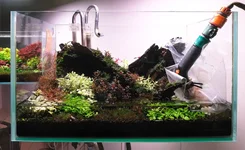
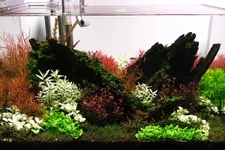
2hrAquaristDSCF2131.webp
2hrAquaristDSCF2230E.webp
 

Top 10 Trending Threads

Back
Top