
Welcome to ScapeCrunch
We are ScapeCrunch, the place where planted aquarium hobbyists come to build relationships and support each other. When you're tired of doom scrolling, you've found your home here.
Social Feed

This 5'x2'x2' tank has been running for at least 10 years, but has been 100% a "fish" tank. Embarrassingly all plants were plastic. However, it does mean that the filters and inert sand/gravel substrate are biologically nicely mature. I am new to the forum so I thought I would introduce myself and the tank to the group.
Almost exactly 1 year ago I decided to try and turn this plastic planted tank into a properly planted fish tank. I had been having some success with planted small low tech shrimp tanks and felt I had the skills to convert this main family display tank to a properly planted tank as well.
So over the last year this tank has evolved considerably, as I learned more and more about fertilisers (which are expensive for this size of tank unless you use dry salts), lighting etc, etc. (After a year I still feel mostly like a beginner).The game-changer was a couple of months ago when I started CO2 injection and suddenly My success rate jumped massively. I still have the challenges of an inert substrate but the CO2 helped enormously.
Here's the tank as of right now

So I'll try and list some stuff .........
Tank - 150 x 60 x 60cm
Filters - 3 x Eheim 2217 canisters. All filled with Eheim coarse foam pads.
Substrate - a mixture of coarse sand and fine gravel. All inert, from around 1-3 mm grain size.
Water - RO remineralised with Salty Shrimp Bee Minerals GH+, to zero dKH, 5 dGH. 50% water change weekly.
Water column ferts - These are from a brand called Solufeed, which is becoming popular in the niche market of planted aquaria in the UK. THese are not aquatic-oriented but are very popular in the hydroponic growing sector here. Brainier folks than me on UKAPS have worked out the best products and right doses. I don't have a set of scales and am inherently a bit lazy about these things so I converted the recommended weights of ferts for my size tank into level teaspoons of dry salts. The tank is big enough so that I can simply dose dry salts daily (I do dissolve them in a jug first).
Macros - Solufeed 2:1:4 High K (https://www.solufeedshop.com/214-high-k-1-kg-18-p.asp) - 1/4 tsp daily, plus K2SO4 - 1/8 tsp daily.
Micros - Solufeed Sodium-free TEC (https://www.solufeedshop.com/tec-sodium-free-54-p.asp) - 1/16 tsp daily.
Substrate ferts - spot-injected boluses of aquatic compost where required.
Lighting - 2 x 120cm Hygger LED units. Currently around 20-30 PAR on the substrate using the Photone app on my iphone. Rising up to 80-90 PAR near the surface.
CO2 - FIre extinguisher system. Cheap regulator, solenoid/timer. Homemade horizontal Yugang reactor plumbed into a variable bypass loop in the outlet of one of the canister filters. Use of Hanna CO2 test confirms around 30 ppm CO2 throughout key lighting period. Tank is aerated overnight.
Temp - heaterstat 25 C
Livestock .......
Plants - I have been through quite a few and have kept those which have worked well. Most species are now a lot more successful with the added CO2.
Currently .......
Alternanthera reineckii rosaefolia (I am struggling a lot with this. Its growing but all leaves becoming algae covered after a couple of weeks)
Bacopa amplexicaulis Aquafleur (seems to need lower light so is tucked away at each end of the tank)
Cryptocoryne balansae (new)
Cryptocoryne Wendtii Red (new)
Eriocaulon sp vietnam (new)
Hygrophila corymbosa (new)
Hygrophila polysperma Rosanervig (new)
Limnophila heterophylla (continues to grow around 12" a week, to be phased out)
Limnophila rugosa (new)
Ludwigia palustris “super red”
Pogostemon helferi (this was an in vitro plant but has grown superbly for me so far. I have even had to remove a load)
Pogostemon samsonii (new)
Rotala bossii
Rotala colorata (thrives in this tank)
Rotala rotundifolia red (thrives but not enough light for good colouration)
Staurogene repens
Challenges with the tank have been mainly trying to deal with lighting the 24" depth and also substrate fertilisation.
Lighting - I have two cheap long Hygger luminaires across the top of the tank, so I have good coverage across the tank but the difference in PAR from top to bottom of the tank is huge. I have struggled to provide enough light on the substrate and at the same time control algae. CUrrently I am using a low-medium light strategy which seems to be successful with a lot of plants and algae is under reasonable control. Careful plant placement seems like could be key here. Lights are currently at around 70% so I do have room for increasing once I get CO2 and fertilisation properly sorted.
Substrate nutrients - I started off using API root tabs, which seemed to work OK but were very expensive to maintain on this size of tank. Then moved onto dried homemade clay balls rolled with dry fert salts. The clay particles have proved problematic as once disturbed into the water column they are so tiny they are hard for my filters to filter them out. I am still suffering from some water cloudiness from residual clay. I have now moved onto "injecting" aquatic pond compost under plants where I see necessary using an adapted 10ml syringe. This technique has worked well but the effects on plant growth are yet to be fully assessed as this is fairly new. Its certainly not a problem to water clarity of any is disturbed from the substrate. I have high hopes for this method of providing a decent amount of slow release nutrients in the substrate.
Ultimate goals - There is no specific aim of this tank in terms of aquascaping. It was always quite a loose idea of what I have trying to achieve. In my mind it is still 50% a "fish" tank and 50% a "planted" tank. I am balancing the needs of both. It does mean I add a lot of nutrients in terms of fish food and water column fertilisation has to be adapted accordingly. I have some hardscape, so it will not officially be a dutch aquascape. However, I feel that description is the nearest to my goal.
Being a bit of a shrimp nut I would love to have a load of dwarf shrimp in the tank but with the acara (who is staying) that is impossible. I am pleased to have recently discovered that he will tolerate large amano shrimp !
I think currently its mainly a question of discovering which plant species are really going to work well in the tank and then just letting them grow in.
Heres a couple more slightly closer pics.


Almost exactly 1 year ago I decided to try and turn this plastic planted tank into a properly planted fish tank. I had been having some success with planted small low tech shrimp tanks and felt I had the skills to convert this main family display tank to a properly planted tank as well.
So over the last year this tank has evolved considerably, as I learned more and more about fertilisers (which are expensive for this size of tank unless you use dry salts), lighting etc, etc. (After a year I still feel mostly like a beginner).The game-changer was a couple of months ago when I started CO2 injection and suddenly My success rate jumped massively. I still have the challenges of an inert substrate but the CO2 helped enormously.
Here's the tank as of right now
So I'll try and list some stuff .........
Tank - 150 x 60 x 60cm
Filters - 3 x Eheim 2217 canisters. All filled with Eheim coarse foam pads.
Substrate - a mixture of coarse sand and fine gravel. All inert, from around 1-3 mm grain size.
Water - RO remineralised with Salty Shrimp Bee Minerals GH+, to zero dKH, 5 dGH. 50% water change weekly.
Water column ferts - These are from a brand called Solufeed, which is becoming popular in the niche market of planted aquaria in the UK. THese are not aquatic-oriented but are very popular in the hydroponic growing sector here. Brainier folks than me on UKAPS have worked out the best products and right doses. I don't have a set of scales and am inherently a bit lazy about these things so I converted the recommended weights of ferts for my size tank into level teaspoons of dry salts. The tank is big enough so that I can simply dose dry salts daily (I do dissolve them in a jug first).
Macros - Solufeed 2:1:4 High K (https://www.solufeedshop.com/214-high-k-1-kg-18-p.asp) - 1/4 tsp daily, plus K2SO4 - 1/8 tsp daily.
Micros - Solufeed Sodium-free TEC (https://www.solufeedshop.com/tec-sodium-free-54-p.asp) - 1/16 tsp daily.
Substrate ferts - spot-injected boluses of aquatic compost where required.
Lighting - 2 x 120cm Hygger LED units. Currently around 20-30 PAR on the substrate using the Photone app on my iphone. Rising up to 80-90 PAR near the surface.
CO2 - FIre extinguisher system. Cheap regulator, solenoid/timer. Homemade horizontal Yugang reactor plumbed into a variable bypass loop in the outlet of one of the canister filters. Use of Hanna CO2 test confirms around 30 ppm CO2 throughout key lighting period. Tank is aerated overnight.
Temp - heaterstat 25 C
Livestock .......
- 6" Blue Acara
- 5" golden gourami
- SAE
- 10 x congo tetras
- 4 x scissortail rasboras
- approx 16 x harlequin rasboras
- 10 x whitefin bentosi tetras
- 4 x Cory sterbai
- 1 x Stiphodon ornatus (who I have owned for over a decade despite my abuse. I am convinced this fish is immortal)
- 6 x Otocinclus
- 3 x amano shrimp
- 3 x ember tetras
- 5 x cherry barbs
- plus one or two other small oddballs I have probably forgotten
Plants - I have been through quite a few and have kept those which have worked well. Most species are now a lot more successful with the added CO2.
Currently .......
Alternanthera reineckii rosaefolia (I am struggling a lot with this. Its growing but all leaves becoming algae covered after a couple of weeks)
Bacopa amplexicaulis Aquafleur (seems to need lower light so is tucked away at each end of the tank)
Cryptocoryne balansae (new)
Cryptocoryne Wendtii Red (new)
Eriocaulon sp vietnam (new)
Hygrophila corymbosa (new)
Hygrophila polysperma Rosanervig (new)
Limnophila heterophylla (continues to grow around 12" a week, to be phased out)
Limnophila rugosa (new)
Ludwigia palustris “super red”
Pogostemon helferi (this was an in vitro plant but has grown superbly for me so far. I have even had to remove a load)
Pogostemon samsonii (new)
Rotala bossii
Rotala colorata (thrives in this tank)
Rotala rotundifolia red (thrives but not enough light for good colouration)
Staurogene repens
Challenges with the tank have been mainly trying to deal with lighting the 24" depth and also substrate fertilisation.
Lighting - I have two cheap long Hygger luminaires across the top of the tank, so I have good coverage across the tank but the difference in PAR from top to bottom of the tank is huge. I have struggled to provide enough light on the substrate and at the same time control algae. CUrrently I am using a low-medium light strategy which seems to be successful with a lot of plants and algae is under reasonable control. Careful plant placement seems like could be key here. Lights are currently at around 70% so I do have room for increasing once I get CO2 and fertilisation properly sorted.
Substrate nutrients - I started off using API root tabs, which seemed to work OK but were very expensive to maintain on this size of tank. Then moved onto dried homemade clay balls rolled with dry fert salts. The clay particles have proved problematic as once disturbed into the water column they are so tiny they are hard for my filters to filter them out. I am still suffering from some water cloudiness from residual clay. I have now moved onto "injecting" aquatic pond compost under plants where I see necessary using an adapted 10ml syringe. This technique has worked well but the effects on plant growth are yet to be fully assessed as this is fairly new. Its certainly not a problem to water clarity of any is disturbed from the substrate. I have high hopes for this method of providing a decent amount of slow release nutrients in the substrate.
Ultimate goals - There is no specific aim of this tank in terms of aquascaping. It was always quite a loose idea of what I have trying to achieve. In my mind it is still 50% a "fish" tank and 50% a "planted" tank. I am balancing the needs of both. It does mean I add a lot of nutrients in terms of fish food and water column fertilisation has to be adapted accordingly. I have some hardscape, so it will not officially be a dutch aquascape. However, I feel that description is the nearest to my goal.
Being a bit of a shrimp nut I would love to have a load of dwarf shrimp in the tank but with the acara (who is staying) that is impossible. I am pleased to have recently discovered that he will tolerate large amano shrimp !
I think currently its mainly a question of discovering which plant species are really going to work well in the tank and then just letting them grow in.
Heres a couple more slightly closer pics.
1 Replies
·
651 views


Journal Quantum Entanglement
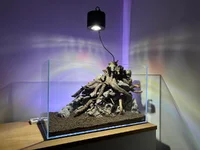
My new scape. It’s been a while. I’ve been busy finishing my novel. It’s published now so back to scaping.
It’s a classic triangular scape and I’m calling it Quantum Entanglement. It’s a working title, so I might change that. Sorry mods.
The real star is the light. Off Amazon for around $130. Fully controllable with a remote. Great value. https://amzn.eu/d/0eRX5eCo
I want to plant it with mainly buces and small anubias spp. on the rocks and wood and MC carpet, with some crypt nevellii or C. X Willisii, and stauro in the shady parts and maybe a ludwigia mini super red highlight behind the last rock on the left.
It’s a classic triangular scape and I’m calling it Quantum Entanglement. It’s a working title, so I might change that. Sorry mods.
The real star is the light. Off Amazon for around $130. Fully controllable with a remote. Great value. https://amzn.eu/d/0eRX5eCo
I want to plant it with mainly buces and small anubias spp. on the rocks and wood and MC carpet, with some crypt nevellii or C. X Willisii, and stauro in the shady parts and maybe a ludwigia mini super red highlight behind the last rock on the left.
12 Replies
·
192 views


Supporting
I Donated 2026
Rockstar
I hadn't seen it mentioned by others that attended Aquashella, but if you hadn't already heard about it or seen it in Aquashella videos, ADA has come out with Amazonia Pro. It's not a replacement for Version 2, but an addition. It is essentially Version 2 on steroids with higher nutrients and of course the negative side effect of potentially higher initial ammonia leaching and, if your not prepared and skilled, more chance of algae. That's even from the mouth of Homma-san himself. The scaping competitors were using it in the competition and AFA was selling 9l bags at the show. They said it would be available on the website within the next couple weeks.
39 Replies
·
879 views
I have read an awful lot of warnings and conjectures by people. And “I used bdbs and a shrimp died so I got rid of it…”…
My personal experience with the product has been uneventful.
I have put rare earth magnets through a quart sample with no hint of any attraction and then washed it with no hint of oil slick or dustiness and then added the rest of the bag to a new aquarium with no treatment, no ill effect…
I have probably employed 7 bags by now with no hint of a problem. Dozens of corys sifting through the stuff as well as khuli loaches and yoyo loaches…. No hint of problems with them…
Other than it self leveling itself and being totally incapable of holding a slopeI love the stuff. The black always looks great. It costs about 1/4 aquarium specific substrates. I really haventexperienced anything negative about it…
I know it is popular here…. Has anybody here had bad experiences with it?
My personal experience with the product has been uneventful.
I have put rare earth magnets through a quart sample with no hint of any attraction and then washed it with no hint of oil slick or dustiness and then added the rest of the bag to a new aquarium with no treatment, no ill effect…
I have probably employed 7 bags by now with no hint of a problem. Dozens of corys sifting through the stuff as well as khuli loaches and yoyo loaches…. No hint of problems with them…
Other than it self leveling itself and being totally incapable of holding a slopeI love the stuff. The black always looks great. It costs about 1/4 aquarium specific substrates. I really haventexperienced anything negative about it…
I know it is popular here…. Has anybody here had bad experiences with it?
12 Replies
·
241 views

Rockstar
Journal 22 gallon long bookshelf
Time to start a new thread.
I’ll fill in some details later, but I’m working on the hardscape now. Any and all criticism is appreciated. The vision is nothing more, and nothing less, than something appealing to the eye.
90cm x 30cm x 30cm Lifegard Aquatics ultra clear bookshelf tank. Buce and anubias on the hardscape, stems towards the back and center, mid to front carpet with some changes in shade and texture down to a flat grade on the right side of the tank.
Lily pipe inlet and skimmer will be in the back left corner with the outflow in the front left to hopefully achieve circular flow. I’ll be running an in-line diffuser. Light will be the P600 Pro that I regrettably did not upside to 900. Oh well. I’ll mount it high and hopefully it’ll have enough spread.
I have some dragon stone and red lava rock rubble I’ll use at the base to blend into the substrate, as well as some stratum I may or may not cap with.


I’ll fill in some details later, but I’m working on the hardscape now. Any and all criticism is appreciated. The vision is nothing more, and nothing less, than something appealing to the eye.
90cm x 30cm x 30cm Lifegard Aquatics ultra clear bookshelf tank. Buce and anubias on the hardscape, stems towards the back and center, mid to front carpet with some changes in shade and texture down to a flat grade on the right side of the tank.
Lily pipe inlet and skimmer will be in the back left corner with the outflow in the front left to hopefully achieve circular flow. I’ll be running an in-line diffuser. Light will be the P600 Pro that I regrettably did not upside to 900. Oh well. I’ll mount it high and hopefully it’ll have enough spread.
I have some dragon stone and red lava rock rubble I’ll use at the base to blend into the substrate, as well as some stratum I may or may not cap with.
298 Replies
·
33351 views

In my never ending quest to piddle around, I have been looking at setting up a nano eco tank/bowl with minimum maintenance. The main issue I have is controlling the temp. The temps in my house fluctuate between 68 - 71 degree regularly and can drop to lower 60s a few weeks in the fall and spring when we do not have the heater on.
Has anyone thought about or had success using an animal heating pad under the bowl/tank? While most are designed for reptiles and regulate between 100-120F, there are some for more mixed use that can be controlled from 68F and up. I don't think this would be too hard to set up. Could be to keep the inside of the tank clear of equipment. Radiant floor heating for your shrimp/fish.
Heating Pad
Has anyone thought about or had success using an animal heating pad under the bowl/tank? While most are designed for reptiles and regulate between 100-120F, there are some for more mixed use that can be controlled from 68F and up. I don't think this would be too hard to set up. Could be to keep the inside of the tank clear of equipment. Radiant floor heating for your shrimp/fish.
Heating Pad
5 Replies
·
81 views

Staff member
Supporting
Founding Member
Expert in Residence
MOTM Winner
Rockstar
As some people may know I had a long running journal on another forum. Glad to see Art get this new site started. A fresh beginning and loads of possibilities ahead. I'll be updating with thoughts here but for today just wanted to share my latest tank pics.


353 Replies
·
64319 views

Supporting
I Donated 2026
Rockstar
Article Contributor
Like my no-tech bowl scaping thread where I have a list of inspiring bowl scapers, I thought it would be awesome to do the same with a Dutch-inspired / True Dutch thread! I have a ton, but I'll post them over time. If anyone else finds good examples of dutch tanks, post them here, too!
First up:
I translated the transcript and got as much info as I could. Here's the things I find interesting:
50% WC weekly
He front-load doses the incoming fresh water volume to:
If you were to look at it through full-volume dosing lens, it's:
Micros are dosed 3x per week, but nothing specific provided. Probably ~0.3-0.5ppm/week? He does say the iron is all gone/undetectable by the evening.
Beautiful tank! I love the balance of colors, textures, and plant groupings. That tiger lily is amazing. Very little algae, too!
First up:
I translated the transcript and got as much info as I could. Here's the things I find interesting:
50% WC weekly
He front-load doses the incoming fresh water volume to:
- NO3: ~30 ppm
- PO4: ~4.2 ppm
- K: ~34 ppm
- Mg: ~3.4 ppm
If you were to look at it through full-volume dosing lens, it's:
- NO3: ~15 ppm
- PO4: ~2.1 ppm
- K: ~17 ppm
- Mg: ~1.7 ppm
Micros are dosed 3x per week, but nothing specific provided. Probably ~0.3-0.5ppm/week? He does say the iron is all gone/undetectable by the evening.
Beautiful tank! I love the balance of colors, textures, and plant groupings. That tiger lily is amazing. Very little algae, too!
13 Replies
·
827 views


Staff member
I Donated 2026
Founding Member
Hello Welcome, tṛtīyāya
Welcome to ScapeCrunch, @tṛtīyāya!
We would love to get to know you. Please tell us about yourself. What tank do you have?
We would love to get to know you. Please tell us about yourself. What tank do you have?
0 Replies
·
13 views
I understand that the process of aquasoil neutralizing kh is basically it turning it into co2 through chemical reactions.
However, in practice it just seems to raise the ph if the soil if the ph buffering capacity is exhausted?
If I pre-acidify RO water with HCL the aquasoil seems to raise the ph back up to around where it normally is after a day or 2.
However, in practice it just seems to raise the ph if the soil if the ph buffering capacity is exhausted?
If I pre-acidify RO water with HCL the aquasoil seems to raise the ph back up to around where it normally is after a day or 2.
1 Replies
·
104 views
Staff member
I Donated 2026
Founding Member
Hello Welcome, Forest Alex
Welcome to ScapeCrunch, @Forest Alex!
We would love to get to know you. Please tell us about yourself. What tank do you have?
We would love to get to know you. Please tell us about yourself. What tank do you have?
0 Replies
·
20 views