
Welcome to ScapeCrunch
We are ScapeCrunch, the place where planted aquarium hobbyists come to build relationships and support each other. When you're tired of doom scrolling, you've found your home here.
Social Feed

Supporting
I Donated 2026
Rockstar
Article Contributor

The 2hrAquarist legend Dennis Wong tested the Hanna Test Kit vs a $3,000+ CO2 testing device and found accurate results in low kH aquasoil based tanks when compared. $30 for CO2 readings vs $3,000+!
It's a simple kit that comes with simple instructions, two differently sized vials for different detection ranges, a titration syringe phenolphthalein indicator, and an NaOH solution of some unknown concentration to titrate with.
For the range of detection on the Hanna CO2 test kit we want (0-50ppm):
- Add 10mL of aquarium water to the small flask. Add 1 drop phenolphthalein and swirl gently.
- With the titration syringe (markings are "reversed" from traditional syringes), add the NaOH solution dropwise and swirl gently until color goes from clear to pink. Don't shake/agitate, or you will de-gas your CO2 concentration.
- For the 50ppm detection range, multiply the number on the syringe by 50 to get your result (if you used 0.4mL NaOH to turn the vial pink, you would have 20ppm CO2).
My findings:
It seems to be "accurate" based on my comparisons with 1) drop checkers, 2) my pH reading/meter, and 3) the inhabitant-response (fish gasping at 35+ppm, shrimp uncomfortable at 30ppm+). It's not perfectly accurate (±5ppm), but it does a good "instant" job at giving some information in about 1-2 minutes. The kit also comes with enough for MANY, many tests (at least a hundred). For $30 I think it should become standard equipment for most CO2-injecting hobbyists.I was worried about interactions with other acids in the flask, and I'm sure there are a few, but in clean, low-kH water, it doesn't seem like a problem. I found some stuff online from published journal articles about how there are no other worrisome strong acids to compete with the NaOH and that the CO2 readings from NaOH titration are generally accepted as accurate (in peer-reviewed journals). Not a silver bullet for CO2 testing, but really helps me get an understanding of my tank and keep it dialed in.
How I use it
- If I want a quick glance of CO2 concentration for whatever reason in that moment (e.g., my fish are lethargic or shimp are at the surface).
OR, the more complex way using it to dial in CO:
- Day 1 of CO2 on a new tank: I keep an eye on inhabitants and their behaviors (to make sure I don't over-inject) and I test 2-3 times throughout the day. The most important is the test done right before the CO2 shuts off, which would be the maximum CO2 level for the day. As long as I didn't get to "true yellow" on my Drop Checker, I hopefully plateaued in terms of injection, finding the equilibrium between injection and off-gassing.
- On Day 2: CO2 comes on 1-3 hours before the photoperiod. I compare the CO2 readings at the very start of the photoperiod, once during, and once at the end. A quick estimative plot on the graph should tell me if I'm at/around equilibrium.
- For example, if my tank tests 6-10ppm CO2 before the solenoid turns on, then 20ppm when the lights come on, then 25ppm halfway through the photoperiod, and 30ppm by the end of the photoperiod, I know I'm somewhere in the proper "zone" (highlighted in pale yellow):

- For example, if my tank tests 6-10ppm CO2 before the solenoid turns on, then 20ppm when the lights come on, then 25ppm halfway through the photoperiod, and 30ppm by the end of the photoperiod, I know I'm somewhere in the proper "zone" (highlighted in pale yellow):
- On Day 3: I double-check the measurement at the start of the photoperiod, during, and at the end of the CO2 injection. As long as all 3 are close/approaching 30ppm, we're good!
On general timing of CO2 injection in this hobby:
I continue to hear/read from reputable sources about how plants use the most CO2-per-hour in the first 3-4 hours of the photoperiod, which is why it's so important to have CO2 injection reach/near 30ppm @ equilibrium between injection and off-gassing.
Many beginners inject too little, or start injecting too late relative to their photoperiod. As Wong states in his article here,
I think many users fall in the "Low injection rate" category, where they are only hitting optimum CO2 levels in the afternoon (when plants are using less of it to begin with!):

But they don't realize that you can fix that either by 1) increasing surface agitation (for increased off-gassing) as well as increasing injection rate:

OR by 2) Starting your CO2 injection way earlier than you think. For example:
Many hobbyists read "turn CO2 on 1 hour before lights" and end up with this:

Where they are only reaching optimum levels waaaay too late in their photoperiod, when they really should either start the CO2 way earlier, or start their photoperiod way later, like this:

To bring it all home (what I think):
- The Hanna CO2 test kit is a lot cheaper than a reliable pH pen/meter/computer, and requires no calibration fluids or calibration itself.
- It's been tested to be somewhat accurate when compared to a very expensive aquatic CO2 testing device.
- You can use something like the Hanna CO2 test kit to test for whether you're starting CO2 early enough, or whether you are even reaching equilibrium between off-gassing and injecting CO2.
- Like all titration, it can be prone to user error. If the goal is light pink, everyone will see light pink differently. Just do your best to be consistent with your readings!
- It costs $33+ shipping and will likely last the average user a few years (if the reagents don't go bad before then). Worth it!


44 Replies
·
6994 views


Supporting
I Donated 2026
Rockstar
Before taking up this hobby, I had a Creality 3D printer I used on rare occasions. I purchased it used and had problems with it from the start. It was supposed to be user friendly but that definitely wasn't my experience.
Once I put together my first scape and realized I could print some helpful parts and tools, I decided to purchase a new Bambu Labs A1 Mini. It opened my eyes to how easy and fun 3D printing could be. In the time since, I've been printing more and more items, not just for aquarium use, but stuff for projects all around the house. I decided it was time for an upgrade to something with a larger build volume. I was planning to move up to the A1 initially but then began thinking, perhaps having an enclosed printer might be smarter, to future proof my needs and desires going forward. After a lot of back-n-forth debating between the Bambu P2S and X2D, I ended up with the P2S this weekend. I have an expanding list of new aquarium related items I want to print
So what printers do others here use and what are your thoughts?
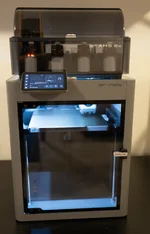
Once I put together my first scape and realized I could print some helpful parts and tools, I decided to purchase a new Bambu Labs A1 Mini. It opened my eyes to how easy and fun 3D printing could be. In the time since, I've been printing more and more items, not just for aquarium use, but stuff for projects all around the house. I decided it was time for an upgrade to something with a larger build volume. I was planning to move up to the A1 initially but then began thinking, perhaps having an enclosed printer might be smarter, to future proof my needs and desires going forward. After a lot of back-n-forth debating between the Bambu P2S and X2D, I ended up with the P2S this weekend. I have an expanding list of new aquarium related items I want to print
So what printers do others here use and what are your thoughts?
9 Replies
·
157 views


Supporting
Journal Low and Slow
Finally a journal.
I’ll soon be setting up two new tanks, a UNS 90p and a 50c. (Not so!) Patiently awaiting tanks and stands delivery.
They will both be middle energy tanks. I have lengthy periods of busy time and travel that mean the tanks need to survive without human intervention here and there. So plenty of automation is needed, and slow and steady wins over high energy. Or in BBQ smoking terms: low and slow.
Plans:
My last tank has had a rough year. Hurricane Helene meant two weeks with no electricity, and much longer without decent water changes.
Then last summer the tank developed a slow leak while I was out of town (ugh!). Had to fly home for a week to triage. Fish and plants have been in temporary tanks. Plants are struggling. Photo is when they had already been in temporary bin for over 6 weeks, I was surprised it didn’t look like an algae infested swamp.

Sooo ready for my new tanks! These are my first really nice tanks, I’ve only owned petco specials before.
For the new tanks I'm planning on over ordering plants since my surviving plants are clearly pretty weak at this point.
I’ll soon be setting up two new tanks, a UNS 90p and a 50c. (Not so!) Patiently awaiting tanks and stands delivery.
They will both be middle energy tanks. I have lengthy periods of busy time and travel that mean the tanks need to survive without human intervention here and there. So plenty of automation is needed, and slow and steady wins over high energy. Or in BBQ smoking terms: low and slow.
Plans:
- Injected CO2, but less than 30ppm
- Inert gravel
- Tidal HOB filter and partial UGF plate.
- Less than EI ferts, but more than PPS pro.
- Tap water (my tap is 50 TDS and only 10ppm Ca) remineralized to 30ppm Ca and 3-4 dKH.
- Lower light levels: Week aqua L on 90p and Chihiros wrgb 2 slim on 50c.
- Easy slow growing plants, and a few fish. Thinking the 50c will be a shrimp tank.
- Some hardscape but nothing crazy
My last tank has had a rough year. Hurricane Helene meant two weeks with no electricity, and much longer without decent water changes.
Then last summer the tank developed a slow leak while I was out of town (ugh!). Had to fly home for a week to triage. Fish and plants have been in temporary tanks. Plants are struggling. Photo is when they had already been in temporary bin for over 6 weeks, I was surprised it didn’t look like an algae infested swamp.
Sooo ready for my new tanks! These are my first really nice tanks, I’ve only owned petco specials before.
For the new tanks I'm planning on over ordering plants since my surviving plants are clearly pretty weak at this point.
56 Replies
·
4603 views

Staff member
I Donated 2026
Founding Member
Hello Welcome, Neo shredder
Welcome to ScapeCrunch, @Neo shredder!
We would love to get to know you. Please tell us about yourself. What tank do you have?
We would love to get to know you. Please tell us about yourself. What tank do you have?
0 Replies
·
11 views

Supporting
I Donated 2026
AquaGirls
It will be tough to get away, but I have managed to finagle enough coverage for the weekend, so I did it! I have my ticket! I figure why not? It’s actually not that far from me. Daichi Araki from ADA is teaching an aquascaping masterclass on Saturday morning. Also interested in the ADA Shizuku workshop.
Juris Jutjajevs previously announced he will be attending the Jersey show.
I have never been to an Aquashella, so don’t entirely know what to expect, but I presume it is much like any large convention exhibit hall experience. Any ‘Crunchers thinking of attending the Jersey show?
Juris Jutjajevs previously announced he will be attending the Jersey show.
I have never been to an Aquashella, so don’t entirely know what to expect, but I presume it is much like any large convention exhibit hall experience. Any ‘Crunchers thinking of attending the Jersey show?
24 Replies
·
561 views

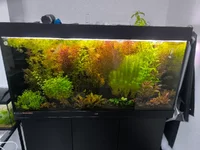
Hello everybody,
I want to vacuum my complete soil and pull out all the plants add some apt root tabs en replant after.
Does anybody have tips or tricks to keep the shrimp safe during this big clean up.
I have a 350 liter tank 120x50x60. So thats quite a big surface.
The reason for the clean up is that my plants need to be replanted since i have not been doing maintenance for a few weeks and had some algae problems.
Since i need to pull out all the plants, a big vacuum would not hurt and will be easy.
Thanks in advance
I want to vacuum my complete soil and pull out all the plants add some apt root tabs en replant after.
Does anybody have tips or tricks to keep the shrimp safe during this big clean up.
I have a 350 liter tank 120x50x60. So thats quite a big surface.
The reason for the clean up is that my plants need to be replanted since i have not been doing maintenance for a few weeks and had some algae problems.
Since i need to pull out all the plants, a big vacuum would not hurt and will be easy.
Thanks in advance
5 Replies
·
151 views

I Donated 2026
Expert in Residence
MOTM Winner
Started a new tank with the idea of show casing Lagenandra meeboldii which I have not showcased before. Wanted to feature Hygrophila lower Hlaingbwe, but I removed it later as I think it would be too large for this tank.
New substrate, new filter, squeezed filter mulm from the other matured tank, then ran the tank one week day before planting. 100% water change after planting, then 100% water change every other day since then. Dosing 1ml APT3 after water change day, and remineralizing to 5dGH using APT Sky. Trying out the low water column dosing approach for the initial period.
Filter: Oase 250
Lights: Week aqua a430 80%
Substrate: APT Feast
Was going to Journal about startup issues, however, it seems like the tank has already stabilized, skipping diatoms and green dust phase.
Freshly planted for a couple of days:
13/2/2026
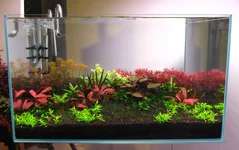
Replanted the tops for Myriophyllum roraima, Cut and replanted Rotala blood red to begin building up the bush form. Trimmed old leaves
Foreground seems a bit blocky for now, so I think I'lll move stuff round again. Probably when the BV grows out some more.
Pic on 23/2/2026
Readings at this stage:
Potassium: 2.3ppm
Ammonia: 0.1ppm
reduce water changes to 2 times a week.

New substrate, new filter, squeezed filter mulm from the other matured tank, then ran the tank one week day before planting. 100% water change after planting, then 100% water change every other day since then. Dosing 1ml APT3 after water change day, and remineralizing to 5dGH using APT Sky. Trying out the low water column dosing approach for the initial period.
Filter: Oase 250
Lights: Week aqua a430 80%
Substrate: APT Feast
Was going to Journal about startup issues, however, it seems like the tank has already stabilized, skipping diatoms and green dust phase.
Freshly planted for a couple of days:
13/2/2026
Replanted the tops for Myriophyllum roraima, Cut and replanted Rotala blood red to begin building up the bush form. Trimmed old leaves
Foreground seems a bit blocky for now, so I think I'lll move stuff round again. Probably when the BV grows out some more.
Pic on 23/2/2026
Readings at this stage:
Potassium: 2.3ppm
Ammonia: 0.1ppm
reduce water changes to 2 times a week.
99 Replies
·
8260 views

Journal Waterbox 20g AIO Planted Tank
NC AL’s Waterbox 20g AIO Planted Tank
Current view as of 5/26/26

Current view as of 5/26/26
Tank: Waterbox 20 AIO
Return pump: AI Axis 40
Lighting: (2) AI Blade Fresh 12”
Dosing pump: Ecotech Marine
CO2 injected
The purpose of this tank is to maintain a healthy planted tank for at least 1 year. There is a stipulation that I must be able to do this using my tap water for water changes.
63 Replies
·
2901 views
Staff member
I Donated 2026
Founding Member
Hello Welcome, Jemal
Welcome to ScapeCrunch, @Jemal!
We would love to get to know you. Please tell us about yourself. What tank do you have?
We would love to get to know you. Please tell us about yourself. What tank do you have?
0 Replies
·
23 views
Staff member
I Donated 2026
Founding Member
Hello Welcome, Patches
Welcome to ScapeCrunch, @Patches!
We would love to get to know you. Please tell us about yourself. What tank do you have?
We would love to get to know you. Please tell us about yourself. What tank do you have?
0 Replies
·
27 views

I Donated 2026
I wanted to share my experience so far with a cheap flow meter from Aliexpress.
I am generally a “you get what you pay for” aquarist, but I have taken a gamble due to circumstances. It is still early days, but it feels like it may have paid off.
Looking to add a flow meter to help tune my CO2 in a newly set up 130L tank, I searched far and wide for the different options. They were few and far between, most were for far larger flows than I needed and those that were appropriate were ridiculously expensive to get to Australia. So I went searching on the various Chinese discount sites and came across the LZB-3WB flow meters. They are cheap… real cheap. Less than $30 Australian landed, which made me nervous, but felt it was worth a shot at that price.
Not knowing what flow ranges I would need I ordered a 6-60ml/minute model.
After installing it, it was clearly too high of a range for my tank, but it did allow for some visibility while adjusting CO2. It was certainly better than a bubble counter.
Here is a picture of it action:

As you can see, the reading is below the scale of the meter, but with a marker I could at least set a starting point as I adjusted my CO2 higher. Also the adjustment valve was useless, a tiny turn would shut the flow off or open it to max out the meter.
I ordered the below as a replacement:

2.5-25ml/minute seems like a good range for my tank.
As a bonus the valve is better than most standard regulator needle valves. I can adjust the flow in increments of about 1ml/minute.
Below is the valve in action:

They have been in service for 2 months total now, 1 month each, so still an early review. It has been a solid upgrade though and was an easy install. They come with big 8mm barbed fittings but they can be unscrewed to reveal 1/8 female threads that standard needle valves for aquariums fit. I have also got some 1/8 to push fit fittings that I am yet to install as I am heading away on holiday for 2 weeks soon and don’t want to make any changes for the house-sitters to potentially have to fix!
Pros: adjusting my CO2 was made so much easier by being able to see exactly how much of an increase I was making with each adjustment. Monitoring that the valve isn’t drifting has been easy also, a quick check of the meter tells me it is steady.
Cons: I doubt that the reading is accurate. This means little to me, as I am not using it for a calculation or comparison between tanks. As long as the reading is consistent, even if it is wrong, I am fine with that. Also, the max pressure is listed as 40psi. I am unsure if that is a failure or accuracy maximum. Again, it doesn’t affect me as I run a low regulator pressure due to using a reactor. If I were using a diffuser that needed a high pressure, it may make me nervous.
As always, with any cheap gear, your mileage may vary. But, I thought it was worth sharing as it may help those with limited access to flow meters of appropriate sizes. So far it is proving to be the second best $25 I have spent on this tank, second only to the super red bristlenose I have in the tank.
I am generally a “you get what you pay for” aquarist, but I have taken a gamble due to circumstances. It is still early days, but it feels like it may have paid off.
Looking to add a flow meter to help tune my CO2 in a newly set up 130L tank, I searched far and wide for the different options. They were few and far between, most were for far larger flows than I needed and those that were appropriate were ridiculously expensive to get to Australia. So I went searching on the various Chinese discount sites and came across the LZB-3WB flow meters. They are cheap… real cheap. Less than $30 Australian landed, which made me nervous, but felt it was worth a shot at that price.
Not knowing what flow ranges I would need I ordered a 6-60ml/minute model.
After installing it, it was clearly too high of a range for my tank, but it did allow for some visibility while adjusting CO2. It was certainly better than a bubble counter.
Here is a picture of it action:
As you can see, the reading is below the scale of the meter, but with a marker I could at least set a starting point as I adjusted my CO2 higher. Also the adjustment valve was useless, a tiny turn would shut the flow off or open it to max out the meter.
I ordered the below as a replacement:
2.5-25ml/minute seems like a good range for my tank.
As a bonus the valve is better than most standard regulator needle valves. I can adjust the flow in increments of about 1ml/minute.
Below is the valve in action:
They have been in service for 2 months total now, 1 month each, so still an early review. It has been a solid upgrade though and was an easy install. They come with big 8mm barbed fittings but they can be unscrewed to reveal 1/8 female threads that standard needle valves for aquariums fit. I have also got some 1/8 to push fit fittings that I am yet to install as I am heading away on holiday for 2 weeks soon and don’t want to make any changes for the house-sitters to potentially have to fix!
Pros: adjusting my CO2 was made so much easier by being able to see exactly how much of an increase I was making with each adjustment. Monitoring that the valve isn’t drifting has been easy also, a quick check of the meter tells me it is steady.
Cons: I doubt that the reading is accurate. This means little to me, as I am not using it for a calculation or comparison between tanks. As long as the reading is consistent, even if it is wrong, I am fine with that. Also, the max pressure is listed as 40psi. I am unsure if that is a failure or accuracy maximum. Again, it doesn’t affect me as I run a low regulator pressure due to using a reactor. If I were using a diffuser that needed a high pressure, it may make me nervous.
As always, with any cheap gear, your mileage may vary. But, I thought it was worth sharing as it may help those with limited access to flow meters of appropriate sizes. So far it is proving to be the second best $25 I have spent on this tank, second only to the super red bristlenose I have in the tank.
26 Replies
·
1556 views