
Welcome to ScapeCrunch
We are ScapeCrunch, the place where planted aquarium hobbyists come to build relationships and support each other. When you're tired of doom scrolling, you've found your home here.
Social Feed
Chapter 1: Assessing the true status of plants/animals is not as easy as it first appears
1) First premise: The overall condition of an organism can be assessed by its external form or by its internal contents.
--- with the content being [with few exceptions] more important than the form, because the specific form is [in most cases] based on the content
--- the content has more predictive value than the form
--- there are exceptions when form may override content: e.g. external mechanical damage [e.g. due to too strong water flow or leaf nibbling by snails/fish] or algae/cyanobacteria infestation of plants [not due to their poor condition, but simply due to uncontrolled algal overgrowth]
2) Second premise: Most aquarists judge the condition of their plants/animals by their external form.
--- typically by growth rate, size, coloration, absence of external deformities or absence of algae (in plants) or by liveliness/vigor, appetite and ability to reproduce (in animals)
3) Result: Most aquarists judge the condition of their plants/animals by secondary (and therefore potentially misleading) measures.
Examples (possible combinations) of external and internal organism conditions that can theoretically occur:
A) good form + good content
B) good form + poor content
C) poor form + good content
D) poor form + poor content
It is important to realize that we do not know the inner content (i.e. the current state of metabolic processes) and we do not have many options to find out. However, if we don't know the second (and more important) part of the equation, we can't be sure of the outcome either!
PS: Many times we do everything we can to achieve the image we want to see in our aquarium, even at the cost of "torturing" its inhabitants. We are not interested in what our plants (or animals) like, but we have elevated our aesthetic preferences to a standard (measure) by which to judge their condition. If a plant fits our aesthetic preferences, then we declare it "perfectly healthy" (i.e. in optimal condition), without acknowledging the possibility that it may be in state B (i.e. good form + poor content).
Chapter 2: So how do we properly assess the condition of our plants/animals to be as close to reality as possible, even if we can't see inside them?
1) Take inspiration from nature (with its laws), use common sense and do not use extreme methods (typically for example unnaturally high nutrient doses)!
A number of scientific studies have presented the evidence that unnaturally high concentrations of certain nutrients (or inappropriate ratios) can be harmful to different plants [under certain circumstances].
--- For example, some studies have suggested that CO2 concentrations above 40 ppm can have a narcotic effect on some plants. Other specialized or scholarly literature recommends 10-20 ppm as the maximum recommended long-term CO2 concentration for aquatic organisms, as higher concentrations can lead to various internal metabolic and physiological disturbances. If it is true that we should not expose aquarium animals to CO2 concentrations above 20 ppm, but we still expose them to such concentrations [long term], then what else can we call it but deliberate torture?
Such high nutrient concentrations [that are used and recommended by some aquarists] are not commonly found anywhere in unpolluted natural waters.
--- While this does not mean anything in itself, it is good to realize that if something is not commonly found in nature (i.e. plants and animals do not normally encounter it), then it is highly likely that they have not developed any mechanisms to cope with such unnatural concentrations (= extremes), or they do have some mechanisms, but they are not built for such extreme situations (i.e. extreme nutrient concentrations). This assumption is logical and central, and is supported by a number of scientific studies.
If we cannot be 100% certain that the concentrations of nutrients (or other agents) we use are truly harmless to our plants/animals, then it is certainly reasonable to stick to such concentrations and mimic conditions that are as close as possible to the natural ones in which the plants/animals in question have thrived for thousands of years (and are thus perfectly evolutionarily adapted to).
While using extremely high doses of nutrients may result in "bigger, faster growing and more colourful" plants, it may also place an unnatural strain on their internal metabolism (in other words, stress them continuously).
--- I have unfortunately met aquarists who cannot admit this possibility. They believe that "good form" is automatically unquestionable proof of overall optimal condition.
2) Continue to evaluate plants/animals by external form, but with the understanding that it is not the only (and obviously not the most important!) measure.
3) If you can afford it, also perform internal content analysis (e.g., dry matter nutrient content can be a relatively useful indicator).
4) Conduct comparative tests.
--- Why use extreme methods when similar results can often be achieved with much more moderate methods that are much gentler on aquarium plants/animals?
--- Take a look at my latest experiment for example, where I only use something like ~11 ppm CO2 (+ very low doses of other nutrients) and think about whether it is really necessary to use that much more.
A few final notes on algae:
Sometimes we use to say that "algae only attack unhealthy plants". But how can we know that a plant infested with algae is unhealthy if we are only able to judge its health by its external form?
Of course, it is possible (even likely) that a fast-growing leaf is a worse surface for algae to attach to than a slow-growing (or stagnant) leaf. Of course, a healthy organism is generally more resistant to disease than an unhealthy one. But does this always and everywhere (in all circumstances) apply? Will a plant that grows in an environment perfectly suited to algae successfully resist it? And will it resist them even if we remove all algae eaters (snails/shrimps) from the aquarium, cancel filtration, stop using the surface skimmer, stop regular maintenance and water changes? I highly doubt it. On the contrary, I am convinced that if you remove all the means that help keep algae at bay from the aquarium, then the healthiest plant will not be able to resist them. In an aquarium with no filtration and no bunch of shrimps, algae will simply appear after a month, even if you crawl on hands and knees over broken glass. And regular maintenance and weekly 50% water changes won't help either. On the other hand, with an army of shrimps I don't have to do anything and the algae will never show up.
I know this topic will probably be a bit controversial for some, but I wanted to bring it up here anyway, so that we can at least think about it. I am not imposing my views here on anyone. Advocates as well as opponents of my views will surely find many other arguments to support their views (which is certainly a good thing).
1) First premise: The overall condition of an organism can be assessed by its external form or by its internal contents.
--- with the content being [with few exceptions] more important than the form, because the specific form is [in most cases] based on the content
--- the content has more predictive value than the form
--- there are exceptions when form may override content: e.g. external mechanical damage [e.g. due to too strong water flow or leaf nibbling by snails/fish] or algae/cyanobacteria infestation of plants [not due to their poor condition, but simply due to uncontrolled algal overgrowth]
2) Second premise: Most aquarists judge the condition of their plants/animals by their external form.
--- typically by growth rate, size, coloration, absence of external deformities or absence of algae (in plants) or by liveliness/vigor, appetite and ability to reproduce (in animals)
3) Result: Most aquarists judge the condition of their plants/animals by secondary (and therefore potentially misleading) measures.
Examples (possible combinations) of external and internal organism conditions that can theoretically occur:
A) good form + good content
1) External form = good
2) Internal content = good
3) Overall condition = optimal
B) good form + poor content
1) External form = good => e.g. disturbed internal metabolism but not reflected in external appearance
2) Internal content = bad
3) Overall condition = suboptimal
- Example (in fish): higher concentration of harmful substances in internal organs, nephrocalcinosis (deposits in kidneys), higher mortality rate of fry, shorter lifespan, overall higher stress levels etc.
- Example (in plants): higher concentration of harmful substances or too high concentration of nutrients in the tissue, "obesity", increased excretion of organic exudates, mild poisoning (narcotic effect), different colouration - richer or paler (paradoxically considered desirable by aquarists and as evidence of optimal condition)
C) poor form + good content
1) External form = bad => e.g. external deformation due to purely external damage (without serious impact on the overall state of internal metabolism)
2) Internal content = good
3) Overall condition = suboptimal
D) poor form + poor content
1) External form = poor => e.g. disturbed internal metabolism which is also reflected in the external appearance
2) Internal content = bad
3) Overall condition = suboptimal
It is important to realize that we do not know the inner content (i.e. the current state of metabolic processes) and we do not have many options to find out. However, if we don't know the second (and more important) part of the equation, we can't be sure of the outcome either!
PS: Many times we do everything we can to achieve the image we want to see in our aquarium, even at the cost of "torturing" its inhabitants. We are not interested in what our plants (or animals) like, but we have elevated our aesthetic preferences to a standard (measure) by which to judge their condition. If a plant fits our aesthetic preferences, then we declare it "perfectly healthy" (i.e. in optimal condition), without acknowledging the possibility that it may be in state B (i.e. good form + poor content).
Chapter 2: So how do we properly assess the condition of our plants/animals to be as close to reality as possible, even if we can't see inside them?
1) Take inspiration from nature (with its laws), use common sense and do not use extreme methods (typically for example unnaturally high nutrient doses)!
A number of scientific studies have presented the evidence that unnaturally high concentrations of certain nutrients (or inappropriate ratios) can be harmful to different plants [under certain circumstances].
--- For example, some studies have suggested that CO2 concentrations above 40 ppm can have a narcotic effect on some plants. Other specialized or scholarly literature recommends 10-20 ppm as the maximum recommended long-term CO2 concentration for aquatic organisms, as higher concentrations can lead to various internal metabolic and physiological disturbances. If it is true that we should not expose aquarium animals to CO2 concentrations above 20 ppm, but we still expose them to such concentrations [long term], then what else can we call it but deliberate torture?
Such high nutrient concentrations [that are used and recommended by some aquarists] are not commonly found anywhere in unpolluted natural waters.
--- While this does not mean anything in itself, it is good to realize that if something is not commonly found in nature (i.e. plants and animals do not normally encounter it), then it is highly likely that they have not developed any mechanisms to cope with such unnatural concentrations (= extremes), or they do have some mechanisms, but they are not built for such extreme situations (i.e. extreme nutrient concentrations). This assumption is logical and central, and is supported by a number of scientific studies.
If we cannot be 100% certain that the concentrations of nutrients (or other agents) we use are truly harmless to our plants/animals, then it is certainly reasonable to stick to such concentrations and mimic conditions that are as close as possible to the natural ones in which the plants/animals in question have thrived for thousands of years (and are thus perfectly evolutionarily adapted to).
While using extremely high doses of nutrients may result in "bigger, faster growing and more colourful" plants, it may also place an unnatural strain on their internal metabolism (in other words, stress them continuously).
--- I have unfortunately met aquarists who cannot admit this possibility. They believe that "good form" is automatically unquestionable proof of overall optimal condition.
2) Continue to evaluate plants/animals by external form, but with the understanding that it is not the only (and obviously not the most important!) measure.
3) If you can afford it, also perform internal content analysis (e.g., dry matter nutrient content can be a relatively useful indicator).
4) Conduct comparative tests.
--- Why use extreme methods when similar results can often be achieved with much more moderate methods that are much gentler on aquarium plants/animals?
--- Take a look at my latest experiment for example, where I only use something like ~11 ppm CO2 (+ very low doses of other nutrients) and think about whether it is really necessary to use that much more.
A few final notes on algae:
Sometimes we use to say that "algae only attack unhealthy plants". But how can we know that a plant infested with algae is unhealthy if we are only able to judge its health by its external form?
Of course, it is possible (even likely) that a fast-growing leaf is a worse surface for algae to attach to than a slow-growing (or stagnant) leaf. Of course, a healthy organism is generally more resistant to disease than an unhealthy one. But does this always and everywhere (in all circumstances) apply? Will a plant that grows in an environment perfectly suited to algae successfully resist it? And will it resist them even if we remove all algae eaters (snails/shrimps) from the aquarium, cancel filtration, stop using the surface skimmer, stop regular maintenance and water changes? I highly doubt it. On the contrary, I am convinced that if you remove all the means that help keep algae at bay from the aquarium, then the healthiest plant will not be able to resist them. In an aquarium with no filtration and no bunch of shrimps, algae will simply appear after a month, even if you crawl on hands and knees over broken glass. And regular maintenance and weekly 50% water changes won't help either. On the other hand, with an army of shrimps I don't have to do anything and the algae will never show up.
I know this topic will probably be a bit controversial for some, but I wanted to bring it up here anyway, so that we can at least think about it. I am not imposing my views here on anyone. Advocates as well as opponents of my views will surely find many other arguments to support their views (which is certainly a good thing).
35 Replies
·
4396 views


Supporting
I Donated 2026
Rockstar
Article Contributor
This is not a step by step tutorial, more for inspiration and general information!
My very first DIY stand was a 100cm two-door home-depot plywood stand. It looks fine in pictures, but was NOT up to the insanely high, unhealthy standards of excellence that I hold myself to with everything:
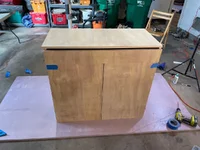


No journal for this old tank.
The lesson here was: don’t use home depot plywood! It sucks. Find a real plywood dealer and spend the extra $.
My next stand was way more ambitious: a 150cm x 60cm stand, designed to hold up 2400+ lbs, made from quality baltic birch plywood. 3 doors, two interior weight-bearing vertical panels, adjustable leveling feet. It worked great, and can be seen in my two journals Many Lessons and Inert Sand Trials:
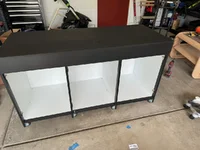
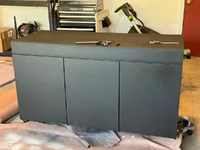
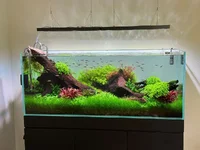
I did a WAY better job on this stand, and it now resides with @Kwyet ! Also, a spray finish really makes a big difference.
After that, the 90cm Experiment Tank stand. Two doors, and instead of a cumbersome middle panel, I used one hefty plywood column:


Scottish accent Fookin' crispay
This tank also had a waterproof, sealed bottom “rim” so up to 2cm of water would have to fill the stand bottom before it overflows. Useful for emergencies or leaks, when combined with loud water leak alarms! This stand and tank is in my garage, soon to be sold to anyone in Colorado who wants it!
This stand is for my new 120cm tank! This stand is the culmination of seven years of stand-making. All of my mistakes, lessons, preferences, and skills were combined to make the stand of my dreams!
And of course, I had to move homes and got seriously injured, requiring surgery, while I was trying to finish it. Sorry for the lack of pictures!
I would not say this design is beginner friendly. It’s not expert, but likely intermediate difficulty. I have a Wen track saw and a Sawstop PCS Cabinet saw, which changes the entire process compared to someone working with more difficult tools. I also have a Graco Magnum X7 paint sprayer for a professional paint finish.
First, I started with mocking up the stand in Shapr3D, my modeling program:
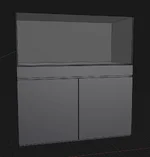

My local lumber company had really good deals on 5x5’ sheets of ¾” baltic birch plywood.
IT IS CRITICAL for precision woodworking like this (no trim to cover up mistakes) to get exact measurements, particularly for the thickness of the plywood. For example, using a pair of digital calipers, this 3/4" plywood was 17.8mm thick (0.7 in a lot smaller than .75"), which is what I used in my modeling program to create the exact length of cuts to properly span 120cm long and 60cm deep.
I collected the exact measurements of each part needed, and threw it into Opticutter to determine how to best cut my 5x5’ plywood sheets:
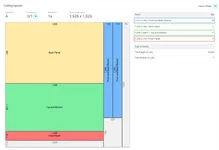
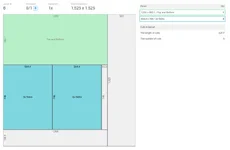

You don't need to study these sheets; the photos are just to show you how Opticutter works to save you from creating too much waste, and using the fewest cuts!
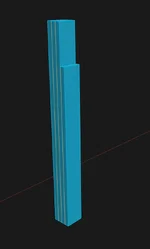
4-plywood-thick center column, with "notch" for the front brace to fit flush:
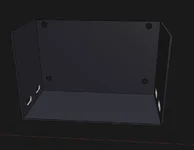
Top down first on a flat, even surface, then add sides and back:
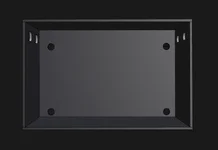
Flip right-side-up, and add the bottom panel:
Add the rear brace, the front brace, and the center column. Make sure the front brace and column are flush with the front of the top/back panel edges.
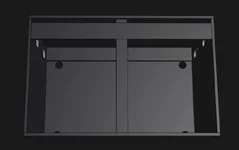
Add the front panel and bottom lip pieces:
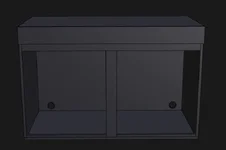
For the doors, create a notched finger pull (side view):

Door hinge stuff:
And it's done! Here's some of the few pictures I DID take of this process, sorry! I had a lot going on:
Gluing the 4-ply-thick center column:

To make the access holes in the back and side panels, I 3D printed some plastic guides for my router bit to follow, then roughly cut the inside out so the router had less material to work through:

Perfect routered holes:
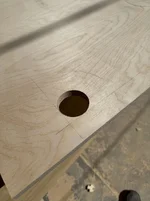
I learned to score the plywood with my box cutter first, so when it chipped from the rough jigsaw cut, it chipped ONLY to the scored lines:

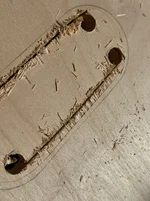
I removed the excess interior material with the jigsaw, then routered. I also used a roundover bit (in process on the left hole, right hole not rounded):
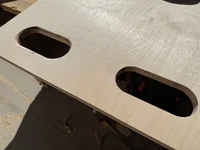
Any chips or imperfections could be fixed later with bondo wood filler and sanding.
Once I had my access holes cut out, I could assemble! I used clamps to hold the panels together and flush, used an Incra T-Rule (amazing device) to mark a line that was the middle of my plywood panel's core:

Then, I drilled countersink holes with this bit for the screw heads to sit below the level of the wood:
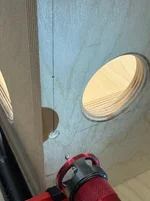
Screws:
Since the screws on the top, bottom, and rear of the stand would never be visible, I decided to skip the annoying "pocket screw and glue" scenario and just go with crazy robust torx-head 1.5” construction screws. I LOVED it. Definitely my preferred method, though they really do require pre-drilling AND drilling countersink heads. Still, way stronger than pocket screws my god.
Wood filling and Priming:
Bondo wood filler is amazing stuff. I used TONS of it, this was just the first pass:
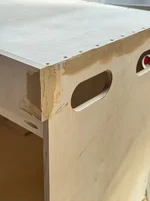
Apply, sand, apply more, sand more.
Then I primed with Sherwin Williams Gallery Series primer, and sprayed with a TrueAirless 515 tip in my Magnum X7:

Once the primer was dry, I sanded it, and sprayed again. Once dry, sanded again. Lots of sanding:

I wiped the tank down with tack cloth, then went for the finishing coat using a Graco FFLP 310 Tip and Sherwin-Williams Gallery Series Waterborne Topcoat in true black. Probably a matte or satin sheen, I can’t recall. Not cheap, good paint! Make sure to filter your paint through a find mesh before spraying.
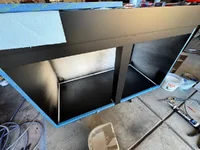
By far the best, most perfect finish I've ever had on a stand. BTW, the doors are fully adjustable up, down, left and right to get them nicely aligned. Blum hinges rock!
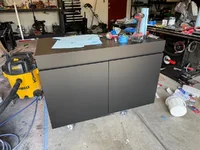
Once it was all put together, I got some help to move it into the new house. And installed the oversized Aquarium Mat.
I paid Tommy, the owner of Aqua Rocks Colorado, a delivery fee to have my custom 120x60x50cm tank delivered and installed on the stand. Once positioned evenly around all sides, I trimmed the aquarium mat with an Xacto knife, and was finished!
I'm tired today, but I'll upload more pics of this stand soon to this thread and to the 120cm Journal, too!
My very first DIY stand was a 100cm two-door home-depot plywood stand. It looks fine in pictures, but was NOT up to the insanely high, unhealthy standards of excellence that I hold myself to with everything:
No journal for this old tank.
The lesson here was: don’t use home depot plywood! It sucks. Find a real plywood dealer and spend the extra $.
My next stand was way more ambitious: a 150cm x 60cm stand, designed to hold up 2400+ lbs, made from quality baltic birch plywood. 3 doors, two interior weight-bearing vertical panels, adjustable leveling feet. It worked great, and can be seen in my two journals Many Lessons and Inert Sand Trials:
I did a WAY better job on this stand, and it now resides with @Kwyet ! Also, a spray finish really makes a big difference.
After that, the 90cm Experiment Tank stand. Two doors, and instead of a cumbersome middle panel, I used one hefty plywood column:
Scottish accent Fookin' crispay
This tank also had a waterproof, sealed bottom “rim” so up to 2cm of water would have to fill the stand bottom before it overflows. Useful for emergencies or leaks, when combined with loud water leak alarms! This stand and tank is in my garage, soon to be sold to anyone in Colorado who wants it!
The new 120cm stand:
This stand is for my new 120cm tank! This stand is the culmination of seven years of stand-making. All of my mistakes, lessons, preferences, and skills were combined to make the stand of my dreams!
And of course, I had to move homes and got seriously injured, requiring surgery, while I was trying to finish it. Sorry for the lack of pictures!
I would not say this design is beginner friendly. It’s not expert, but likely intermediate difficulty. I have a Wen track saw and a Sawstop PCS Cabinet saw, which changes the entire process compared to someone working with more difficult tools. I also have a Graco Magnum X7 paint sprayer for a professional paint finish.
First, I started with mocking up the stand in Shapr3D, my modeling program:
My local lumber company had really good deals on 5x5’ sheets of ¾” baltic birch plywood.
IT IS CRITICAL for precision woodworking like this (no trim to cover up mistakes) to get exact measurements, particularly for the thickness of the plywood. For example, using a pair of digital calipers, this 3/4" plywood was 17.8mm thick (0.7 in a lot smaller than .75"), which is what I used in my modeling program to create the exact length of cuts to properly span 120cm long and 60cm deep.
I collected the exact measurements of each part needed, and threw it into Opticutter to determine how to best cut my 5x5’ plywood sheets:
You don't need to study these sheets; the photos are just to show you how Opticutter works to save you from creating too much waste, and using the fewest cuts!
Steps I followed for this stand:
- Cut all panels using table/track saw.
- Make 4-ply support column. Make notch cut ~145mm from top of column to fit behind front brace. Glue and trim/clean.
- Cut out "access holes" in panels, including pocket holes for front and back brace, predrilled holes for front brace (in middle, and upper portion for future front panel) and predrilled holes for back panel. Use a router with roundover bit to create round, smooth holes for cord and tubing access, as well as handles for moving the stand around!
- Run the "standing height "of the side and back panels (and 4-ply center column) through table saw to make uniform height for all 4 parts. All of these 4 parts should be cut to the exactly same height.
- Trim door “finger-pull” with a router. Just a 45-degree "slice" off the door's corner to make a finger pull.
- To assemble: Flip top upside down, test fit sides and back, secure with screws. Make front edge flush, back can be trimmed down with router flush bit if necessary.
- Attach the bottom panel, Make front edge flush, as the back can be trimmed down.
- Add 4-ply column, ensure front edge flush.
- Add front and back "braces".
- Add front panel, and bottom "lips" that hold any spilled water in.
- Spray and sand stand, fill gaps with Bondo wood filler. Sand and repeat until corners, cracks and divots are smooth.
- Caulk the inner corners where water would be.
- Paint stand and doors.
- Attach doors.
- Add feet.
- Run electrical and LED strips.
- Cut foam mat to size.
4-plywood-thick center column, with "notch" for the front brace to fit flush:
Top down first on a flat, even surface, then add sides and back:
Flip right-side-up, and add the bottom panel:
Add the rear brace, the front brace, and the center column. Make sure the front brace and column are flush with the front of the top/back panel edges.
Add the front panel and bottom lip pieces:
For the doors, create a notched finger pull (side view):
Door hinge stuff:
And it's done! Here's some of the few pictures I DID take of this process, sorry! I had a lot going on:
Gluing the 4-ply-thick center column:
To make the access holes in the back and side panels, I 3D printed some plastic guides for my router bit to follow, then roughly cut the inside out so the router had less material to work through:
Perfect routered holes:
I learned to score the plywood with my box cutter first, so when it chipped from the rough jigsaw cut, it chipped ONLY to the scored lines:
I removed the excess interior material with the jigsaw, then routered. I also used a roundover bit (in process on the left hole, right hole not rounded):
Any chips or imperfections could be fixed later with bondo wood filler and sanding.
Once I had my access holes cut out, I could assemble! I used clamps to hold the panels together and flush, used an Incra T-Rule (amazing device) to mark a line that was the middle of my plywood panel's core:
Then, I drilled countersink holes with this bit for the screw heads to sit below the level of the wood:
Screws:
Since the screws on the top, bottom, and rear of the stand would never be visible, I decided to skip the annoying "pocket screw and glue" scenario and just go with crazy robust torx-head 1.5” construction screws. I LOVED it. Definitely my preferred method, though they really do require pre-drilling AND drilling countersink heads. Still, way stronger than pocket screws my god.
- SPAX #8, 1-1/2" Interior Flat Head Torx Wood Screws
- INCRA T-Ruler 6 inch for marking my ~8.9mm line (middle of the plywood core I was screwing into).
Wood filling and Priming:
Bondo wood filler is amazing stuff. I used TONS of it, this was just the first pass:
Apply, sand, apply more, sand more.
Then I primed with Sherwin Williams Gallery Series primer, and sprayed with a TrueAirless 515 tip in my Magnum X7:
Once the primer was dry, I sanded it, and sprayed again. Once dry, sanded again. Lots of sanding:
I wiped the tank down with tack cloth, then went for the finishing coat using a Graco FFLP 310 Tip and Sherwin-Williams Gallery Series Waterborne Topcoat in true black. Probably a matte or satin sheen, I can’t recall. Not cheap, good paint! Make sure to filter your paint through a find mesh before spraying.
By far the best, most perfect finish I've ever had on a stand. BTW, the doors are fully adjustable up, down, left and right to get them nicely aligned. Blum hinges rock!
Once it was all put together, I got some help to move it into the new house. And installed the oversized Aquarium Mat.
I paid Tommy, the owner of Aqua Rocks Colorado, a delivery fee to have my custom 120x60x50cm tank delivered and installed on the stand. Once positioned evenly around all sides, I trimmed the aquarium mat with an Xacto knife, and was finished!
I'm tired today, but I'll upload more pics of this stand soon to this thread and to the 120cm Journal, too!
Questions? Ask below! I love to help out.
1 Replies
·
16 views

Supporting
I Donated 2026
Rockstar
Article Contributor
See this post regarding AR Mini trimming/planting, and this post regarding Cyperus helferi trimming and planting!
I have hardly seen this subject talked about enough, but I think that it's one of the biggest reasons contributing to beginner's algae-filled downfalls! If you're buying plants from big stores like Aquarium Plants Factory (really good btw), Buceplant, etc. 90% of the plants you are receiving are terrestrially-grown.
Here's an important fact about terrestrially-grown aquarium plants
100% of all terrestrial leaves, when submerged under water, for any plant, will eventually get algae and die.
Some can take a while (anubias, java fern, cyperus helferi), while others will either melt (Crypts) or quickly get algae (AR Mini, Staurogyne repens, stem plants, etc)
But what about buying submerged-growth plants? From hobbyists, or BurrAqua, for example?
There is still a chance that your tank's conditions are different enough that many, if not most leaves you plant, will melt/die/attract algae.
How do we fix this? By leaving only enough leaves for the plant to continue to absorb light and put out new growth. Usually the top 4-6 leaves for stem plants.
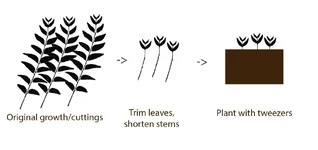
It's a lot of work up front, but you will MAJORLY reduce the amount of waste, DOC 's, and algae-inducing scenarios if you trim your plants before planting.
I've done this in ALL of my tanks in the last 4 years with great success.
The easiest way to do this is with stainless squeeze scissors over your sink:
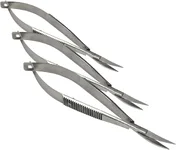
Here's the ones I recommend.
Yes, it takes a ton of patience. But if it could make a big difference in preventing the 2-3 month algae bloom in your tank, would you do it?
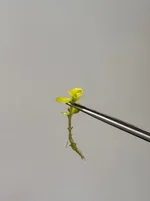
Lysimachia nummularia 'Aurea', only a few top leaves left, 3" of stem.
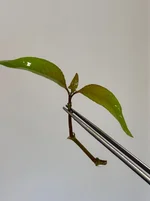
Hygrophila corymbosa. Note how I left the leaf nodes on the stem? That's where roots will grow from. Almost all stem plants need nodes to grow roots, even if you've removed the leaves from them.
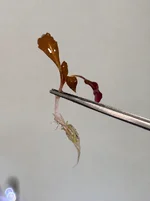
Terrestrially-grown AR 'Mini' from APF. See how I did the same in this thread for my previous tanks.
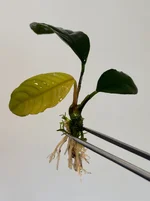
This Anubias barteri var. coffeefolia was grown terrestrially (often called 'emersed' or emergent) in a greenhouse. I removed all but the newest 3 leaves, and trimmed the roots too. Terrestrial roots are quite different from submerged with certain plants.
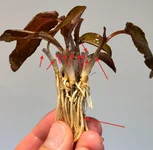
Almost ALL Cryptocoryne species are grown terrestrially. These plants grow as a Rosette, where the inner-most leaves on the "stem" are the freshest, and the outer-most are the oldest. I removed a TON of old terrestrial leaves, leaving just enough for the plant to be able to grow new submerged leaves in my tank as quickly as possible, while leaving as few algae-attracting terrestrial leaves as possible. I also trimmed the roots, which were 5" long upon receiving the plant.

Lobelia cardinalis 'mini'
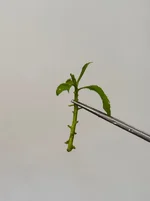
Penthorum sedoides. Would also look very similar for Staurogyne repens, too.
Did you know that Blyxa japonica is actually a stem plant? It looks like a rosette, but it's actually a squat, wide stem plant. The lowest/outermost leaves are the oldest, and even though this is a true aquatic plant with no terrestrial form in nature, I know that it likes to throw a fit and melt a good portion of it's oldest leaves when transitioning to my tank's conditions. Here's what it looked like when I received it from @Burr740:

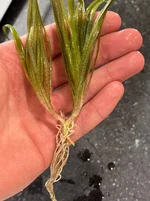
Nice and trimmed up. Less problematic at the 1-2 month mark in the tank's development, I know it!
What about delicate/feather plants?
They're super annoying to prep. I still only keep the top 3-4" max.
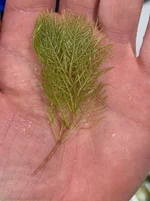
With Myriophyllum mattogrossense 'Golden', I only keep a few inches and still try to remove some of the lower leaves that would otherwise just rot by being buried in my inert sand.

What about Myriophyllum sp. "Roraima"? F*ck that. Nightmare to trim lower leaves, just trim it to 3" (not pictured) and discard the bottom when planting.
Curious what you guys think! I know I could receive plenty of "I've never done this, my tank has been fine" but I'd recommend trying it first before having a strong opinion of it
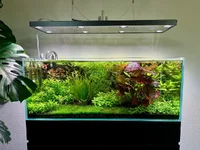
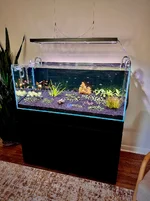
By the way, all plants pictured were actually used in my upcoming 120cm Showcase tank:
I have hardly seen this subject talked about enough, but I think that it's one of the biggest reasons contributing to beginner's algae-filled downfalls! If you're buying plants from big stores like Aquarium Plants Factory (really good btw), Buceplant, etc. 90% of the plants you are receiving are terrestrially-grown.
Here's an important fact about terrestrially-grown aquarium plants
100% of all terrestrial leaves, when submerged under water, for any plant, will eventually get algae and die.
Some can take a while (anubias, java fern, cyperus helferi), while others will either melt (Crypts) or quickly get algae (AR Mini, Staurogyne repens, stem plants, etc)
But what about buying submerged-growth plants? From hobbyists, or BurrAqua, for example?
There is still a chance that your tank's conditions are different enough that many, if not most leaves you plant, will melt/die/attract algae.
How do we fix this? By leaving only enough leaves for the plant to continue to absorb light and put out new growth. Usually the top 4-6 leaves for stem plants.
It's a lot of work up front, but you will MAJORLY reduce the amount of waste, DOC 's, and algae-inducing scenarios if you trim your plants before planting.
I've done this in ALL of my tanks in the last 4 years with great success.
The easiest way to do this is with stainless squeeze scissors over your sink:
Here's the ones I recommend.
Yes, it takes a ton of patience. But if it could make a big difference in preventing the 2-3 month algae bloom in your tank, would you do it?
Here are some specific plant examples:
For most true stem plants, I like to leave 3-4" of stem, trimming roots if necessary, and leaving only 4-6 of the freshest leaves. More than that, they will eventually be algae magnets. Less than that (like 2 leaves only) they might not survive the shock.Lysimachia nummularia 'Aurea', only a few top leaves left, 3" of stem.
Hygrophila corymbosa. Note how I left the leaf nodes on the stem? That's where roots will grow from. Almost all stem plants need nodes to grow roots, even if you've removed the leaves from them.
Terrestrially-grown AR 'Mini' from APF. See how I did the same in this thread for my previous tanks.
This Anubias barteri var. coffeefolia was grown terrestrially (often called 'emersed' or emergent) in a greenhouse. I removed all but the newest 3 leaves, and trimmed the roots too. Terrestrial roots are quite different from submerged with certain plants.
Almost ALL Cryptocoryne species are grown terrestrially. These plants grow as a Rosette, where the inner-most leaves on the "stem" are the freshest, and the outer-most are the oldest. I removed a TON of old terrestrial leaves, leaving just enough for the plant to be able to grow new submerged leaves in my tank as quickly as possible, while leaving as few algae-attracting terrestrial leaves as possible. I also trimmed the roots, which were 5" long upon receiving the plant.
Lobelia cardinalis 'mini'
Penthorum sedoides. Would also look very similar for Staurogyne repens, too.
Did you know that Blyxa japonica is actually a stem plant? It looks like a rosette, but it's actually a squat, wide stem plant. The lowest/outermost leaves are the oldest, and even though this is a true aquatic plant with no terrestrial form in nature, I know that it likes to throw a fit and melt a good portion of it's oldest leaves when transitioning to my tank's conditions. Here's what it looked like when I received it from @Burr740:
Nice and trimmed up. Less problematic at the 1-2 month mark in the tank's development, I know it!
What about delicate/feather plants?
They're super annoying to prep. I still only keep the top 3-4" max.
With Myriophyllum mattogrossense 'Golden', I only keep a few inches and still try to remove some of the lower leaves that would otherwise just rot by being buried in my inert sand.
What about Myriophyllum sp. "Roraima"? F*ck that. Nightmare to trim lower leaves, just trim it to 3" (not pictured) and discard the bottom when planting.
Curious what you guys think! I know I could receive plenty of "I've never done this, my tank has been fine" but I'd recommend trying it first before having a strong opinion of it
By the way, all plants pictured were actually used in my upcoming 120cm Showcase tank:
0 Replies
·
10 views

Staff member
I Donated 2026
Founding Member
Hello Welcome, jujypop
Welcome to ScapeCrunch, @jujypop!
We would love to get to know you. Please tell us about yourself. What tank do you have?
We would love to get to know you. Please tell us about yourself. What tank do you have?
0 Replies
·
9 views

Journal 22 gallon long bookshelf
Time to start a new thread.
I’ll fill in some details later, but I’m working on the hardscape now. Any and all criticism is appreciated. The vision is nothing more, and nothing less, than something appealing to the eye.
90cm x 30cm x 30cm Lifegard Aquatics ultra clear bookshelf tank. Buce and anubias on the hardscape, stems towards the back and center, mid to front carpet with some changes in shade and texture down to a flat grade on the right side of the tank.
Lily pipe inlet and skimmer will be in the back left corner with the outflow in the front left to hopefully achieve circular flow. I’ll be running an in-line diffuser. Light will be the P600 Pro that I regrettably did not upside to 900. Oh well. I’ll mount it high and hopefully it’ll have enough spread.
I have some dragon stone and red lava rock rubble I’ll use at the base to blend into the substrate, as well as some stratum I may or may not cap with.


I’ll fill in some details later, but I’m working on the hardscape now. Any and all criticism is appreciated. The vision is nothing more, and nothing less, than something appealing to the eye.
90cm x 30cm x 30cm Lifegard Aquatics ultra clear bookshelf tank. Buce and anubias on the hardscape, stems towards the back and center, mid to front carpet with some changes in shade and texture down to a flat grade on the right side of the tank.
Lily pipe inlet and skimmer will be in the back left corner with the outflow in the front left to hopefully achieve circular flow. I’ll be running an in-line diffuser. Light will be the P600 Pro that I regrettably did not upside to 900. Oh well. I’ll mount it high and hopefully it’ll have enough spread.
I have some dragon stone and red lava rock rubble I’ll use at the base to blend into the substrate, as well as some stratum I may or may not cap with.
237 Replies
·
25418 views
Staff member
I Donated 2026
Founding Member
This is the future home for the announcements when someone obtains an achievement badge. Let the games begin!
2030 Replies
·
50191 views

Supporting
I Donated 2026
Journal MrJG - UNS 90L
@Sb1415 Apologies I totally snagged the format of your journal post for this so thank you!
Many moons ago I was an active and contributing member on plantedtank.net, I think at one point I had around 14 scaped tanks going before burnout and life changes. Instead of weekends consisting of maintenance I transitioned to camping/boating and life has been great. I’ve always missed it. After downsizing and making a move to a new home I kept only a small 12x12 cube tank that started life as an amateur iwagumi layout, Seiryu and hairgrass only. I put it on the nightstand beside my bed and added some of my favorite Anubias and crypts from taken down tanks. Its been sitting there running for 5-6 years now, low light, top offs only w tap. Maintenance when it got out of control. Super old aquasoil now flattened out to a thick 4-5 inch thick layer in a perfect line front to back.
In Aug/Sept 25 had a bit of a health issue that kept me in bed for several weeks recovering while I looked at this sad little cube, mostly healthy but not truly thriving. No fertilizer being added for years, GDA covered anubias leaves that also were many years old and I thought to myself I should make this better… that was the tipping point. OK I’ll do a deep clean on the substrate, get some stems to throw in there, maybe get a carpet going. Tissue cultures/stems ordered and I got to work. No more top offs, 10% water changes instead. TDS ~900 when I started. Ultimately everything melted back and didn’t grow well. I’d been keeping the lighting so dim all these years to maintain just the crypts/epiphytes without it turning into a mess and I was ok with it again. That was the spark.
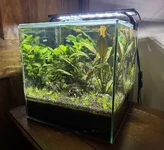
I decided I wanted to build out a new tank, most of my old hardware/tanks I had let go of in a bulk way so I was going to have to start new with everything sans some 5 gallon buckets of Amazonia that I’d placed in the basement of the new house.. Phoenix rising from the ashes? Most likely more like algae emerging from the depths. I still consider myself a beginner and maybe amateur at best so yeah…
So I got to work again reading, researching, what’s new, what has changed since I’ve been out of the loop for so long? Ooo dark start that sounds much better, in line CO2 diffusers cool! CO2 reactors, pretty awesome sounding, 2Hr aquarist read every article, and I’m back in baby!
Tank inspiration
None really hence no name, it fit right into a slot to occupy my mind from a not so great situation that I was in and I’m ok with that. Ultimately I’d like this to be a low-mid energy tank that can have minimal amounts of weekly maintenance while still looking the part. I’d prefer to keep it as simple as possible while still having some high tech bits. Get all the equipment out of the tank, co2, low-mid level lighting, minimal/simple fertilization. I got busy ordering equipment and started brainstorming layouts and what hardscape materials I could find. Instagram was my friend for a while, seems that everything that kept grabbing my attention were island style layouts with a very thin layer of sand surrounding. I’ve also always been partial to big chonky pieces of driftwood, I thought to go the manzanita route but wysiwyg pieces were fetching stupid prices. I ran across this ironwood in a listing and couldn’t let it go. The deep lines in the bark were just calling me so I quick snap ordered it before my brain could process dimensions, I knew it would fit but didn’t fully visualise how much it would ultimately limit the layout. I wanted to stay mostly inert with stone and eventually/begrudgingly ordered the tumbled lava stone with the intention of keeping it to a island/river layout style and mimicking some of my found instagram muse tanks. It will mostly likely end up more nature style although the start will be more Willy Wonka than anything. Thanks @Burr740 for that, I shopped like a kid in a candy store.
Equipment
Tank

Many moons ago I was an active and contributing member on plantedtank.net, I think at one point I had around 14 scaped tanks going before burnout and life changes. Instead of weekends consisting of maintenance I transitioned to camping/boating and life has been great. I’ve always missed it. After downsizing and making a move to a new home I kept only a small 12x12 cube tank that started life as an amateur iwagumi layout, Seiryu and hairgrass only. I put it on the nightstand beside my bed and added some of my favorite Anubias and crypts from taken down tanks. Its been sitting there running for 5-6 years now, low light, top offs only w tap. Maintenance when it got out of control. Super old aquasoil now flattened out to a thick 4-5 inch thick layer in a perfect line front to back.
In Aug/Sept 25 had a bit of a health issue that kept me in bed for several weeks recovering while I looked at this sad little cube, mostly healthy but not truly thriving. No fertilizer being added for years, GDA covered anubias leaves that also were many years old and I thought to myself I should make this better… that was the tipping point. OK I’ll do a deep clean on the substrate, get some stems to throw in there, maybe get a carpet going. Tissue cultures/stems ordered and I got to work. No more top offs, 10% water changes instead. TDS ~900 when I started. Ultimately everything melted back and didn’t grow well. I’d been keeping the lighting so dim all these years to maintain just the crypts/epiphytes without it turning into a mess and I was ok with it again. That was the spark.
I decided I wanted to build out a new tank, most of my old hardware/tanks I had let go of in a bulk way so I was going to have to start new with everything sans some 5 gallon buckets of Amazonia that I’d placed in the basement of the new house.. Phoenix rising from the ashes? Most likely more like algae emerging from the depths. I still consider myself a beginner and maybe amateur at best so yeah…
So I got to work again reading, researching, what’s new, what has changed since I’ve been out of the loop for so long? Ooo dark start that sounds much better, in line CO2 diffusers cool! CO2 reactors, pretty awesome sounding, 2Hr aquarist read every article, and I’m back in baby!
Tank inspiration
None really hence no name, it fit right into a slot to occupy my mind from a not so great situation that I was in and I’m ok with that. Ultimately I’d like this to be a low-mid energy tank that can have minimal amounts of weekly maintenance while still looking the part. I’d prefer to keep it as simple as possible while still having some high tech bits. Get all the equipment out of the tank, co2, low-mid level lighting, minimal/simple fertilization. I got busy ordering equipment and started brainstorming layouts and what hardscape materials I could find. Instagram was my friend for a while, seems that everything that kept grabbing my attention were island style layouts with a very thin layer of sand surrounding. I’ve also always been partial to big chonky pieces of driftwood, I thought to go the manzanita route but wysiwyg pieces were fetching stupid prices. I ran across this ironwood in a listing and couldn’t let it go. The deep lines in the bark were just calling me so I quick snap ordered it before my brain could process dimensions, I knew it would fit but didn’t fully visualise how much it would ultimately limit the layout. I wanted to stay mostly inert with stone and eventually/begrudgingly ordered the tumbled lava stone with the intention of keeping it to a island/river layout style and mimicking some of my found instagram muse tanks. It will mostly likely end up more nature style although the start will be more Willy Wonka than anything. Thanks @Burr740 for that, I shopped like a kid in a candy store.
Equipment
Tank
- UNS 90L
- 90 cm x 30 cm x 30 cm
- 79 liters or 21 gallons by volume, 62.5 liters or 16.5 gallons actual w hardscape
- Oase Thermo 200
- Replaced the charcoal media with more ceramic from Oase
- Replaced w Fzone stainless steel -Fzone glass Lily w skimmer ⅝”
- Replaced tubing with UNS pro tubing ⅝”
- Fzone Quick release ⅝” so Lily pipes can be cleaned without having to reprime filter
- Gla inline atomizer - replaced Fzone Co2 inline diffuser ⅝”
- GLA dual stage - replaced Fzone pro series dual stage regulator w/ 5lb tank
- Timed on 3 hours before lights on, off 1 hour before lights off
- Using distilled by gallon, remineralized with salty shrimp GH targeting GH around 4-5
- Hoping for 0-1 KH
- Dark start cycled with prime dechlorinated Tap and APT Start
- 80% old used ADA Amazonia v1, small bits sifted and bagged to create slight slope
- 2HR Feast topped to around 2 inches
- UNS Bora sand
- UNS Kona pebbles
- Fzone Bright 90 - 90CM
- Before hardscape made rough par map using photone with diffuser iPhone 15 Pro
- At 100% top 404, mid 219, base 127 PAR
- At 50% top 190, mid 110, base 62 PAR
- Will be starting tank with 45-50% lighting intensity
- Timed at 3pm-9pm photoperiod with 60 minute ramps
- Current Colorcast LED strip w/frosted background
- Timed scenes for dawn (orange 1 HR during pre-ramp) /daylight (green during ON cycle) /sunset (red 1 HR during post-ramp) /night (indigo 1 HR after lights out)
- Arizona Ironwood
- Black tumbled lava stone
- APT 1 and 3 dosed at recommended levels per calculator
- APT Jazz - in 3-4 months as Feast gives out
- Trying to keep it simple with fertilization to start
40 Replies
·
3168 views

Sponsor
Expert in Residence
Rockstar
0 Replies
·
34 views

I Donated 2026
Journal 75P - Journey Into High Tech
Inspiration, Goals, & Considerations
I've had an interest in aquariums since a young age and had my own aquarium with fish like Angelfish and Mollies around middle school. Growing up, my dad had a bigger tank with Blood Parrots and Silver Dollars. Over 10 years ago, I had a low maintenance 55 gallon planted tank. I was pretty proud of it, but always envied the high tech tanks I saw on forums/social media and told myself when I broke that tank down that the next time I set up a tank, it would be like what I envied. At the end of 2024, I set up a small low tech 5 gallon planted tank to help scratch my aquarium itch, which really only reaccelerated my desire for setting up a high tech tank. And now, here we are!
The size of the tank was mostly dictated by the space. I originally planned on something around 30 gallons, but my LFS had the UNS 75P in stock and after measuring and discussing with my wife, we agreed it would work for the space. The tank is between the kitchen and living room, which is essentially a play area for my son, so lighting needs to be adjusted to make sure he's not blinded by the light when looking up at the tank.
Generally, I'd like to have a visually pleasing aquarium with lots of fish and plants that's peaceful to enjoy. I'd like to automate / reduce as much friction as possible and I realize there's still plenty I need to learn, so I'll need to have patience when things go wrong. I want to keep away from anything that's hard to get out of the tank once it's in (duckweed, moss, pest snails, etc). I felt like sharing prices below might give value to anyone in the future that's looking to start where I did with a high tech tank.
Specs (prices include sales tax)
Tank:
Lighting:
Filtration:
Co2:
Inflow & Outflow Pipes:
Substrate & Hardscape:
Fertilization:
Other Misc Equipment:
Chihiros CO2 Drop Checker
5 x Oase ShutOff Valve 16/22
Inkbird WiFi ITC-308 - $38
SwitchBot Leak Detectors - $15 each
"Stand"
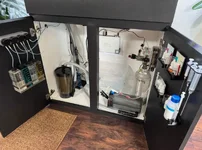
Because the guts are located in a kitchen cabinet, I didn't want to screw directly into it and damage it. I was also concerned silicone would not be able to dry and outgas properly when sealing the edges. I opted to line the cabinet with contact paper. It's essentially a giant sticker, so I lined the sides, bottoms, and a second layer over the bottom edges/joints. I built a 3 panel "stand" inside of the cabinet so I could house everything and screw into the plywood without any concerns. I used 1 sheet of 3/4" Maple plywood and coated 1 side with a latex primer followed by a layer of latex white paint. This is mostly for water resistance and not necessarily water proof. I placed a silicone cabinet liner under the right side equipment. I made a shelf to place the EcoFlow on so if there's a catastrophic leak it's off the bottom.
One consideration I hadn't thought about was how "cramped" the cabinet would be since I placed the EcoFlow on a shelf with a "wall", which essentially made the work area much tighter.
Cable Management: Raceway and cable clips
Water
Express Water RO5DX - $160
Coming soon
I've had an interest in aquariums since a young age and had my own aquarium with fish like Angelfish and Mollies around middle school. Growing up, my dad had a bigger tank with Blood Parrots and Silver Dollars. Over 10 years ago, I had a low maintenance 55 gallon planted tank. I was pretty proud of it, but always envied the high tech tanks I saw on forums/social media and told myself when I broke that tank down that the next time I set up a tank, it would be like what I envied. At the end of 2024, I set up a small low tech 5 gallon planted tank to help scratch my aquarium itch, which really only reaccelerated my desire for setting up a high tech tank. And now, here we are!
The size of the tank was mostly dictated by the space. I originally planned on something around 30 gallons, but my LFS had the UNS 75P in stock and after measuring and discussing with my wife, we agreed it would work for the space. The tank is between the kitchen and living room, which is essentially a play area for my son, so lighting needs to be adjusted to make sure he's not blinded by the light when looking up at the tank.
Generally, I'd like to have a visually pleasing aquarium with lots of fish and plants that's peaceful to enjoy. I'd like to automate / reduce as much friction as possible and I realize there's still plenty I need to learn, so I'll need to have patience when things go wrong. I want to keep away from anything that's hard to get out of the tank once it's in (duckweed, moss, pest snails, etc). I felt like sharing prices below might give value to anyone in the future that's looking to start where I did with a high tech tank.
Specs (prices include sales tax)
Tank:
UNS 75P (8mm Glass - 29.52" x 17.71" x 17.71") - $519
UNS Atmos Backlight - $274
Lid - Working on getting a custom lid made
Lighting:
Chihiros WRGB II Pro 60 - $263
Chihiros WRGB II Pro Shades- $40
3D Printed Side Shades - Still need to do this
Chihiros Hanging Rope Kit- $37
Chihiros LED Lights Hanging Stand Kit - $64
Chihiros WRGB II Pro Shades- $40
3D Printed Side Shades - Still need to do this
Chihiros Hanging Rope Kit- $37
The mounting screws provided protruded beyond the bracket and would not fit with the backlight. I ended up getting washers and placing them outside the bracket to limit the screw depth.
Really disliked the fact that the stand was branded with Chihiros and visible when looking into the aquarium.
UNS Light Hanging Bar - $105
Filtration:
Oase BioMaster 2 Thermo 850 - $461
Oase tubing - Included with filter
Co2:
Misc. 10lb Cylinder - $118 (includes CO2)
CO2 Art PRO-SE Regulator - $105
Aqua Rocks Colorado Small Yugang Reactor 19mm w/ 90 degree elbows - $150
Inflow & Outflow Pipes:
Aqua Rocks Colorado Stainless Steel Lily Pipes 17mm - $54
Aqua Rocks Colorado Lily Pipe Clipper - $11
Substrate & Hardscape:
UNS Controsoil - Black, 'normal' used as a base and ‘fine’ on top - ~$129
CaribSea Super Naturals- Jungle River Sand (foreground sand) - $42 (only used a small mount of the bag - will user remainder in upcoming tank)
UNS Controsand Santa Fe (used as accent around dragon stone) - $57 (only used a small mount of the bag - will user remainder in upcoming tank)
UNS Controsand Sequoia (used as accent around dragon stone) - $52 (only used a small mount of the bag - will user remainder in upcoming tank)
I was surprised how dirty these rocks were and how much rinsing was required. For the price point, I felt like they should have come pre-washed.
Driftwood & Dragon Stone from Aquarium Co-Op - $111
Fertilization:
Burr Aqua Micros and Macros
Chihiros Magnetic Stirrers - $100
Battery Backup & PowerEcoFlow DELTA 3 Max (2kwh) - $680
Unfortunately prolonged power outages are not uncommon for us. We've been without power for multiple consecutive days, 7 days being the longest. This battery backup gives me some peace of mind knowing the tank can run for some time uninterrupted giving me the flexibility to get the generator out and running at a later time, refill with gas, etc. I believe run time will be around 12 hours.
Other Misc Equipment:
Chihiros CO2 Drop Checker
5 x Oase ShutOff Valve 16/22
Inkbird WiFi ITC-308 - $38
SwitchBot Leak Detectors - $15 each
"Stand"
Because the guts are located in a kitchen cabinet, I didn't want to screw directly into it and damage it. I was also concerned silicone would not be able to dry and outgas properly when sealing the edges. I opted to line the cabinet with contact paper. It's essentially a giant sticker, so I lined the sides, bottoms, and a second layer over the bottom edges/joints. I built a 3 panel "stand" inside of the cabinet so I could house everything and screw into the plywood without any concerns. I used 1 sheet of 3/4" Maple plywood and coated 1 side with a latex primer followed by a layer of latex white paint. This is mostly for water resistance and not necessarily water proof. I placed a silicone cabinet liner under the right side equipment. I made a shelf to place the EcoFlow on so if there's a catastrophic leak it's off the bottom.
One consideration I hadn't thought about was how "cramped" the cabinet would be since I placed the EcoFlow on a shelf with a "wall", which essentially made the work area much tighter.
Cable Management: Raceway and cable clips
Water
Express Water RO5DX - $160
I saw this recommended by @Naturescapes_Rocco, and feel like the value is pretty hard to beat. I waited until it was on sale to purchase, but even at the $190 list price, it's great. Water source is an artesian spring (well). From the tap, TDS measures 56. In my 5g, I've used water straight from the tap, but opted for RO so I can keep things consistent with this setup. TDS after initial filter flushing was 0 (yeah, 0!).
55 Gallon Brute Trash Can, 44 Gallon Brute Trash Can, 32 Gallon Greenmade Trash Can, and 2x dollys.I need to improve this setup because it's a PITA. RO goes into the 55g, then I need to transfer it to the 44g to fill the tank. The 32g was originally what I purchased because that was the biggest Costco had, but it didn't hold enough water to fill the tank, so I had to rethink my plans. Seeing the 55g in person, I wasn't confident I could fit 2 side by side in the space I set up the RO in (which I couldn't). This setup is very clunky and requires a lot of water moving to make it to the tank. I've been using the 32g for waste water so I could water plants with it, but I might get worn down quickly and send it down the drain.
Plants (all UNS TC)- Homalomena Sp Sekadau South (babysitter)
- Hydrocotyle Tripartita (potentially babysitter)
- Alternanthera Reineckii Rosanervig (initially planned as babysitter, but may keep some in long term)
- Hemianthus Callitrichoides 'Cuba'
- Rotala Rotundifolia Blood Red
- Anubias Nana Petite
- Micranthemum 'Monte Carlo'
- Alternanthera Reineckii 'Mini'
- Echinodorus Rose
Coming soon
- 25x Red Neon Blue Eye Rainbow
- 7x C005 Corydoras pantanalensis
- 3x C123 Yellow Cory 'Rio Nanay'
- Aphyosemion bivittatum 'Funge' Pair
- 5x Stiphodon rutilaureus Goby
- 1x True Siamese Algae Eaters
- 1x Bamboo Shrimp
- 8x Amano Shrimp
81 Replies
·
4618 views

Supporting
I Donated 2026
Rockstar
There are several threads discussing the new Aquael Hypermax 4500BT. I'm sure many would like some reports on it's performance over time. We have a thread discussing nano canister filters. We're all waiting for one of @Naturescapes_Rocco in depth write-ups discussing his filtration set-up. @Pepere and @*Ci* have unique set-ups as well, @Kwyet has used a matten filter, and we have several other members running sumps. That doesn't even include all those running sponge and HOB filters.
The idea is that we can consolidate a lot of filter information in one place making it easier to find rather than searching through so many threads. Maybe this won't work but I thought it was worth giving it a try. Perhaps it may be better listed as an article at some point.
I'm going to get things started by discussing factors I feel are most important to me when choosing a filter.
1) Filtration Performance: This goes without saying. The filter’s primary job is to keep our water clean and free of anything that harms the inhabitants. Of course, there are multiple factors that play into this. Some say flow is most critical, while others claim media volume is most important. Are there other factors? I still have limited experience, but my view, having done considerable reading, is that flow tends to be a bit overblown. You’ll see recommendations of anywhere from 4 to 10 times turnover rate with most leaning toward the higher end of that. I don’t think turnover rate is really the detail to be concerned about, at least with heavily planted tanks like are the norm here. I think the focus should be simply on ensuring flow achieves the goal of effectively moving water through the system to remove toxins/waste, delivering nutrients, and aiding gas (oxygen/CO2) transfer. If a turnover rate of 3 or 4 does that without dead spots in the tank, you should be good. After all, most of us here are plant focused and therefore, the fish we generally have are smaller community species that typically don’t care for high flow (there are, of course, exceptions).
I think there’s a simpler answer regarding media volume; more is better. Obviously, there must be a balance between internal volume and overall size of the filter. Real estate in and around our aquarium stands is precious. Filters like the Fluval FX6 and the newest Aquael Hypermax are huge. If you’re going for one of those, you’re likely putting it on a large tank with plenty of space underneath but again, it’s a matter of finding the right balance that provides the performance you need in a manageable size.
2) Reliability/Durability: This is where solid reviews come in handy and why getting feedback from users here is invaluable. Filtration performance becomes moot if the filter isn’t running, or worse yet, just flooded your house. Being able to easily source spare parts is also valuable, which is why sticking to the top well-known brands is often a safe route. It’s also why many aquarists place canister filters in protective containers, something else to consider when taking into account, size of filter. (this is something I should really do as I’ve had to clean up a few significant spills after filter maintenance and not getting the top secured in place properly )
)
3) Tie – Maintenance/Noise Level: These two factors are equally important to me. If the filter is a pain to maintain, I’m going to put it off, and that’s bad. It affects the performance. But equally important to me is how noisy it is. I tend to be sensitive to annoying little sounds regardless of where I am; at home, in the car, at work, you name it. If the aquarium is in a part of the house I spend a lot of time in, well then, it’s even more important.
I don’t know if Oase was first to do it, but the idea of the prefilter was, I think, a game changer for many. I imagine it was derived from people installing foam filters on the intake pipes. Having an easily removable section with foam filters that catch a lot of large particles before entering the primary filter chamber is a great idea, resulting in expanded intervals between main filter head removals for cleaning.
Another aspect of maintenance is ease of priming. This could also be an aspect of performance but I don’t think it is quite as important. I’m not sure there is a canister filter that is truly or consistently easy to prime. Some may start out that way, but over time, become less and less so. This is an area I’d really like to see product designers put more serious thought. My experience so far is with Oase and the Fluval 07 series. Hated the Fuval priming and I’m just so-so with the Oase. Let me know your experience with priming other brands.
As for noise, I don’t mind the slight hum of an impeller as long as it’s steady and consistent, much the same way some people, including myself when I was younger, like the smooth steady sound of a fan at night to help them sleep. It’s when the sound becomes inconsistent, I’m bothered. I also don’t care for the sound of splashing/trickling water while I’m focused on other things. Only when I’m camping near the banks of a creek or other body of water is this OK . This is one of the main reasons I’m not a fan of HOB filters. I’m also tweaking my CO2 reactor designs to minimize the bubble sounds of CO2 entering the reactor.
4) Cost: Let’s be clear, the cost doesn’t stop when you pay the retail price for the filter. There’s the cost of media and spare parts plus the cost of electricity. What’s the rated wattage of the filter. I see the Aquael filters claim to consume lower power and are therefore cheaper to run. What about special filter cartridges or foam. Is it easy to cut foam filters from inexpensive bulk material? How often are gasket replacements necessary, or are there common issues with parts failing over time. Of two Fluval 07 filters I’ve used, both needed replacement impeller shafts. Oase Biomaster filters seem to have an issue with the input/output head often needing replaced.
I admit cost isn’t a critical factor for me, but I know it is for many others, so this is another instance where finding the right balance is key, in this case, the balance between price and performance.
Share your thoughts. Do these factors seem to align with yours or do you think I’m way off base. Tell us what types and brands of filters you prefer and why.
The idea is that we can consolidate a lot of filter information in one place making it easier to find rather than searching through so many threads. Maybe this won't work but I thought it was worth giving it a try. Perhaps it may be better listed as an article at some point.
I'm going to get things started by discussing factors I feel are most important to me when choosing a filter.
1) Filtration Performance: This goes without saying. The filter’s primary job is to keep our water clean and free of anything that harms the inhabitants. Of course, there are multiple factors that play into this. Some say flow is most critical, while others claim media volume is most important. Are there other factors? I still have limited experience, but my view, having done considerable reading, is that flow tends to be a bit overblown. You’ll see recommendations of anywhere from 4 to 10 times turnover rate with most leaning toward the higher end of that. I don’t think turnover rate is really the detail to be concerned about, at least with heavily planted tanks like are the norm here. I think the focus should be simply on ensuring flow achieves the goal of effectively moving water through the system to remove toxins/waste, delivering nutrients, and aiding gas (oxygen/CO2) transfer. If a turnover rate of 3 or 4 does that without dead spots in the tank, you should be good. After all, most of us here are plant focused and therefore, the fish we generally have are smaller community species that typically don’t care for high flow (there are, of course, exceptions).
I think there’s a simpler answer regarding media volume; more is better. Obviously, there must be a balance between internal volume and overall size of the filter. Real estate in and around our aquarium stands is precious. Filters like the Fluval FX6 and the newest Aquael Hypermax are huge. If you’re going for one of those, you’re likely putting it on a large tank with plenty of space underneath but again, it’s a matter of finding the right balance that provides the performance you need in a manageable size.
2) Reliability/Durability: This is where solid reviews come in handy and why getting feedback from users here is invaluable. Filtration performance becomes moot if the filter isn’t running, or worse yet, just flooded your house. Being able to easily source spare parts is also valuable, which is why sticking to the top well-known brands is often a safe route. It’s also why many aquarists place canister filters in protective containers, something else to consider when taking into account, size of filter. (this is something I should really do as I’ve had to clean up a few significant spills after filter maintenance and not getting the top secured in place properly
)3) Tie – Maintenance/Noise Level: These two factors are equally important to me. If the filter is a pain to maintain, I’m going to put it off, and that’s bad. It affects the performance. But equally important to me is how noisy it is. I tend to be sensitive to annoying little sounds regardless of where I am; at home, in the car, at work, you name it. If the aquarium is in a part of the house I spend a lot of time in, well then, it’s even more important.
I don’t know if Oase was first to do it, but the idea of the prefilter was, I think, a game changer for many. I imagine it was derived from people installing foam filters on the intake pipes. Having an easily removable section with foam filters that catch a lot of large particles before entering the primary filter chamber is a great idea, resulting in expanded intervals between main filter head removals for cleaning.
Another aspect of maintenance is ease of priming. This could also be an aspect of performance but I don’t think it is quite as important. I’m not sure there is a canister filter that is truly or consistently easy to prime. Some may start out that way, but over time, become less and less so. This is an area I’d really like to see product designers put more serious thought. My experience so far is with Oase and the Fluval 07 series. Hated the Fuval priming and I’m just so-so with the Oase. Let me know your experience with priming other brands.
As for noise, I don’t mind the slight hum of an impeller as long as it’s steady and consistent, much the same way some people, including myself when I was younger, like the smooth steady sound of a fan at night to help them sleep. It’s when the sound becomes inconsistent, I’m bothered. I also don’t care for the sound of splashing/trickling water while I’m focused on other things. Only when I’m camping near the banks of a creek or other body of water is this OK
. This is one of the main reasons I’m not a fan of HOB filters. I’m also tweaking my CO2 reactor designs to minimize the bubble sounds of CO2 entering the reactor.4) Cost: Let’s be clear, the cost doesn’t stop when you pay the retail price for the filter. There’s the cost of media and spare parts plus the cost of electricity. What’s the rated wattage of the filter. I see the Aquael filters claim to consume lower power and are therefore cheaper to run. What about special filter cartridges or foam. Is it easy to cut foam filters from inexpensive bulk material? How often are gasket replacements necessary, or are there common issues with parts failing over time. Of two Fluval 07 filters I’ve used, both needed replacement impeller shafts. Oase Biomaster filters seem to have an issue with the input/output head often needing replaced.
I admit cost isn’t a critical factor for me, but I know it is for many others, so this is another instance where finding the right balance is key, in this case, the balance between price and performance.
Share your thoughts. Do these factors seem to align with yours or do you think I’m way off base. Tell us what types and brands of filters you prefer and why.
125 Replies
·
6972 views
Hi everyone,
I’ve recently been working on an application to help aquarists with water-chemistry calculations. I have just released the first version and written a short introductory article about it:
Every Aquarium Has Its Own Balance: Aquarium Water Calculator
Aquarists are often told that a healthy aquarium is all about balance. Far less is said about how to define that balance or achieve it in practice. The right targets depend on the water source, livestock, plants, CO₂, lighting and fertilization method. That question led me to create Aquarium Water Calculator - a tool that translates the general idea of “balanced water” into specific targets and a practical recipe.
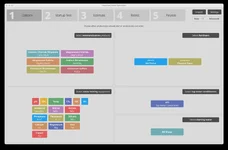
Custom remineralization instead of a one-size-fits-all mix
Many ready-made remineralization products provide a recommended dose and describe their general effect on GH, KH or conductivity, but the exact proportions of their individual ingredients are often unavailable. Users may not know how much calcium, magnesium, potassium, sodium, chloride or sulfate they are actually adding.
One fixed mixture cannot precisely meet the needs of every aquarium. Soft-water fish and shrimp have different requirements from livebearers, while a heavily planted, CO₂-injected aquarium may have different needs altogether.
Aquarium Water Calculator allows users to create custom recipes from readily available salts with declared compositions. Using the measured source-water values, water volume and either preset or custom targets, it calculates which components to use and how much of each to add for that particular aquarium.
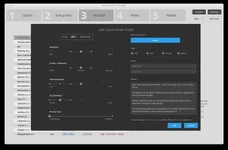
Balance without costly trial and error
Unsuitable remineralization or fertilization can contribute to poor plant growth, algae problems or inappropriate conditions for livestock. Finding a solution through trial and error can cost time and money and, in the worst cases, affect the health of the aquarium’s inhabitants.
Aquarium Water Calculator lets aquarists experiment with different options virtually before changing their water. Users can adjust target values, salts, fertilizers and doses and see how each change affects the overall water chemistry. Unsuitable combinations, excesses or missing components can be identified before products are purchased or a recipe is used.
Calculations are not a substitute for testing. Prepared water can be retested, and the recipe can then be refined according to the measured results. I recommend testing any new recipe on a separate batch of water first.
Which fertilizer is actually right for a particular aquarium?
Commercial fertilizers vary considerably in their composition and nutrient ratios. A product may add nutrients that are already present in sufficient amounts while failing to provide those that are deficient. Trying different fertilizers can therefore become unnecessarily expensive.
The program can compare available fertilizers and identify which product or combination best matches the selected targets. Users can choose products based on what their aquarium actually needs rather than relying only on a general description on the label.
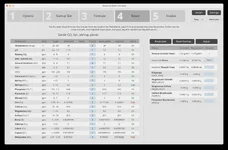
A practical way to learn about water chemistry
Water chemistry can be difficult to understand because changing one component may affect several parameters at once. The application therefore also serves as a hands-on educational tool. Users can see how salts, fertilizers and target values affect GH, KH, pH, TDS, CO₂, calcium, magnesium, potassium and plant nutrients. By experimenting without altering the aquarium itself, users can develop a practical understanding of the individual components and how they interact.
The application in brief
Aquarium Water Calculator is a commercial desktop application from Fish Tank Apps. I created the first version for my own use and later developed it further based on feedback from friends who tried it. Users enter their source-water test results and choose either preset or custom targets. The application then calculates a complete remineralization and fertilization recipe that can be adjusted after the prepared water is retested.
The program does not test water directly and is not a substitute for laboratory analysis or professional instruments. It is an informational and planning tool; users must verify the calculated values with their own tests and evaluate them in the context of their particular aquarium.
For more information: Link to the product page
Following a discussion with Art, the app has been added to the ScapeCrunch Useful Links Directory: Fish Tank Apps – Aquarium Water Calculator
I would also like to invite up to three ScapeCrunch members to test the application in detail. Each selected tester will receive a complimentary permanent license.
Ideally, I’m looking for members who would be willing to explore the application’s menus and features, test it using a real aquarium or water-preparation scenario, and share a detailed written review here with photos and screenshots showing the testing process and results. If someone would prefer to document the test in a YouTube video, that would also be very welcome.
The complimentary license would be provided for independent testing, not in exchange for a positive review. Honest feedback, whether positive, mixed or critical, would be equally valuable to me.
If you are interested, please send me a private message with a little information about your aquarium setup, water source, the water-testing kits and equipment you have available, whether you use CO₂, and which fertilizers you currently use or prefer.
Thank you for taking a look!
I’ve recently been working on an application to help aquarists with water-chemistry calculations. I have just released the first version and written a short introductory article about it:
Every Aquarium Has Its Own Balance: Aquarium Water Calculator
Aquarists are often told that a healthy aquarium is all about balance. Far less is said about how to define that balance or achieve it in practice. The right targets depend on the water source, livestock, plants, CO₂, lighting and fertilization method. That question led me to create Aquarium Water Calculator - a tool that translates the general idea of “balanced water” into specific targets and a practical recipe.
Custom remineralization instead of a one-size-fits-all mix
Many ready-made remineralization products provide a recommended dose and describe their general effect on GH, KH or conductivity, but the exact proportions of their individual ingredients are often unavailable. Users may not know how much calcium, magnesium, potassium, sodium, chloride or sulfate they are actually adding.
One fixed mixture cannot precisely meet the needs of every aquarium. Soft-water fish and shrimp have different requirements from livebearers, while a heavily planted, CO₂-injected aquarium may have different needs altogether.
Aquarium Water Calculator allows users to create custom recipes from readily available salts with declared compositions. Using the measured source-water values, water volume and either preset or custom targets, it calculates which components to use and how much of each to add for that particular aquarium.
Balance without costly trial and error
Unsuitable remineralization or fertilization can contribute to poor plant growth, algae problems or inappropriate conditions for livestock. Finding a solution through trial and error can cost time and money and, in the worst cases, affect the health of the aquarium’s inhabitants.
Aquarium Water Calculator lets aquarists experiment with different options virtually before changing their water. Users can adjust target values, salts, fertilizers and doses and see how each change affects the overall water chemistry. Unsuitable combinations, excesses or missing components can be identified before products are purchased or a recipe is used.
Calculations are not a substitute for testing. Prepared water can be retested, and the recipe can then be refined according to the measured results. I recommend testing any new recipe on a separate batch of water first.
Which fertilizer is actually right for a particular aquarium?
Commercial fertilizers vary considerably in their composition and nutrient ratios. A product may add nutrients that are already present in sufficient amounts while failing to provide those that are deficient. Trying different fertilizers can therefore become unnecessarily expensive.
The program can compare available fertilizers and identify which product or combination best matches the selected targets. Users can choose products based on what their aquarium actually needs rather than relying only on a general description on the label.
A practical way to learn about water chemistry
Water chemistry can be difficult to understand because changing one component may affect several parameters at once. The application therefore also serves as a hands-on educational tool. Users can see how salts, fertilizers and target values affect GH, KH, pH, TDS, CO₂, calcium, magnesium, potassium and plant nutrients. By experimenting without altering the aquarium itself, users can develop a practical understanding of the individual components and how they interact.
The application in brief
Aquarium Water Calculator is a commercial desktop application from Fish Tank Apps. I created the first version for my own use and later developed it further based on feedback from friends who tried it. Users enter their source-water test results and choose either preset or custom targets. The application then calculates a complete remineralization and fertilization recipe that can be adjusted after the prepared water is retested.
The program does not test water directly and is not a substitute for laboratory analysis or professional instruments. It is an informational and planning tool; users must verify the calculated values with their own tests and evaluate them in the context of their particular aquarium.
For more information: Link to the product page
Following a discussion with Art, the app has been added to the ScapeCrunch Useful Links Directory: Fish Tank Apps – Aquarium Water Calculator
I would also like to invite up to three ScapeCrunch members to test the application in detail. Each selected tester will receive a complimentary permanent license.
Ideally, I’m looking for members who would be willing to explore the application’s menus and features, test it using a real aquarium or water-preparation scenario, and share a detailed written review here with photos and screenshots showing the testing process and results. If someone would prefer to document the test in a YouTube video, that would also be very welcome.
The complimentary license would be provided for independent testing, not in exchange for a positive review. Honest feedback, whether positive, mixed or critical, would be equally valuable to me.
If you are interested, please send me a private message with a little information about your aquarium setup, water source, the water-testing kits and equipment you have available, whether you use CO₂, and which fertilizers you currently use or prefer.
Thank you for taking a look!
0 Replies
·
35 views